Search This Blog

Sunday, January 5, 2020

FOR THE LOVE OF WORDS


FOR THE LOVE OF WORDS – by Elizabeth Clements

     Writers love words and fill pages with them. I love discovering new words, but if the word is too unfamiliar, it has pulled me out of the story to ponder the meaning when the context leaves me clueless. When I head for the dictionary, the “mood” created in the story evaporates and I am once more brought to my own reality.
     We have been told in writing courses to keep it simple, to write at the level of a sixth-grader and this is what newspapers employ. But what’s the fun in that when there are so many deliciously wonderful words out there? The dictionary is full of them. The more syllables in a word, the more interesting they become, and have a rhythm all their own. There are also one-syllable words that can pack a punch.
     I recently binge-watched a new series on Netflix called “The Witcher”. I admire the imagination that went into the creation of the creatures and critters and was immediately pulled into the dark and mysterious world of another time. It was definitely medieval and yet it was much more. Unique yet familiar in its plot but spellbinding in its depiction. Dangerous times when it’s best to close the shutters at night and stuff rags around windows to not emit any light for lurking evil. So when our valiant hero drops the succinct f-bomb, for the first time, I’m stopped dead.
Yes, research has supported the word exists since the 15th century, yet to me it seems far too modern. I’ve been a movie-goer since I was a child and in the hundreds of movies I’ve watched growing up, I never encountered that word until Hollywood decided in the late 1960s to add expletives (and explicit violence) to some movies to make them more “realistic”. Perhaps that trend can be blamed as far back as Gone With The Wind when Rhett Butler declared, “Frankly, my dear, I don’t give a damn.” To the best of my knowledge, I think that was the first time an expletive was used in a movie and it created shock waves and quite probably set a precedent.
     Also, to this day I have never forgotten my stunned reaction to watching Clockwork Orange—for me a most shocking view of violence for this naïve and sheltered farm girl. Then along came Bonnie and Clyde and in my opinion, the 1960’s brought a new age in movies and a definite loss of innocence evolved. So, is it any wonder that we hear children these days uttering words as they play which would have had my mouth scrubbed out with soap when I was their age? Astonishing is the fact that growing up, I never heard the f-bomb, although my step-dad used the Lord’s name in vain quite often.
I think expletives, besides being succinct, are used for shock value—at least originally. I read somewhere that the use of the f-bomb shows a lack of imagination on the part of the writer. This can be argued, although I admit I don’t like the word and only once—in extreme agitation, did I not only use it once, but three times in rapid succession as I viewed my upended beef casserole splattered on the floor. My sons were very young and very shocked and still love to bring it up when we reminisce around the family table after a good meal.
The f-bomb is most often used in a display of intense emotion or action. When used, that word does not require additional elaboration, such as, he said angrily. I think my little anecdote can testify to that.
     I love writing but sometimes it can be frustrating when I seek that elusive word that precisely describes what I want to say. While writing my first draft I’m content to let the words flow (or stumble) and just get the story down. Editing, on the other hand, can be an exercise in frustration. I have been amazed I’ve spent an hour on one paragraph. One time I remember I had written a perfect description and accidentally lost it and mentally beat myself up trying to replicate it. That was on a word processor dinosaur from the 80’s that didn’t have the cut and paste function of the current computer programs. And I never got the rewrite worded so perfectly like the first time.
I recently watched Pride and Prejudice for the nth time and was captivated anew by the way Elizabeth and Darcy spoke with such elegance that I found myself leaning forward to catch every word.  Keira Knightley, with her beautiful English voice, captured the essence of Victorian romance with her impeccable enunciation, thanks in part to the screenwriter’s skill with the speech of that era.               Amazingly, my husband has watched the film numerous times, too—sometimes even without me.
I love big words and believe what’s the point of even having them if we’re advised to stick to simple words in our writing. I remember the first time I heard gobsmacked. I had to think for a moment what it meant—gob and smacked. Oh, how delicious an image that conjures. One can almost titter over that one.  And that ridiculously long but whimsical word in Mary Poppins…supercalifragilisticexpialidocious (I had to go to Google to ensure I spelled it right) automatically makes me smile.
      One word, however, that does not make me smile is procrastination. It resembles me far too much. Procrastination has been the bane of my existence, most noticeably as I grew older. Yet, as I ponder over when that trait got the best of me, I realize exactly when it became my biggest vice: porridge!
      Porridge and cabbage rolls with sauerkraut are the most vile foods created. And one perhaps the most vile—boiled spinach. But I digress. Porridge was the breakfast food in winter and my mother made it with water (not milk like a friend of hers). I would stare at this gob of glue in my bowl that not even sugar could improve and procrastinate lifting a disgusting spoonful to my mouth until it was time to run for the bus. I got away with that tactic a few times…until one night it was my supper. Thankfully time has dulled further horrors of that loathsome food, although I admit porridge can be reasonably palatable when cooked with milk, then a little cream and a good dollop of strawberry jam or cinnamon and sugar. I loved Cream of Wheat which was a treat when company came to stay and the guest cooked it <grin>.
     Would you believe I never had pizza until I was nearly nineteen and never had Chinese food until my twenties? But to this day I still love the fragrance of fresh-baked bread. Mondays was bread and laundry day and as I ran into the house after school, the buns were just finished and four loaves were in the oven and potato soup and dumplings simmered on the stove. I couldn’t wait until supper; I’d steal a bun and tear it open and stuff the insides into my mouth and sometimes I was quick enough to grab a second one before my mother caught me. No wonder that bread, to this day, is my favorite comfort food. And potato soup.
     What foods bring back memories for you, either good memories or not so palatable?

Here is an excerpt from the first book of my trilogy, Beneath A Horse Thief Moon that involves food. Mike gets his own story in Beneath A Fugitive Moon:

      Mike whipped off his brown hat, revealing a long rope of wavy golden hair tied back in a tail. He leaned down from his horse and swallowed up Sara's small hand in his big one and in a voice that rumbled like distant thunder, said, “I'm Mike, Miz Sara. And you can call me anythin' you want just as long as you call me for supper.” His huge grin could swallow Texas.
Sara laughed, surprised that she liked Mike instantly and was not intimidated by his size.”
“Can you forget about your gut for once?” Josh teased.
Mike grinned. “I try, but it keeps growlin' at me.” The blond giant dismounted and stood a head taller than his friends.
Sara looked up, a long way up. “Oh, my, your Mama must have fed you real good.”
“Yup, she surely did, and twice on Sundays.”
Everyone laughed.
“All funnin' aside, Miz Sara,” Mike said. “We're here to help. We don't expect no pay from you, nor would we take it. Not even from this big jackass.” He playfully slapped Chase on the back, nearly bringing Chase to his knees.
“That goes for me, too,” Josh said, nodding.
“Won't you come in and have a cup of coffee and some pie I just made?” Sara said.
“Pie! Now that's the best offer I've had in a month of Sundays,” Mike rumbled and smacked his lips in anticipation. “She a good cook, Chase?”
“Wait till you taste her stew.”
For such big men, their footsteps were quiet as they filed in after Sara. Mike sniffed loudly. “Son of a bitch, somethin' smells good.”
“That's why it's called sonofabitch stew,” Chase said.
“I think I'm in love.” Mike gave Sara a smile that could make an angel give up her wings. “That smells mighty good.”
            “If you hold your mouth just right you might even get some for supper.” Chase released a silent sigh. Everything was going to be fine now that his two friends had arrived.


NEW YEAR - NEW/OLD IDEAS

Post by Doris McCraw
writing as Angela Raines

Photo property of the author
First post of 2020. So what kind of year will it be? One of the writing prompts from the December 26 improv writing session was, "What do you want to accomplish in 2020?" Well, I wrote, "I want to finish this blasted book."

You see I've been working on a book that I hope to finish and submit soon. It is a story that has taken on a life of its own and I've been learning so much about the characters. That is one of the reasons for the delay. I want to make sure their story is told the best I can tell it.

In the meantime, I continue to read and perform as Helen. In honor of the New Year, I want to share a poem of hers that resonated with me. Additionally, I like to share what I garnered from her writing practices that may be helpful. I'll start with the poem.

Photo property of the author
New Year's Morning
by Helen Hunt Jackson


Only a night from old to new!

Only a night, and so much wrought!
The Old Year's heart all weary grew,
But said: "The New Year rest has brought."
The Old Year's hopes its heart laid down,
"The blossoms of the New Year's crown
As in a grave; but, trusting, said: Bloom from the ashes of the dead."
And cried: "I have not half I need.
The Old Year's heart was full of greed; With selfishness it longed and ached,
True love it shall understand;
My thirst is bitter and unslaked. But to the New Year's generous hand All gifts in plenty shall return;
I was a slave; it shall go free,
By all my failures it shall learn. I have been reckless; it shall be Quiet and calm and pure of life.
The Old Year had its work to do;
And find sweet peace where I leave strife." Only a night from old to new! Never a night such changes brought. No New Year miracles are wrought.
All nights are sacred nights to make
Always a night from old to new! Night and the healing balm of sleep! Each morn is New Year's morn come true, Morn of a festival to keep. Confession and resolve and prayer;
Each sunrise sees a new year born.
All days are sacred days to wake New gladness in the sunny air. Only a night from old to new; Only a sleep from night to morn.
The new is but the old come true;

Each sunrise sees a new year born.
What I learned from Helen's writing and business practices
1. Helen would rise and start writing around 5 AM and continue until about Noon every day of the week, unless she was feeling ill.
2. When she wrote "Ramona" she spent eight months in a hotel in New York writing the story. (Remember this was hand written)
3. If a publisher did not want to pay her what she thought her work was worth, she would find someone who would.
4. She kept a journal where she would track her submission and what she was paid for them.
5. Helen started writing late in life, but the amount of work she turned out was amazing
6. Helen observed the world around her, vividly writing about the people, places and things she saw. 
7. Helen did not limit her work to just one genre. She wrote poetry, essays, novels and of course non-fiction books. 
8. Helen not only read other authors, she reviewed their works and encouraged others to put their work out into the world. (This also included her friend, Emily Dickenson)
So there you have what I've garnered from my study of Helen (Hunt) Jackson. I find her a great role model.
I wish all of you the very best in 2020, that your stories find their readers, that your fingers fly across your keyboards, and you find joy in the books you read. I also thank each and every one of you for the continued support and ro Prairie Rose Publications for bringing our stories out into the world.

Doris Gardner-McCraw -
Author, Speaker, Historian-specializing in Colorado and Women's History
Angela Raines - author: Where Love & History Meet
Angela Raines FaceBook: Click Here


Friday, January 3, 2020

SAECULUM--HOW LONG WILL WE BE REMEMBERED?--by Cheryl Pierson

I learned a new word the other day, thanks to a dear friend of mine, Sharon Cunningham. She posted on Facebook about the word, “saeculum”—which was one that I’d never heard of. I didn’t even know there was an actual word for this “event” or “circumstance.”

Saeculum means the period of time from when an event occurred until all people who had an actual memory of the event have died. The example she used was World War I. The saeculum for that war is over.

It can also be applied to people. (Something else I never thought about.) A person’s saeculum doesn’t end until all people who have a clear memory of knowing that person are gone. So even though a person has died, their saeculum will live for another two or three generations!

Isn’t this amazing? And comforting, somehow. Yes, eventually our saeculum will be over, but what amazes me, and comforts me at the same time, is knowing there is a word—an actual TERM—for the idea of this memory of an event or person.

When you think about it, knowing that someone has created a word to define this period of time is important, because it defines it and gives it meaning—not just some nebulous “I remember Mama” type idea that is passed down. It means, I DO REMEMBER MAMA. I remember how Mama used to sing, I remember how Mama used to cook, how her palm felt on my forehead in the night when she came to check on me. I remember “that” look when she was upset with me, and I remember how she cried when she learned her dad, my grandfather, had died.
Valentine's Day 1965, Mom, my sister Karen, me, and my oldest sister, Annette
Nov. 1960--my sisters, Karen and Annette cutting up in the living room
Sept. 1966--my mom and dad together
Dec. 1965--my mom wearing the hula skirt my sister Annette brought me from Hawaii for Christmas
April 1960--my grandmother (mom's mother), a not-quite-3-year-old me, and my sister Annette
January 1960--Mom's 38th birthday


I remember Mama the way I knew her. And when we talk to other members of the family who knew and remembered her, we learn many other facets about her personality and things about her as a person we would never have known otherwise. It’s this way with every person we know!

But let’s take it one step further: I remember family. My own, of course—two sisters, Mama and Daddy. But what about extended family? Sometimes we tend to just “move on” in our lives and not dwell on memories of long ago because somehow, they don’t seem important to us. But now that there is a word that defines us in relationship to those memories, doesn’t it seem a little more important that we remember those long-ago times? Soon, there will be no one to remember, and the saeculum for our entire family will be gone.

A group of my cousins at a family reunion

Oddly enough, I remember what I thought AS A CHILD at family get-togethers—the excitement of seeing my cousins, of taking a trip to visit everyone, of staying up late and having a bit more freedom since I had grandparents at both ends of the small town where both sides of my family had many members living—and I felt special because of that. I was the ONLY ONE of my cousins who had THAT! So we always had somewhere to walk to when they were with me—to one grandparents’ house or the other.

As an adult, I think back on those simpler times and wonder what else was going on in the “adult world”—sisters, brothers, in-laws all gathering with their children and meal preparation for so many people—my mother was the oldest of eleven children!

My mother, El Wanda Stallings Moss, and my aunt (my dad's sister) JoAnne Moss Jackson

Two unforgettable women!

Everyone tried to come home to Bryan County during Christmas and/or Thanksgiving. Such an exciting time, but for the adults…tiring and maybe stressful? If so, I don’t remember ever seeing that side of anyone.   


My mom and dad as newlyweds in 1944--El Wanda Stallings Moss and Frederic Marion Moss--around 22 years old

So, maybe that’s why I think writing is so important. My mom always said she wanted to write down her life story, but “life” kept getting in the way and it never happened. When she ended up with Alzheimer’s, the time for writing down anything was over. Though the written word doesn’t add to a person’s saeculum, it does at least two things for those left behind: It helps preserve the stories and memories the deceased person has talked about before they passed, and it gives future generations a glimpse into their ancestors’ lives, thoughts, beliefs, and dreams.

This is my great-grandmother, "Mammy" (Emma Christi Anna Ligon Stallings)--my mother's dad's mother. I never knew her, but I felt like I did from the stories Mom told me about her. She was born not long after the Civil War ended, and regaled my mother with stories of her growing up years. I wish I had listened better when Mom tried to tell me about her!

We die, and eventually are forgotten by the world. Events happen that were, at the time,  life-changing, world- altering, such as wars, rampant disease, and tragedies of other kinds. These, though horrific at the time, will eventually be relegated to the tomes of the historical past…and forgotten…by many. There is nothing to stop it. All saeculums will be over for individual people and for events. And they will all become history.

What we can leave behind for others is our pictures, the written word of who we are and what we believe, and if we have a particular talent or craft, pieces of that—carvings, quilts, beautiful artwork or writings, creations of so many kinds.
A painting my mom did many years ago of an old barn in a snowstorm. Sorry it's so small! Couldn't make it bigger without making it blurry.

Our saeculum is fragile, and fleeting. So for 2020, my one and only resolution is to try to keep some kind of journal for my children, or for anyone who might be interested in the future. I want to write about my childhood, just the regular every-day things we did, the heat of the Oklahoma summer nights, the fireflies that lit up those nights until we knew we had to go home or get in trouble! The way the house creaked, and how the attic fan sounded like a freight train as it brought in that blessed cooler air during those same hot summer nights. So many memories of “nothing special”—just the business of living.  I want to write about the way life was then—because it will never be that way again, for better or worse.
My best friend, Jane Carroll, and me, on a fall day in the sandbox. I was about 8, and Jane was a year older. We moved in just down the street from one another during the same week of 1963! Jane is gone now, but I still love her and miss her.

Will anyone give a hoot? Maybe not. But I will know I’ve done what I could do if anyone DOES care. I’m not sure Laura Ingalls Wilder thought anyone would care about her stories—but look at what a glimpse into the past they have provided for so many generations! I’m no Laura Ingalls Wilder. My journals won’t begin to make the impression on the world that hers did. But you never know who might read them and think, “I wish I had known her!” (Even after my saeculum is over!)

Me, at age three.

Do you have anything you would like to leave to future generations to remember you by? This fascinates me!


Wednesday, January 1, 2020

LOVE AND NEW BEGINNINGS By Sarah J. McNeal #I-Love-Books, #Love-In-The-NewYear @PrairieRosePub

Every Day Is A New Beginning

Today is the first day of a brand new year. It’s nice to have a fresh start with a clean slate. The New Year is like a blank page only without the scary pressure of writing a New York bestselling novel. If you’ve been doing something that hasn’t worked out, now is the time to ditch it. If you’ve been doing something that seems to be working, take the New Year as a chance to take it up a notch…at least that’s what we aspire to do. 

Traditionally, many people have made their resolutions for the New Year or have made their intentions, but a study conducted by the University of Scranton revealed that only 8 percent the people actually achieve their New Year’s resolutions. So what’s the point to all this new beginnings fuss and bother? I’d like to suggest that maybe the driving force behind all these New Year’s resolutions, or whatever you want to call them, is hope; the hope that this year our desires and dreams might just come true. Hope is a powerful force.
We who write romance stories are the proliferators of hope. We give our readers characters who fall in love, but have a hard time getting to their happily ever after. But those readers hope that somehow, some way that couple is going to find happiness. They march through the pages with that hope in their hearts and the silent promise we gave them at the beginning of each story because hope is eternal and love conquers all.
   
And as luck would have it, my new book, CURSED, Legends of Winatuke, book 2 releases January 8th and is ready to pre-order right now.


CURSED, Legends of Winatuke, book 2
(Formerly The Lake of Sorrows)
By Sarah J. McNeal
Fire Star Press
Pre-order Link:   https://www.amazon.com/dp/B0833DG588

The legend begins when love and evil collide.


Blurb:


Hawk McKnight is a troubled man with a secret life. Emma Dawson is a burned out doctor weighed down by emotional baggage. Can Hawk and Emma put aside their past long enough to save Hawk’s brother, Peregrine, from a deadly curse? Is there a chance Hawk and Emma can find happiness again, or will the curse consume Peregrine and replace any joy between Hawk and Emma with regret and heartache under its evil enchantment?

Excerpt: 

He downed another shot of Chegari whiskey as he remembered that terrible day when the demon, Inx, threw his brother into the Lake of Sorrows. It was certain death to even drink the water from the lake. It was said a man could lose his mind just by staring into the lake’s depths. Try though he did to reach into the lake to retrieve Peregrine, he couldn’t save him. The Nivasi creatures who occupied the lake’s murky depths, stole memories and created mind torture so terrible it was said the victims would pray for death to come quickly. Hawk shivered at the thought that Peregrine might have suffered in such a way before he died. No amount of alcohol could drive away the bitter loss of his brother or the terrible guilt that weighed on his heart for not being able to liberate him.

A messenger drew Hawk from his morose thoughts. 
  
"My liege, I do not wish to disturb you, but Domingomae has delivered a message for you from Prince Raphael." Mericet entered the tent with a sealed parchment in his hand.

Hawk took the message and noticed that the boy's hair was wet and his clothes damp. "Water's scarce out here, Mericet. Mind you don't waste it by bathing in the middle of the day."

"Yes, my liege." Mericet nodded his head obediently and waited respectfully by the opening of the tent for further instructions.

Pulling the dagger from his wide leather belt, Hawk cut the seal from the parchment and began to read. The first words grabbed his attention immediately. "My God," he gasped aloud, "Peregrine is alive." He glanced at Mericet. "My brother is alive."

Mericet nodded. "That is good, my liege. I am glad for you."

Hawk leaped from his chair and paced as he continued to read aloud. Your brother is living among the Gypsies, playing his violin, and performing his water show twice a day. But he is altered, Hawk. You must come to Vel’ka Mulano with all due haste.

He stopped pacing. "Altered? What could he mean?"

Excerpt:

Emma held her breath. Something is wrong. Her heart began to pound against the confines of her ribs. Is someone in the apartment? She didn't have a gun or mace, or even a sharp object like a pencil nearby to protect herself. Maybe if she could quietly move across the kitchen she could grab a butcher knife from the drawer beside the sink. Every nerve in her body became electrified. Her muscles tensed with dread.

Out of the darkness, a big hand grabbed her by the shoulder. She took in a ragged breath. Her heart pounded in her ears. What to do now? Her vocal cords froze in her throat as the intruder turned her around to face him. She heard herself whimper and hated her weakness.

"Please don't hurt me," she whispered in a shaky voice.

She heard gruff laughter. "Why would I want to hurt you, Emma?" A light switched on and there, in the glow of a forty-watt incandescent bulb, stood the tall figure of Hawk McKnight. He appeared wild and dangerous, as if he'd walked out of a medieval movie scene. Dressed in a loose, white shirt open halfway down his broad chest and a short leather jacket with sleeves attached by strips of rawhide graced with buttons carved from what looked like horn or bone down the front he grinned at her. Around his slim waist was a wide, leather belt with a dagger tucked in it and a leather bag hanging from his left hip. In a scabbard across his back rested a heavy broadsword which looked as perilous as the man. Emma knew by his attire he must have recently come from that other place where his family and friends originated…Winatuke.


Diverse stories filled with heart

Facebook
Twitter
Website
My Amazon Author’s Page
Prairie Rose Author Page
The Wildings
Prairie Rose Blog
Fantasy & Dreams Blog


Wednesday, December 25, 2019

A Christmas Tradition

    Through the years, my family has had many Christmas traditions. At my maternal grandparents' home, we danced around the Christmas Tree in the Danish tradition.  My grandmother (whose parents inspired THE LEGACY) served cookies from this recipe, along with many other kinds of cookies, every year. As you can guess from the name, the recipe is very old. Every time I make this recipe, I think of her.


Ice Box Pecan Cookies

Ingredients

1 cup butter
½ cup sugar
1 cup chopped pecans (can use pecan pieces)
2 cups flour, scant
Extra granulated sugar

Instructions

1. Beat butter and sugar well.
2. Add flour and nuts. If necessary, knead dough to use all 2 cups of flour.
3. Form into logs, 1 to 1½ inches in diameter.
4. Place in ice box (refrigerator) for 1-2 hours.
5. Cut into approximately 1/3 inch slices.
6. Bake on ungreased cookie sheet at 375 degrees until slightly brown around the edges.
7. Cool for several minutes on cookie sheet.
8. As you remove each still-warm cookie from the sheet, roll in granulated sugar, covering all sides.
9. This recipe does not double well.

What are some of the Christmas traditions in your family? 

Merry Christmas and Happy 2020.

Ann Markim


    Buy Links:      Paperback at Amazon    Amazon Kindle 


Tuesday, December 24, 2019

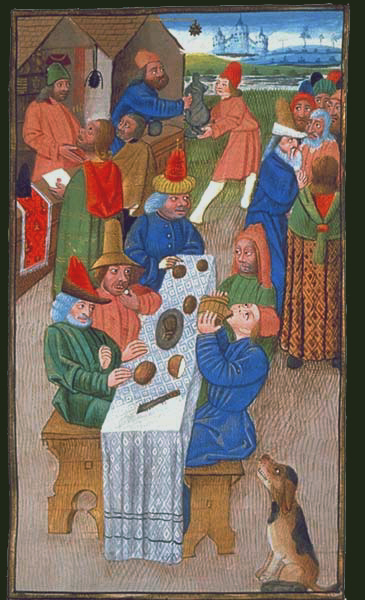
Medieval peasants tuck in: feasting at Christmas and Easter

Feasting for a noble or a king in the medieval period could be a splendid, lengthy, expensive affair, where dishes were produced and shown to display wealth and power. What about feasts for the bulk of the population who lived on the land?

In an age without freezers and only limited storage methods – smoking, salting, drying, preserving, keeping – all foodstuffs had to be produced in time to the rhythms of the farming year. In the Middle Ages, that meant the Christian calendar. Feasts were allied to the high points of harvests, saints’ days, Christ’s life, the change of the seasons and the winter and summer solstices.

Christmas especially, covering the darkest time of the year and preceded by the fast of Advent, was celebrated for almost two weeks by all classes. No work was done in that ‘quiet’ season of the farming year and people celebrated by dancing, singing, story-telling, drinking and eating.

In the countryside, some lucky peasants might be fed within their lords’ manor houses over Christmas as part of the Christian tradition of charity and share in rich dishes and strong beers. Other peasants would feast at home. Meat, as a luxury, would certainly be enjoyed, usually in the form of bacon, salted beef or mutton. Such cuts would be made into stews or slow roasted. Pepper was used as a spice by all classes and at Christmas carefully hoarded spices such as ginger, some dried herbs from the kitchen garden and perhaps even exotic fruits such as dried raisins might be added to the stews to add different flavours. We know that peasants had access to exotic spices and dried fruits because the Sumptuary Laws forbade indulgence in both rich clothes and expensive foods by the ‘lower’ classes.

Fine wheat bread, if peasants could produce it (by grinding the flour in secret away from their lords’ mill) would be a treat. River fish or eels would make a change from the usual salted dried cod of winter-time. Waterfowl, chickens, and – once they had escaped and bred from their specially constructed warrens – rabbits, could be caught, roasted or turned into stews and pies.

Hard cheese, which would keep through the winter, might have been part of a peasant’s Christmas feasting and certainly there would have been pottages, vegetable one pot stews made from the cut and come again greens and root vegetables (not potatoes yet) from the kitchen garden.

As well as food treats, peasant households would decorate their homes for their Christmas feasts. Holly, ivy and mistletoe were cut and brought indoors to make the Christmas Bush that hung from the rafters. And after Christmas there was the festival of wassailing in cider apple districts. People would gather in the orchards and light fires under the trees, dance round them and drink to them.

The lengthening days of early spring were often times of sparse commons for everyone as winter stores were eaten and the new crops and growth were still not ready. The hard fasting of Lent, and before that the feast of Shrovetide when all the dairy food ‘luxuries’ not allowed during the fasting time were used up, gave way at last to Easter.

Richer peasants might feast on lamb or suckling pig, served with the first spring greens. Eggs featured heavily since they symbolised the stone rolled away from the tomb of Christ. Pace or paschal eggs, coloured with onion skins and wine, were part of the Easter feast, which, like Christmas, could last over several days.

What did people drink during these festive times?


Willam the Conqueror feasts in England ahead of the Battle of Hastings (from the Bayeux Tapestry)A drink common to ancient Roman and northern European lands was mead, made of honey and water. Mead was the drink of choice at Anglo-Saxon feasts. Because drinking water was so often impure in the ancient world, ale was the 'everyday' drink, but mead was for feasting. There were mead halls and, in the halls, mead benches, where men sat drinking side by side. Drinking horns and glasses were richly ornamented and highly prized. Anglo-Saxon wine, some grown from grapes that could flourish in the south of England, was light, quickly consumed and not very strong. Ale, drunk by all ages, was a sweetish, thick drink, again not very alcoholic. Mead was the intoxicating draft, subject of riddles and poetry and drunk prodigiously in seasonal feasts. A later recipe from the fourteenth century describes ‘fine mead’, with the honey pressed from the combs and added to water left after boiling the empty combs (as for ordinary mead), then flavoured with pepper, cloves and apples and left to stand.

Happy Holidays!

(All pictures from Wikimedia Commons).

Lindsay Townsend

I mention Christmas feasts in "Sir Conrad and the Christmas Treasure" and "The Snow Bride", plus the lack of festing in "Sir Baldwin and the Christmas Ghosts". You can find these romances on Amazon and at the Prairie Rose Website here


Sunday, December 22, 2019

Book review: A Husband For Christmas by Sarah J McNeal

24089217

Blurb:

Jane Pierpont and her son, Robin, survived the Titanic, but her husband went down with the ship and the emotional scars of that night have kept her and her son locked into that frightening event. Robin is terrified of deep water and Jane has nightmares and survivor’s guilt. She yearns for a family, a loving husband and maybe another child, but she feels disloyal to Michael’s memory whenever Teekonka Red Sky comes near her.

Teekonka Red Sky loves Jane and her son, but all his efforts to help them past their painful memories of the night Michael Pierpont died have been unsuccessful. Unwilling to give up, can his Lakota beliefs help him bring peace to Robin and free Jane to love again?


My review:

Teekonka and Jane's (and Rob!) happily-ever-after delivers a preciously sweet and heartwarming Christmas story, perfect for a quick read amidst the busy of the season.

Teekonka embodied patience and gentleness pursuing Jane, and built a special relationship with her son.  He knew what he wanted and he was willing to do what was necessary to get the family he needed, and provide them with their dreams as well.  Jane showed beauty and devotion while she sorted out her head and embraced the gift of a future she craved.

It was fun getting to reconnect with previous characters from the Wilding series and see what they're up to.

Purchase links: