In 1890, suffragists were finally united behind one national
organization. After twenty years of competition, the National Woman Suffrage
Association and the American Woman Suffrage Association joined to become the
National American Woman Suffrage Association (NAWSA). Efforts to unite the two
organizations began shortly after the split of women’s rights activists over
the Fifteenth Amendment in 1869. (The American association supported it, even
though women were not included. The National association opposed it, believing
the exclusion of women from the amendment would prolong the fight for women’s
suffrage.) Alice Stone Blackwell (daughter of American association founder,
Lucy Stone) led the negotiations to merge the two groups.
 |
| Elizabeth Cady Stanton and Susan B. Anthony |
Elizabeth Cady Stanton became the first president of the combined
organization, but she didn’t like the administrative duties associated with
leadership. Her good friend Susan B. Anthony stepped up and took over most of
the tasks involved in leading the new association during Cady’s two-year term.
NAWSA turned its focus to winning the right to vote on a state-by-state basis.
In 1892, Anthony was elected to the presidency. Since she was already 72
years old at that point, she groomed two protégées during her time in office,
Carrie Chapman Catt and Anna Howard Shaw. Catt became head of the organization
when Anthony resigned from her leadership position in 1900.
The NAWSA did not exclude African American women from membership at the
national level. However, state and local organizations were allowed to bar them
and many did so. National conventions held in the south (like Atlanta in 1895
and New Orleans in 1903) were segregated.
But encouraging developments brought hope to the suffragists.
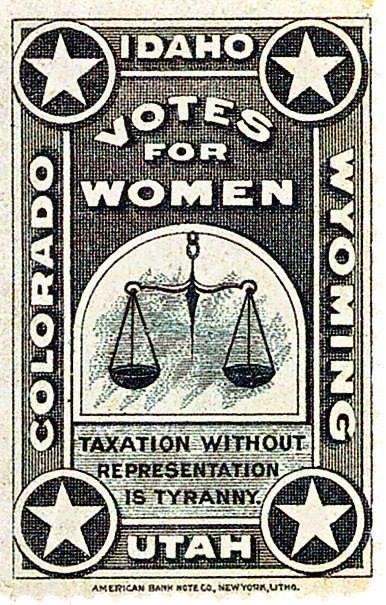 |
A privately-minted stamp (to
be used alongside regular postage) put out by suffragists celebrating the four
States in which women can presently vote on the same basis as men. (Source: National Federation of Democratic Women web site)
In 1890, Wyoming became the first state to enter the union with women already
having the right to vote in the territory.
Three years later, the question of women’s
suffrage was put up for a statewide referendum in Colorado. Carrie Chapman Catt
led the effort on behalf of the NAWSA. The Colorado Non-Partisan Equal Suffrage
Association, a grassroots coalition, rallied across the state in support of
votes for women. The measure passed and Colorado women won the right to vote.
When Utah Territory applied for statehood,
women convinced politicians to include women’s suffrage in the new state
Constitution. This became the law with statehood in January of 1896.
At the 1889 Constitutional Convention held
to found the state of Idaho, women’ suffrage was a highly controversial topic
of discussion. Northwest suffragist Abigail Scott Dunaway and Women's Christian
Temperance Union President Harriet Skelton were invited to address the
convention. Consequently, temperance and women’s suffrage became linked as they
were in many states. The women were unable to persuade the state founders to
grant women the right to vote that year, but seven years later Idaho became the
fourth state to enfranchise women.
However, not all efforts to win the right
to vote in western states were successful.
Washington was one of the first
territories to attempt granting rights to women. In 1854, a legislative measure
was defeated by one vote. After years of trying to work with the legislature to
win the vote, they next tried to secure the vote via voter referendums in 1889
and again in 1898. Both bids were unsuccessful.
In Kansas, suffrage
for women and suffrage for blacks were both put before voters in November 1867.
Both referendums failed.

South Dakota
clipping
At the South Dakota statehood convention in October 1889, after
contentious discussions over full suffrage for women, politicians granted only
partial suffrage, legislating that ‘any woman having the required
qualifications as to age, residence and citizenship may vote at any election
held solely for school purposes. As State and county superintendents are
elected at general and not special elections, women can vote only for school trustees.
They have no vote on bonds or appropriations.’ Later that month, the South
Dakota Equal Suffrage Association was formed and Anna Shaw led the effort for
the NAWSA.
When South Dakota became a state in November, the first state legislature
voted to put the issue up for a referendum in 1890. Although women campaigned
diligently for full suffrage, the measure was defeated.

Several years of concerted efforts by suffragists on the national and
state levels led to the 1896 referendum on votes for women in California. That measure
also failed.
While this is not an exhaustive list of all initiatives to win rights
for women to vote during this time period, these are some of the most
high-profile efforts. By 1900, women in only four states had secured full
suffrage.
After dedicating their
lives to fighting for equal rights for women, especially the right to vote,
Elizabeth Cady Stanton and Susan B. Anthony turned leadership of the National
American Woman Suffrage Association over to a new generation at the end of the
century. Stanton died in 1902. Anthony died in 1906. Neither had won the legal
right to vote even in her own state. It would be thirteen years after Anthony’s
death before the goal she and Stanton had spent much of their lives fighting
for would finally be achieved.
Previous installments:
Voting in Colonial America:
NOW YOU CAN VOTE, NOW YOU CAN’T:
The Fight Begins:
https://prairierosepublications.blogspot.com/2020/03/the-fight-begins.html
A Rupture in the Cause
https://prairierosepublications.blogspot.com/2020/04/a-rupture-in-cause.html
A Rupture in the Cause
https://prairierosepublications.blogspot.com/2020/04/a-rupture-in-cause.html
Hope Emerges
Ann Markim

.


