Search This Blog

Showing posts with label Colorado. Show all posts

Sunday, November 7, 2021

A Passion For ...

 Post by Doris McCraw

writing as Angela Raines

Photo property of the author

November is National Novel Writing Month, commonly known as NaNoWriMo, where people work to write 50,000 words in thirty days. More importantly, it's National Native American Heritage Month. 

I do not have any Indigenous past relatives that I know of, but my departed ex did. Whenever we'd have conversations, he knew little to nothing about that heritage. From what I understand it came from both sides of his family. I always felt bad that his family couldn't or didn't talk about that heritage.

For myself, knowing where I came from, what has made me unique has been important. Much of my actions, philosophy, and even foods I ate, came from those ancestors. 

There has always been a fascination with the roots of civilizations. As a child, I was always reading about the Olmec, Aztec, Toltec, and Anasazi people. Later, after visiting the Cahokia Mounds I tried to find more about that group of people. To this day, I find myself reading anything I can on the history of the mounds and it's people. Overview of Cahokia Mounds

This naturally grew to include the lives and civilizations of later indigenous people. Illinois, where I grew up, as most know, got its name from the 'Illini' people. The Fox, Kickapoo, Sacs, were among the early people of that state. Here is a map to help illustrate:


In Colorado, where I now reside, the dominant group was the Ute, who primarily lived in the mountains. The other nations were the Cheyenne, Arapahoe, Apache, Pueblo, and Shoshone. Of course, there were earlier people. In Dinosaur National Monument there are petroglyphs plus Mesa Verde is in the southwest part of the state. Here is a link that offers more on that subject. https://www.uncovercolorado.com/native-american-tribes-in-colorado/

I have a copy of this map in my possession. I find it endlessly useful. I've also included the link that includes more information about the map.

https://www.aaanativearts.com/OLDus_tribes_AtoZ.htm

Thank you for allowing me to share my passion for these people and their history.

 An article on the creation of National Native Heritage Month 

Until next month, stay safe, follow your passion, and keep reading and writing.


Doris Gardner-McCraw -
Author, Speaker, Historian-specializing in
Colorado and Women's History
Angela Raines - author: Telling Stories Where Love & History Meet

Wednesday, June 24, 2020

Finally, Progress


     In 1890, suffragists were finally united behind one national organization. After twenty years of competition, the National Woman Suffrage Association and the American Woman Suffrage Association joined to become the National American Woman Suffrage Association (NAWSA). Efforts to unite the two organizations began shortly after the split of women’s rights activists over the Fifteenth Amendment in 1869. (The American association supported it, even though women were not included. The National association opposed it, believing the exclusion of women from the amendment would prolong the fight for women’s suffrage.) Alice Stone Blackwell (daughter of American association founder, Lucy Stone) led the negotiations to merge the two groups.
Elizabeth Cady Stanton and Susan B. Anthony

     Elizabeth Cady Stanton became the first president of the combined organization, but she didn’t like the administrative duties associated with leadership. Her good friend Susan B. Anthony stepped up and took over most of the tasks involved in leading the new association during Cady’s two-year term. NAWSA turned its focus to winning the right to vote on a state-by-state basis.
     In 1892, Anthony was elected to the presidency. Since she was already 72 years old at that point, she groomed two protégées during her time in office, Carrie Chapman Catt and Anna Howard Shaw. Catt became head of the organization when Anthony resigned from her leadership position in 1900.
     The NAWSA did not exclude African American women from membership at the national level. However, state and local organizations were allowed to bar them and many did so. National conventions held in the south (like Atlanta in 1895 and New Orleans in 1903) were segregated.
     But encouraging developments brought hope to the suffragists.

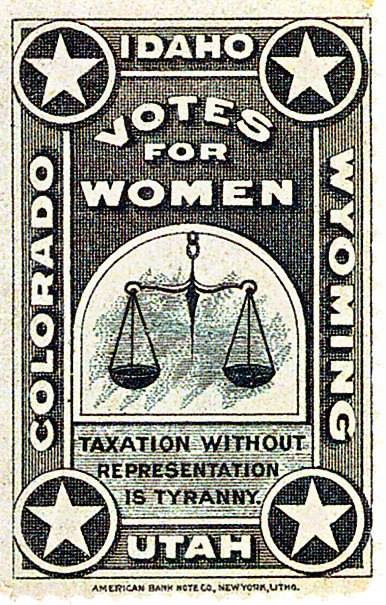
A privately-minted stamp (to be used alongside regular postage) put out by suffragists celebrating the four States in which women can presently vote on the same basis as men. (Source: National Federation of Democratic Women web site)
     In 1890, Wyoming became the first state to enter the union with women already having the right to vote in the territory.
     Three years later, the question of women’s suffrage was put up for a statewide referendum in Colorado. Carrie Chapman Catt led the effort on behalf of the NAWSA. The Colorado Non-Partisan Equal Suffrage Association, a grassroots coalition, rallied across the state in support of votes for women. The measure passed and Colorado women won the right to vote. 

     When Utah Territory applied for statehood, women convinced politicians to include women’s suffrage in the new state Constitution. This became the law with statehood in January of 1896.    

     At the 1889 Constitutional Convention held to found the state of Idaho, women’ suffrage was a highly controversial topic of discussion. Northwest suffragist Abigail Scott Dunaway and Women's Christian Temperance Union President Harriet Skelton were invited to address the convention. Consequently, temperance and women’s suffrage became linked as they were in many states. The women were unable to persuade the state founders to grant women the right to vote that year, but seven years later Idaho became the fourth state to enfranchise women.
    
     However, not all efforts to win the right to vote in western states were successful.

     Washington was one of the first territories to attempt granting rights to women. In 1854, a legislative measure was defeated by one vote. After years of trying to work with the legislature to win the vote, they next tried to secure the vote via voter referendums in 1889 and again in 1898. Both bids were unsuccessful.  
     In Kansas, suffrage for women and suffrage for blacks were both put before voters in November 1867. Both referendums failed.
South Dakota clipping
     At the South Dakota statehood convention in October 1889, after contentious discussions over full suffrage for women, politicians granted only partial suffrage, legislating that ‘any woman having the required qualifications as to age, residence and citizenship may vote at any election held solely for school purposes. As State and county superintendents are elected at general and not special elections, women can vote only for school trustees. They have no vote on bonds or appropriations.’ Later that month, the South Dakota Equal Suffrage Association was formed and Anna Shaw led the effort for the NAWSA.
     When South Dakota became a state in November, the first state legislature voted to put the issue up for a referendum in 1890. Although women campaigned diligently for full suffrage, the measure was defeated.

     Several years of concerted efforts by suffragists on the national and state levels led to the 1896 referendum on votes for women in California. That measure also failed.
     While this is not an exhaustive list of all initiatives to win rights for women to vote during this time period, these are some of the most high-profile efforts. By 1900, women in only four states had secured full suffrage.    
     After dedicating their lives to fighting for equal rights for women, especially the right to vote, Elizabeth Cady Stanton and Susan B. Anthony turned leadership of the National American Woman Suffrage Association over to a new generation at the end of the century. Stanton died in 1902. Anthony died in 1906. Neither had won the legal right to vote even in her own state. It would be thirteen years after Anthony’s death before the goal she and Stanton had spent much of their lives fighting for would finally be achieved.
Previous installments:
Voting in Colonial America:

NOW YOU CAN VOTE, NOW YOU CAN’T:

The Fight Begins:
https://prairierosepublications.blogspot.com/2020/03/the-fight-begins.html

A Rupture in the Cause
https://prairierosepublications.blogspot.com/2020/04/a-rupture-in-cause.html

Hope Emerges
 .


Wednesday, September 11, 2019

Countdown to Kaye Spencer's Favorite Rodeo Song – Part 1 of 4 #rodeo #rodeosongs #prairierosepubs


July 4, 2019 marked the 150th anniversary of a rodeo in Deer Trail, Colorado. Deer Trail is proud to claim the honor of being “world’s first rodeo. In fact, The Handbook of Texas Online states: “One of the earliest 'bronco-busting contests' on record was held on July 4, 1869, in Deer Trail, Colorado Territory.”*


Thinking about the Deer Trail rodeo took me back through the years, and I consequently spent a good deal of time reminiscing about my own rodeo years.

During my teenage years and into my early twenties, my best friend was part of a family of small-circuit rodeo-ers. This family and my parents were friends during their school years, so rodeo was part of our collective entertainment. Although, my dad didn’t ride saddle broncs much past his early twenties, my family rarely missed attending a rodeo that was within a day’s drive from home.

From about age 14 through 21, I didn’t miss attending these three rodeos:

*The Brush Rodeo in Brush, Colorado, which is ten miles from where I grew up in Fort Morgan. The Brush rodeo began in 1954. I was the Brush rodeo queen when I was 16. The Brush Rodeo Facebook page is HERE https://www.facebook.com/BrushRodeo/

If I locate a picture of me as a Brush Rodeo queen, I’ll include it in a later post.

*The Deer Trail Rodeo in Deer Trail, Colorado, which is about 70 miles straight south of Fort Morgan. The Deer Trail Rodeo Facebook Page is HERE. 

Colorado Map - Deer Trail and Fort Morgan marked in red and blue respectively**

 *Cheyenne Frontier Days in Cheyenne, Wyoming, which is 100 miles from Fort Morgan. Website Here


Quick anecdote: When I was the Brush Rodeo Queen, I participated in the Cheyenne Frontier Days parade and in the rodeo arena parade. At that time, visiting queens weren’t allowed to bring their own horses, so horses were supplied by rodeo cowboys.

Fast forward thirty-ish years to my job as Director of Exceptional Student Services for 13 school districts…

One evening, and in the midst of deep conversation in the hotel’s bar at an educational conference, one of the school superintendents I worked with and I discovered he was the cowboy who loaned me his horse for those parades all those years ago. (Yes, I know, TMI.)

Back to the title of this article and rodeo songs.

In the course of my reminiscing, rodeo songs naturally cropped up, and I spent a few minutes… okay… hours… on YouTube searching for, and listening to, rodeo songs. Consequently, I decided to write this four part article leading up to my favorite rodeo song. I’ve chosen my seven favorite rodeo songs, which I will share in similarly themed pairs, until the last post, which will focus on my favorite rodeo song.

Now for Numbers 6 and 7…

While one of these songs isn’t technically a rodeo song in that it doesn’t take place inside a rodeo arena, bronc riding is a rodeo event and that’s good enough for me. Pay attention to the similar theme in these two songs. In fact, the lyrics are quite similar.

Number 7
Bad Brahma Bull - Chris LeDoux


Number 6
Strawberry Roan - Marty Robbins


What are your favorite rodeo songs?

Until next time,
Kaye Spencer


You can find Kaye here:

Amazon Author Page | BookBub | Blog | Twitter | Pinterest

Attribution:

** “Large Detailed Roads and Highways Map of Colorado State with All Cities: Colorado State: USA: Maps of the USA: Maps Collection of the United States of America.” Maps of All States, Regions and Cities of the United States of America | Maps of the USA, https://www.maps-of-the-usa.com/usa/colorado/large-detailed-roads-and-highways-map-of-colorado-state-with-all-cities.

*Handbook of Texas Online, Sylvia Gann Mahoney, "RODEOS," accessed September 10, 2019, http://www.tshaonline.org/handbook/online/articles/llr01. 

Bull and Rodeo Clown images: Fotolia.com - author purchased license
Bronc image: Morguefile.com - photographer beat0092


Wednesday, January 9, 2019

Gambling with Love by Kaye Spencer - January #blogabookscene #prairierosepubs #westernromance


The blog-a-book-scene theme for January is Baby, It's Cold Outside. Here is teaser from my western romance Gambling with Love, which is set in Wyoming and Colorado in the spring of 1883.

Deputy Federal Marshal Nick Foster is on the trail of gambler Lainie Conrad, a woman wanted for murder, and has finally caught up with her at a hotel during a spring blizzard. They have a history...


Teaser

Taking the stairs to the second-floor hallway, Nick let himself into Lainie’s room. Low light glowed from the oil lamp on the bedside table, and fire burned in the parlor stove near the bed, neither of which surprised him. Lainie liked to be comfortable, and paying to have a warm, lighted room awaiting her arrival was something she would do.

Stowing his gear and coat in a corner, he looked the room over. Apparently, she was traveling light nowadays. Her steamer trunks and portmanteau were missing. It looked like she was living out of a couple of oversized leather bags. For as fastidious in her dress and grooming as she was, that wasn’t like her, which made him wonder what she was up to.

Nick added another piece of wood and a shovelful of coal to the stove, grateful to be inside after riding three hours through the raging blue norther that, right now, was doing its damnedest to batter down the building with gusts of howling wind that rattled windowpanes and slammed loose shutters. He looped his gun belt over a bedpost within easy grasp, stretched out on the bed, situated his hat on the off-hand side, and slipped a set of handcuffs beneath it. He’d give her a chance to come with him of her own accord, but knowing Lainie… Well, she wasn’t getting away so easily this time.

While he waited, it felt good to let the weariness of the trail ease from his bones. Minutes later, the doorknob grated, and the door opened. That she didn’t use her key told him she knew he was waiting for her. It was her gambler’s nature; she noticed every little detail.

She paused at the threshold, coffee pot in hand, and the trim line of her figure silhouetted for a moment against the dim yellow hallway light before she stepped into the room, closed and locked the door. Crossing the few steps to the stove, she situated the coffee pot on the flat top, and placed a coffee cup, the room key, along with her reticule, on the table. Taking her time, and seemingly oblivious to his presence, she removed her short-waisted jacket, draped it over a chair back, and sashayed to the bed.

Lamp light shadows played off her swept-up golden tresses, and visions of their last night together in New Orleans seized him. Right then, he hated himself for how shamelessly he still loved her.

“You can only imagine my extreme disappointment when I saw you standing on the stairs. All this time I’d hoped you were dead.”

The teasing welcome in her tone belied her harsh words, and a warm rush of missing her made it hard to keep a clear head with a churning den of rattlers twisting around in his belly. He’d never loved a woman before Lainie waltzed into his life, and even though she’d run out on him almost as quickly as she’d arrived, there was no room in his heart for another woman. There never would be.

“Your aim was off. It was just a graze, but it rang my bell and bled like hell.” There wasn’t enough light for her to see it, but he turned his head and pointed to the scar that began at his right temple and ended over his ear.

“Why are you assuming my aim was off? By your own admission, it did knock you out, which was the object of my intent, I’ll have you know.”

Nick cocked an eyebrow, mocking her. “So, you’re a sharpshooter?”

He loved the lyrical lilt of her laughter, and she laughed now. “Next time you use that little parlor gun of yours, make sure you’re close enough to cram it right into the poor chump’s belly when you pull the trigger. You still might not kill him, but you’ll increase your chances of slowing him down, that’s for sure.”

“Why, thank you so much for the advice. However, in my defense, if you hadn’t tried to disarm me, I wouldn’t have pulled the trigger. It was your own fault that I shot you. Your ultimatum left me no choice, but to demonstrate the sincerity of my convictions.”

 Her voice dripped of syrupy sweet sarcasm.

Nick remembered all too well. “Are you planning on shooting me again?”

A grin played at the corners of her lips. “That depends upon your intentions toward my virtue.” Lainie busied herself with adjusting the lamp wick until she was satisfied with the glow.

Her subtle jasmine fragrance made it difficult to keep his hands to himself. “You know my intentions toward your virtue have never been honorable.”


Gambling with Love is available on Amazon.com

Print | eBook | Kindle Unlimited


As I don't send out a newsletter, you might consider following me on these venues:

Amazon (for new release notifications| BookBub (my book recommendations) | Blog (weekly posts)| Twitter (history trivia)


Until next time,

Kaye Spencer
Writing through history one romance upon a time

Sunday, November 4, 2018

LUCY MAGGARD - A Force to be Reckoned With #history #womenshistory #west


For my scheduled first Sunday on the month post I'm writing about Lucy Maggard. To read about the additional 'First Ladies':

Elizabeth McAllister
Cara Bell

Grace Greenwood

Trying to find the true story of Lucy Maggard is one of digging through myth, lies and a whole lot of names changes. An attempt will be made to stick to as many facts as can be verified, but some stories are just too good not to share. Those I will ask you to make up your own mind.

Lucy was born Lucy Ann Davis in New York in 1814. In 1836 when she was twenty-one Lucy married David Maggard. Then in 1854 at the age of thirty-nine she married James S. Coberly. Prior to moving to Colorado Lucy lived in Iowa and Kansas. It was while she was living in Kansas she filed for a depredation claim. In the claim she says she's a widow and her husband, David Maggard died in 1848, and she was the head of the household. For those who would like to read the whole of the claim and its outcome follow this link: Lucy Maggard Kansas claim- Google Books

In May of 1861 Lucy had a judgment against her property in Denver City and it was sold at a Marshal's sale. Whether this had anything to do with her boarding house not selling alcohol even though there were thirty-one saloons close by. According to the Colorado Heritage magazine her boarding house, known as the Temperance House, was known for its buffalo tongue pot pie with bacon and cabbage.

That didn't stop Lucy. She moved to Colorado City in that same year of 1861, the year Colorado became a territory, and opened another boarding house called the "El Paso House" in 1862 as seen in this ad from the Rocky Mountain News, July 22, 1862.


 Colorado City was founded in 1859 and was for a brief time the territorial capital. One story has it that the delegates who were staying in Colorado City were unhappy with their accommodations. In an article in the Colorado Springs Gazette of November 9. 2008, Lucy is partly blamed for the delegates leaving.


While Lucy was one of the early pioneers to the region and one of the few widows, there were others who preceded her in the area, some arriving around 1858. However her daughter, Fidelia's marriage to William H. Garvin was one of the first recorded in the region.

By 1866 Lucy had moved to Montana and appears to have started using the name of her second husband, Coberly. There seems to be some question as to when she married him, but she used that name for the rest of her life. Except for a brief time in Nebraska in 1885, Lucy spent most of the rest of her life in Montana. She died there in 1892 at the age of seventy-seven. 


Lucy's grave marker in Montana


For those interested in what others have to say about this women, here are two more links:
Old Colorado City Article
Granite County History Blog

Until next time happy reading and writing. Get those fingers typing for PRP has some great anthologies coming up.


Doris Gardner-McCraw -
Author, Speaker, Historian-specializing in
Colorado and Women's History
Member of National League of American Pen Women,
Women Writing the West,
Pikes Peak Posse of the Westerners

Angela Raines - author: Where Love & History Meet
For a list of Angela Raines Books: Here 
Photo and Poem: Click Here 
Angela Raines FaceBook: Click Here

Sunday, October 7, 2018

Grace Greenwood - Honorary First Lady of the Pikes Peak Region #PrairieRosePub


As part of an ongoing series about early women in the Pikes Peak Region, October's post is about Grace Greenwood.

To read others post in this series:
Elizabeth McAllister
Cara Bell

Unlike the first two ladies in the series, 'Grace Greenwood' only lived in the area a short time, but her writings sang the praises of Colorado and the Pikes Peak area. But who was 'Grace Greenwood'?

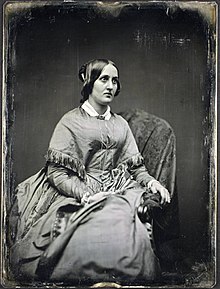
Image result for images of grace greenwood
Image from Wikipedia
Grace Greenwood was the pen name for Sara Jane Lippincott. On September 23, 1823, Sara Jane Clarke was born to Deborah and Dr. Thaddeus Clarke in Pompey, New York. She went to school in Rochester, New York and later moved to Brighton, Pennsylvania with her family.

From an early age, Sara wrote and submitted poems and sketches, and had her first piece of prose published when she was twenty. Like others of her time she used a pen name. Once she started using the name Grace Greenwood, it became who she was. Even friends started calling her by the name Grace.

According the Inez Hunt and Wanetta Draper in their book "Colorado's Restless Ghost" Sara was "Exuberant and self-sufficient in an era when frailty was the fashion. Grace [Sara] grew too tall, was too vital, and too clever. She simply didn't fit her time nor her place; she outgrew them all."

Marrying late in life to Leander K. Lippincott, the couple had one child which they named Ann.While Grace traveled about with their daughter, Leander stayed behind. In 1876 he was indicted for land fraud and fled the country.

Image result for grace greenwood cottage manitou springs colorado
Image from Wikimedia Commons
Grace first came to Colorado in the early 1870s and it was noted in the 'Colorado Magazine' of September 1871, "Grace Greenwood is one of the literary attractions in Denver. She is here on a visiting, lecturing and observation tour, is corresponding for the New York Times and writing up the country in her most graceful style.''  After a visit to Colorado Springs and Manitou Springs she purchased land in the latter town in 1873 and set about having a cottage built for her . While the 'cottage' was being built she stayed with relatives, the Mellons, and enjoyed the company of the town leaders. After moving in, there was an attempted burglary but Grace took her Italian stiletto and went in hot pursuit. After the incident the following appeared in the local paper:
             
          We now give warning to all gentlemen of burglarious proclivities that a good and gallant friend having provided us with a six shooter, we intend to practice diligently with it, firing promiscuously from our balconies o'nights. I am not Mrs. J.B. Lippincott, and haven't any diamonds, our silver is plated, our money in the bank if we haven't over-drawn...I intend setting the shrubbery full of steel traps...no use for them to call again at Clematis Cottage [the name she gave her home] and may be slightly dangerous. P.S. another friend has lent us a brindle-bull terrier--very powerful.

Grace traveled, wrote, lectured and pursued many different causes in her lifetime. She lived in Europe for a time in the 1880s and wrote a a biography of Queen Victoria while there. She died at the home of her daughter on April 20, 1904 at the age of eighty-one.

In the end this woman who championed prison reform, woman's rights, the end of the death penalty and was staunchly anti-slavery, is little known today. To quote the Hunt/Draper book "Her brilliant flash across the Colorado skies had been meteoric and spectacular, but her flame burned out quickly and left no trace." Perhaps it is time to remember the Honorary First Lady of the Pikes Peak Region. 


Doris Gardner-McCraw -
Author, Speaker, Historian-specializing in
Colorado and Women's History
Member of National League of American Pen Women,
Women Writing the West,
Pikes Peak Posse of the Westerners

Angela Raines - author: Where Love & History Meet
For a list of Angela Raines Books: Here 
Photo and Poem: Click Here 
Angela Raines FaceBook: Click Here