Search This Blog

Showing posts with label California. Show all posts

Wednesday, June 24, 2020

Finally, Progress


     In 1890, suffragists were finally united behind one national organization. After twenty years of competition, the National Woman Suffrage Association and the American Woman Suffrage Association joined to become the National American Woman Suffrage Association (NAWSA). Efforts to unite the two organizations began shortly after the split of women’s rights activists over the Fifteenth Amendment in 1869. (The American association supported it, even though women were not included. The National association opposed it, believing the exclusion of women from the amendment would prolong the fight for women’s suffrage.) Alice Stone Blackwell (daughter of American association founder, Lucy Stone) led the negotiations to merge the two groups.
Elizabeth Cady Stanton and Susan B. Anthony

     Elizabeth Cady Stanton became the first president of the combined organization, but she didn’t like the administrative duties associated with leadership. Her good friend Susan B. Anthony stepped up and took over most of the tasks involved in leading the new association during Cady’s two-year term. NAWSA turned its focus to winning the right to vote on a state-by-state basis.
     In 1892, Anthony was elected to the presidency. Since she was already 72 years old at that point, she groomed two protégées during her time in office, Carrie Chapman Catt and Anna Howard Shaw. Catt became head of the organization when Anthony resigned from her leadership position in 1900.
     The NAWSA did not exclude African American women from membership at the national level. However, state and local organizations were allowed to bar them and many did so. National conventions held in the south (like Atlanta in 1895 and New Orleans in 1903) were segregated.
     But encouraging developments brought hope to the suffragists.
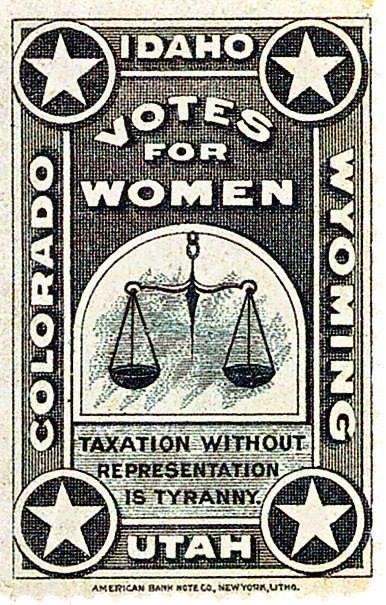
A privately-minted stamp (to be used alongside regular postage) put out by suffragists celebrating the four States in which women can presently vote on the same basis as men. (Source: National Federation of Democratic Women web site)
     In 1890, Wyoming became the first state to enter the union with women already having the right to vote in the territory.
     Three years later, the question of women’s suffrage was put up for a statewide referendum in Colorado. Carrie Chapman Catt led the effort on behalf of the NAWSA. The Colorado Non-Partisan Equal Suffrage Association, a grassroots coalition, rallied across the state in support of votes for women. The measure passed and Colorado women won the right to vote. 

     When Utah Territory applied for statehood, women convinced politicians to include women’s suffrage in the new state Constitution. This became the law with statehood in January of 1896.    

     At the 1889 Constitutional Convention held to found the state of Idaho, women’ suffrage was a highly controversial topic of discussion. Northwest suffragist Abigail Scott Dunaway and Women's Christian Temperance Union President Harriet Skelton were invited to address the convention. Consequently, temperance and women’s suffrage became linked as they were in many states. The women were unable to persuade the state founders to grant women the right to vote that year, but seven years later Idaho became the fourth state to enfranchise women.
    
     However, not all efforts to win the right to vote in western states were successful.

     Washington was one of the first territories to attempt granting rights to women. In 1854, a legislative measure was defeated by one vote. After years of trying to work with the legislature to win the vote, they next tried to secure the vote via voter referendums in 1889 and again in 1898. Both bids were unsuccessful.  
     In Kansas, suffrage for women and suffrage for blacks were both put before voters in November 1867. Both referendums failed.
South Dakota clipping
     At the South Dakota statehood convention in October 1889, after contentious discussions over full suffrage for women, politicians granted only partial suffrage, legislating that ‘any woman having the required qualifications as to age, residence and citizenship may vote at any election held solely for school purposes. As State and county superintendents are elected at general and not special elections, women can vote only for school trustees. They have no vote on bonds or appropriations.’ Later that month, the South Dakota Equal Suffrage Association was formed and Anna Shaw led the effort for the NAWSA.
     When South Dakota became a state in November, the first state legislature voted to put the issue up for a referendum in 1890. Although women campaigned diligently for full suffrage, the measure was defeated.

     Several years of concerted efforts by suffragists on the national and state levels led to the 1896 referendum on votes for women in California. That measure also failed.
     While this is not an exhaustive list of all initiatives to win rights for women to vote during this time period, these are some of the most high-profile efforts. By 1900, women in only four states had secured full suffrage.    
     After dedicating their lives to fighting for equal rights for women, especially the right to vote, Elizabeth Cady Stanton and Susan B. Anthony turned leadership of the National American Woman Suffrage Association over to a new generation at the end of the century. Stanton died in 1902. Anthony died in 1906. Neither had won the legal right to vote even in her own state. It would be thirteen years after Anthony’s death before the goal she and Stanton had spent much of their lives fighting for would finally be achieved.
Previous installments:
Voting in Colonial America:

NOW YOU CAN VOTE, NOW YOU CAN’T:

The Fight Begins:
https://prairierosepublications.blogspot.com/2020/03/the-fight-begins.html

A Rupture in the Cause
https://prairierosepublications.blogspot.com/2020/04/a-rupture-in-cause.html

Hope Emerges
 .


Sunday, November 12, 2017

Early History of Sacramento, California


The history of Sacramento, California, began with its founding by Samuel Brannan  and John Augustus Sutter, Jr. in 1848 around an embarcadero constructed by Sutter’s father, John A. Sutter, Sr., at the confluence of the American and Sacramento Rivers few years prior.

John A. Sutter, Sr. had developed New Helvetia as part of a Spanish Land Grant. However, after the conclusion of the Mexican-American War in 1848, Sutter's New Helvetia fell under U.S. control. A short eight years later, New Helvetia possessed a new name, Sacramento, named after the river that ran on the west side of the community, and it rose in prominence to become the capitol of the state of California.


When news of the gold discovery in Coloma reached San Francisco, a rush of hopeful prospectors began to move northwards to the Sacramento Valley, and by the middle of the year, so-called "Argonauts" flooded Sutter's holdings in search of gold. The arrival of Argonauts in the region decimated the economical integrity of Sutter's New Helvetia, as the prospectors slaughtered his herds of livestock, drove out local Native Americans loyal to Sutter, and divided New Helvetia amongst each other without Sutter's consent. Disappointed with what had become of his holdings, Sutter placed his son as head of fort business operations and retired to a different location. The real city of Sacramento was developed around a wharf, called the Embarcadero, on the confluence of the American River and Sacramento River that Sutter had developed prior to his retirement in 1849.


The junior Sutter worked to organize the city in its growth. Seeing what he considered a viable commercial opportunity in the Embarcadero, Sutter, Jr. invited military officials William H. Warner and his assistant, William Tecumseh Sherman, to survey his father's holdings for a location where he could establish a new city and create the city over a grid of numbered and lettered streets for organizational purposes. A number of businessmen, including millionaire-to-be Samuel Brannan, future California governor Peter Burnett, and George McDougall, brother of future California governor John McDougall, were attracted to the waterfront location. However, Sutter, Jr. and George McDougall disagreed over the terms of the lease of the location, and a trade war erupted between Sutter's Sacramento City and McDougall's new base of operations at Sutterville. Sutter, Sr., who had opposed many of his son's decisions, resumed control of his business affairs after Sutter, Jr. ended the competition between the two cities; trade in the area was biased toward Sacramento City as a result of Sutter, Jr.'s efforts.


Sacramento City did not have a formal government during early and mid-1849, and gambling institutions in the region sought to keep only the loose alcalde government. Unlike other settlements of its time and type, during the first few months of existence, Sacramento City did not have gambling houses and saloons until the summer of 1849. However, many city residents were swayed in favor of the gambling houses; by the fall of that year, the entire legal structure of Sacramento City was established by a large 296-vote margin on a second proposal. 


The government of California had only just reorganized itself into county units; days after the overhaul, the California State Legislature verified that Sacramento was officially recognized by means of charter in February 1850. Sacramento City later petitioned the Legislature to drop the "City" from the settlement's name, which was also granted. Sacramento City was serviced by organized public transportation via the rivers and upheld regular street maintenance by 1850.
 
Early Catholic Church, Sacramento
Churches also appeared early on when the Methodist Episcopalian pastor W. Grove Deal established the first church with regular services in May 1849. Catholic reverend Augustine Anderson arrived in 1850 and constructed a church in 1854, while Jews founded a synagogue called Congregation B'Nai Israel in 1852. In 1849, Edward C. Kemble moved north from San Francisco and established the city's first newspaper, The Placer Times. Kemble's newspaper disassembled three months later when Kemble was stricken with sickness. The first Sacramento theatrical stage, located in the Eagle Theatre (Sacramento, California), was founded in October 1849. The first school was organized in 1853.

However, its location caused the city to periodically fill with water. In January 1850, a major flood devastated the city. Rain from heavy storms had saturated the grounds upon which Sacramento was built, and the American and Sacramento rivers crested simultaneously.

The economic impact was significant because merchandise stationed at the Embarcadero was not secured and washed away in the flood. To resolve the problems, the city sought to resolve these problems by raising the sidewalks and buildings. Sacramento rallied behind Hardin Bigelow, who led efforts to implement emergency measures to protect the city from another disaster of that nature. Responsibility for construction of protective levees and dams won him support, and he was elected first mayor of the city. A second major flood in March 1850 was averted by Bigelow's efforts.

Fires also plagued the city. In April of the same year, the city experienced its first major fire. A second fire in November destroyed a number of commercial establishments in the city. In response to growing fear of a potential catastrophe, citizen volunteers founded California's first fire protection organization, named the "Mutual Hook and Ladder Company."
 
1852 Sacramento Fire-Hugo Wilhelm Arthur Nahl
October 1850 brought the arrival of the New World, a riverboat that carried news of California's admittance to the Union. It also brought the cholera epidemic that killed between 800 and 1,000 people within three weeks including between a quarter to half of the city's physicians. Nearly eighty percent of the population fled. Bodies were buried in mass graves at cemeteries across the city.

By 1852, Sutter's New Helvetia had collapsed completely, and Sutter's Fort had been abandoned. Sacramento's commerce had become reliant on coins, and the city had outgrown its unstable Gold Rush boomtown status and established itself as a full-fledged community. The Embarcadero, which had driven the growth of Sacramento from the start, no longer solely determined if the city would survive or be abandoned.

The year 1852 saw a diversification in Sacramento’s economy; pharmacies, attorney firms, brass foundries, and lingerie shops, among others, lined the streets of the city during this era. Additionally, companies were beginning to take advantage of the fish populations in the American and Sacramento Rivers, a resource that Sutter had discovered and utilized during the era of New Helvetia. The Central Valley's capacity for agriculture was also noted, and wheat surpluses that had originated in the Sacramento area were often shipped to foreign countries.

However, the city suffered a major fire the night of November 4, 1852, and nearly 85% of the city was destroyed in the fire. Like many gold field towns in the state, they also began to replace wooden structures with more fire-resistant materials like brick, stone and iron. The city adapted by implementing iron window shutters to reduce wind draft and make fires harder to spread. A second fire in 1854 destroyed twelve newly reconstructed downtown city blocks, including the city courthouse.

Sacramento Fire Department
California State Capitol

The American state of California's government met in Monterey in late 1849, the capital of the former Alta California, to conduct the first State Constitutional Convention; the seat of government was set in San Jose, although the government disliked the locale. Former Mexican general Mariano Guadalupe Vallejo promised a viable capital city at Vallejo in 1852. Vallejo was unable to sufficiently construct the city of Vallejo, and the government was moved to the city of Sacramento temporarily; after Vallejo failed again, he released himself from his contract to the state, and the government moved to Benicia until Sacramento made a bid for the capital that the Legislature accepted completely in 1854. The same year, the state legislature voted to make Sacramento the permanent state capital. Construction on the California State Capitol commenced in 1860; the structure would take fourteen years to complete.

~o0o~

November weddings can inspire feelings of thankfulness, but sometimes the parties and their families must work out a few kinks first. If you have not already ready read Bridgeport Holiday Brides, you may enjoy learning how two sweet romances end, and how a wedding almost didn't happen. Please CLICK HERE to learn more about the book and for the purchase link.

Zina Abbott is thankful she may enjoy her Thanksgiving holiday with her family near the Gateway to Yosemite.


Monday, May 2, 2016

It's RODEO Time in Scott Valley ............. Gail L. Jenner

It's Rodeo Time in our valley -- Scott Valley -- just a hop, skip and jump across the state line into California from Oregon. This year will have marked the 69th annual Pleasure Park Rodeo and it's an event that not only attracts locals from all over the area, it attracts visitors from around the north state and the West. It takes place every first Sunday in May, hence the big day will have occurred just "yesterday!"

P.S. I'm sure I'm dirty and exhausted and hopefully am fast asleep after a LONG day of fun and sun and dirt and dust! Horses put away.....?  Kids in bed....? Laundry piled up in the laundry room or on the back porch....?

You bet......

Although the Scott Valley Pleasure Park Rodeo started out as an entirely local activity back in the 1940s -- when a group of young men, looking for something exciting to do, were approached by an old cowboy who thought he could help them out. One of the young men had been playing horse polo at West Point and when he came home, he had gathered his friends together and introduced them to the wild sport. From there, it was only a matter of time that an arena was built!

From that auspicious beginning grew the roots of our county's most famous rodeo. At first it was only local cowboys and local "stock" but in a few years, the sport drew larger and larger crowds. It eventually became a professionally sanctioned rodeo. And now we have our May rodeo and the "Old Timers' Rodeo" in July....which is even more of a family affair. If you haven't enjoyed a rodeo, slip on your boots and grab your hat. We have a ton of fun...and everyone gets into the act.

Our oldest son and Doug -- saddle cow race just a couple years ago!
My husband Doug became an active participant; for more than 12 years, he rode bulls (he joined the college rodeo team for a time, as well). All in all, he emerged as a 3-time "All - Around Cowboy." In all that time, he was never thrown from a bull -- although at least twice he did "touch his hat" (and replaced it on his head), which disqualified him. I attribute his success to his amazing upper-body strength, developed while hauling hay (3-wire bales = 120 lbs each), sometimes as many as 1000 bales in a day.

He also participated in a number of raucous and entertaining "local" events, including the Packer's Race, Wild Cow Contest, Wild Cow Milking Contest, Cowhide Race, and even the Wild Horse Race. These events are some of the most popular on rodeo day -- always full of action and "mis-adventure!" Thankfully, he's "retired" now from bull riding, but he still enjoys getting into the action occasionally. But our sons and our daughter all have spent time in the arena, in the dirt, riding calves and steers, horses, and more. From drill team to competition, they've grown up around rodeo.

The annual May weekend begins with Saturday's junior rodeo, followed by a BBQ and dance downtown, and on Sunday, the annual Etna Parade. Everyone loves to see the Junior Pleasure Park horse drill team, the floats, the old cars, the kids, and horses, the Back Country Horsemen and Mountain Men Re-enactors (with their black powder shotguns that when they go off, everyone jumps!)....and more. 
The kids ride a manure spreader!
Re-enactors keep it lively when their black powder guns go "bang!"
Our family is often in the parade -- either with a vintage car or on horseback. The last couple years we've entered some of the Jenner grandkids (the two boys in front, on the left, are two of our grandkids): Mark and Collin. The others are grand nieces and nephews (but only a handful of them....there are plenty more!).
Granddaughter Morgan and friend -- running in high gear!
The rodeo begins with the "Kids'" events, including Mutton Bustin' -- which most of our grandkids have participated in at one time or another...
Dressed for riding his mutton!

Hang on, Buddy, okay????
A long - standing tradition, here is our youngest son Matt, when he was 6 years old young (23 years ago), wearing Doug's chaps from childhood. These chaps have gone through all of the kids so they are nearing 65 years old! Matt is also married now and is a father of two young kids. 

Mutton Bustin' -- for anyone who doesn't know -- is when kids get to ride sheep. They hang on, any which a'way, and try to last for as long as possible. Our grandson (above) won the winning buckle for TWO rodeos this year -- quite a feat for a six-year old...Our older son Nick and his wife Jenny visit with their younger son (6 years old) -- giving him some sage advice before slipping down into the chute?!

But the rodeo is made for little kids... what better place to get dirty and run around without fear?!


And, of course, the main events are the traditional ones: bareback riding, bronc riding, barrel racing, team roping, calf roping, and bull riding. Even now, when I hear the music start, and the announcer call out, "Bareback riders get ready; bull riders, pull down and start pukin'," I think of the number of rodeos I sat threw anxiously watching Doug behind the chutes, getting ready for his turn, grateful that in all those years, he never got hurt!

RODEO

It's a great time celebrated by our multi-generational farm and ranching family, and it's a community event that we all look forward to twice a year.
This photo, taken by a friend, is of a cousin -- not a professional cowboy, but certainly could be!

===========================
Gail Jenner is the wife of a cowboy-rancher- and former rodeo bull rider. Writing about life in the West and on a cattle ranch that has been in the family for 5 generations now (over 140 years) only adds greater inspiration to her stories. Author, educator, rancher's wife, she loves riding and gardening and spending days on the ranch with her husband of 45 years. She is proud that her children and grandchildren find this life as satisfying as she does! In addition, she and 6 of the Jenner "girls" have joined together to establish a retail sales business of 100% All Natural Angus (ranch-bred and raised) premium beef, called Jenner Family Beef!
For more about her, check out: www.gailjenner.com  or

Monday, July 6, 2015

Five Generations Strong....Ranching is What We Do.... By Gail L. Jenner


Although I've briefly talked about the ranch, I thought I'd delve a little more into its history. Several people have mentioned they enjoy hearing about the ranch. So here's a little more on the Jenner Cattle Company, three generations working together today, representing 3 of the 5 original generations:

L-R: nephew Frank; "Great Papa" Jack (91); brother-in-law John; son Matt; hubby Doug; son Nick.
 The Jenner Cattle Company, Inc., is one of the oldest ranches in Scott Valley, Siskiyou County, California.  For those who think California is the land of beautiful people and beautiful beaches and sun year-round, they have not visited the most northern quadrant of the state! Forty miles from Oregon, we are a rural (very rural) mountain community. We are surrounded by the Klamath National Forest, the Trinity-Salmon Alps, and the Marble Mountain Wilderness Area. The "valley" is perhaps 30 miles long and 6 miles wide. Originally the land of the Shasta, it is still the home of one of the largest tribes in northern California. Neighboring tribes include the Karuk and Yurok (further to the coast).

The first contact with whites dates back to Hudson Bay Company's beaver trappers and early mountain men, circa 1928-30. Stephen Meek, brother to Joseph Meek, is "credited" with putting Scott Valley (then called Beaver Valley) "on the map."  Interestingly, Stephen Meek lived for a time on a part of our ranch, and Old Pop used to recall how the Meek would hang his beaver pelts on our barn to dry in the sun (that would have been in Meek's later years -- around 1900+)... today the beaver are few, but they remain -- rather fascinating to watch how quickly they can build a dam. Only trouble is that we often try to plant trees along the slough and they saw them down very quickly! LOL...

The Jenners' entry into the valley goes back to the days of the gold rush (more on that in a future blog <g>).....the gold rush here followed on the heels of the Sierra Mother Lode "rush," but actually produced as much, if not more gold. Gold was first noted in 1848, but it wasn't until 1850 that the rush north into the Trinity region and beyond took hold. Even today, few people realize that the "northern mines" were as rich as they were, and the gold rush here lasted into the 1900s.
The Wagner Saloon in Etna
Part of the family’s ranching operation has its roots in the Wagner Ranch, purchased by Ignace and Mary Ann (Lichtenthaler) Wagner, both of Alsace, France, in March of 1874 (March 17, 1874). Although Ignace first went to mine in the area of Placerville (then known as "Hangtown" in the Sierras), he soon moved north, with a little bit of gold, as did so many gold seekers. He was a hard-worker and began to look around at how he could make a living for his family; farming and ranching was very profitable in the early days and he had come from farming stock. Later, at least one of his sons ran the Wagner Saloon in Etna. 


Another branch of the family included the Kapplers, who founded the original Etna Brewery--which has been resurrected and has won many micro-brewery awards since its "re-creation" in 1990! The Kapplers were also from Germany, arriving again as part of the gold rush. Settling in Etna, the Kapplers established the brewery and built an ice house and were the first to bring electricity to the town in 1898. Prohibition forced the brewery to close, although the beer did win a Blue Ribbon at the San Francisco Exposition in 1915.

The original farmhouse on the Wagner Ranch was built in 1859, but Ignace soon built a new home on the flat, opposite the old structure. The painting below was done by A. Cedro and stretches a good 4-5 feet across; it shows the layout of the Wagner Ranch in its "heyday."

Note the "horse barn" (still a beautiful and historic barn, on the right....).
The Wagners raised prized horses, including some magnificent Percherons; one even won a Blue Ribbon at the 1915 Exposition. They also raised hogs and apples. Today we still butcher hogs in the same way as did the first Wagners and we smoke our hams, bacon, sausage in the "old smokehouse on the hill." 

Our oldest son - note the "scrapers" to the left of the hog - 150 years old.
We also press cider in the 150-year old family cider press, made from a variety of apples on the ranch (many of which were planted later by my husband while in high school). Both are annual traditions that we have passed on now to the sixth generation. In fact, each Christmas our gift to neighbors, family and friends includes some of our wonderful sausage. Everyone looks forward to the gift!

NOTE: if anyone's interested in the historic and fascinating history of processing pork -- I could do a blog with photos...?

The first Jenner to arrive in Scott Valley was E.P. Jenner, who emigrated from Sussex County, England, in 1849 (again, because of the gold rush!), then founded the Union Flour Mill c. 1864, outside the town of Rough and Ready, now called Etna. With gold miners needing food and supplies, it was E.P.’s nephew, Frank S. Jenner, who followed his uncle to the valley and established a ranch on land straddling the “Island” (land between Scott River and Patterson Creek/slough) in the early 1870s, where rich bottomland produces good feed for cattle. 
This is the view from our living room window.

Today we still raise cattle on these rich pastures and native grasses – which adds to the flavor and nutrition found in our beef. It is 100% All Natural, with no hormones, no antibiotics, and it has a strong reputation as prime and superior beef.
The Jenner family, operating in its fifth generation, is centered around Frank’s original Island property, in addition to the Wagner Ranch, but we have also added to the family’s holdings and cow herd in the years since my husband and his brother joined the business (40+ years). And in the last 15 years, our two sons and nephew have joined the family operation/corporation. But "Grandpa Jack" (now 91) still works a good 8-hour day!

Today we run 1000+ cows and we've moved from raising Hereford to Angus-cross cattle. We calve in the late fall but since we have FOUR seasons (yes, temps drop to well below zero in the winter and we get snow that often lasts for days or weeks). With the valley floor at 2800 feet and the mountains around us peaking at 9,000 feet, we are a beautiful, green, lush valley. It's no wonder that so many immigrants from Germany and Switzerland made this valley their home.
    
In addition, the Island ranch features a lush, natural slough, with roughly 50 acres of ponds and four reservoirs. The area is maintained as a natural preserve where waterfowl and other wildlife congregate year-round. 
In winter, the geese often "skate" along the frozen slough....
We limit hunting in order to protect both wildlife and cattle, so it’s not uncommon to see hundreds, if not thousands, of ducks, geese, herons, even pairs of eagles (both Bald and American Golden) and other bird life, as well as beaver and/or otters, etc. The diversity is amazing and there is rarely a day I don't look out and marvel at the beauty and the fertility of nature. We love our cows, and for those who have wondered, cattle AND wildlife do cohabitate incredibly well. Cattle are natural recyclers; they are also natural fire retardants and can convert otherwise dry material into a powerful food source (like the dry hillsides that ignite in California every summer -- a shame they are no longer used to keep the fire danger down). 

Now that we have the sixth generation coming on, it's been wonderful having our rich family history to pass on -- not only the stories, but the actual "material" culture of a family that has lived on the same land for almost 150 years! And now, even the Jenner "girls" have expanded the family's enterprise; we've created our own business, Jenner Family Beef, which offers beef locally and regionally.


Just this year, Jenner beef is being featured at the new and exclusive Clove & Hoof butcher shop and eatery in Oakland, CA......along with an endorsement by San Francisco's Slow Food group. By expanding what we do, we feel that we can provide for our growing family. With four generations at work now and the next coming on, we hope to maintain our family's rich heritage!

========================================================================
Gail L. Jenner is the wife of Doug Jenner. She considers
her life on the ranch to be almost a dream-come-true!
Keeping the history of five generations alive is another
reason she collects and records local history, in addition
to writing historical fiction....
For more, visit: www.gailjenner.com
OR: http://www.amazon.com/Gail-Fiorini-Jenner/e/B005GHR47O
OR: https://www.facebook.com/pages/Author-Gail-L-Jenner/207027702703732?ref=hlhttps://www.facebook.com/pages/Author-Gail-L-Jenner/207027702703732?ref=hl
She is the author of the PRP release of her WILLA Award-winning novel, ACROSS THE SWEET GRASS HILLS. Her stories have also been included in the PRP anthologies, PRESENT FOR A COWBOY, LASSOING A BRIDE, and COWBOY KISSES. She has also coauthored 5 regional histories, and edited and contributed to ANKLE HIGH AND KNEE DEEP, an anthology of Western rural women's stories.

Monday, December 1, 2014

THE APPLEGATE TRAIL....Oregon Pioneers ... By Gail L. Jenner


We hear a lot about the Oregon Trail and the settlers and pioneers who crossed it. 
A particularly important trail for those heading into Oregon was the Applegate Trail – which was the southern alternative to the Oregon Trail. Jesse Applegate, in particular, was instrumental in opening the South Road to Oregon, also known as the Scott-Applegate Trail. Beginning at Fort Hall in Idaho, the trail followed the Humboldt River before crossing the Klamath Basin. Supporters hoped it would encourage settlement in southern Oregon and the upper Willamette Valley.
            Three Applegate brothers, Charles (1806-1879), Lindsay (1808-1892), and Jesse (1811-1888), like so many early pioneers, came via the Oregon Trail in 1843 and settled in the Willamette Valley.
Charles Applegate
Lindsay Applegate


Jesse Applegate
            The Applegates were involved in much of Oregon’s early history. In 1844, Jesse surveyed the townsite of Oregon City, which was the first incorporated American city west of the Rocky Mountains. In 1845, he helped develop the provisional government and Oregon’s first constitution.
            It was in 1846 that Jesse and Lindsay Applegate joined the expedition that located a new route into Oregon from the south; the route was known as the Southern Immigrant Route, the Scott-Applegate Trail, and the Applegate Trail. They crossed the Umpqua River and made their way to present day Ashland, Oregon, and then crossed over Greensprings to the Klamath Basin. They passed Klamath Lake, crossed the Tule and Goose Lake valleys to Northern California, and crossed Black Rock Desert to the Humboldt River where they picked up The California Trail, which also originated at Fort Hall, Idaho.
            Jesse rode ahead of the main party to Fort Hall to tell people of the new overland route and to get a wagon train together. Thus the Applegate Trail was born. By 1849 the Applegate Trail was the main route for hopeful miners going after gold.


 In 1849, Jesse Applegate settled in a place he named Yoncalla in the Umpqua Valley. Charles and Lindsay followed in 1850. Charles and Jesse stayed there until their deaths (in 1879 and 1888). Lindsay served for several years as the Indian agent for the Klamath Reservation then retired to Ashland in 1869. He died in 1892.       
            Today there is a river, a valley, a mountain, a trail, and a town named after the enterprising and ambitious Applegate Brothers.
            There are a few remnants of the trail visible today. One section is at Tubb Springs State Wayside, 18 miles east of Ashland on Highway 66. Wolf Creek Tavern Inn, 20 miles north of Grants Pass off Interstate 5 is also right on the trail. The trail ran roughly parallel to I-5 through much of Douglas County, including the route along Canyon Creek.
           
            From 1853-55, Congress allotted $50,000 for the construction of three military roads within the Oregon Territory: from Camp Stuart, near Jacksonville, to Myrtle Creek; from Myrtle Creek to Scottsburg; and from Salem to Astoria. The section of road passing between Grants Pass and Winchester generally followed the route of the Oregon-California Trail.
 
Freight wagons and mule trains also traveled from California to Jacksonville as well as from the Willamette Valley. In fact, during 1851, reportedly one hundred mules left Union in Humboldt Bay, California, every week for the northern California mines (bordering Oregon) and points north or south. They often carried $4000 to $5000 worth of supplies. Jacksonville became the seat of the pack trade. From Crescent City, California, to Jacksonville, pack trains had to travel 120 miles over rugged terrain. The trip took ten days.

 For the early settlers these trains provided both supplies and news from the outside world. By the 1870s, however, Rogue Valley farmers were exporting products as well as importing supplies, thus these transports provided a ready market for their agricultural goods.
            By 1861, a stage road connected California and Oregon, which made it possible for a stage to travel from Sacramento to Portland, or visa versa, in relative safety and comfort. The route was 710 miles long and necessitated the construction of 60 stage stops/inns along the way. Stages left Sacramento and Portland early each morning and the California Stage Company employed 14 district agents, 75 hostlers, and 35 drivers, in addition to 28 coaches, 30 stage wagons, and 500 head of horses.
            Today, tourists and travelers to Oregon will read and hear of the Applegate Brothers; their endeavors made a significant contribution to early Oregon and California pioneer history.


 Gail L. Jenner is the author of 2 historical novels and five regional nonfiction histories. Her novel ACROSS THE SWEET GRASS HILLS (Winner of the WILLA Literary Award) was re-released from Prairie Rose Publishing in December 2013. ACROSS THE SWEET GRASS HILLS is now also part of a special 5-western book gift pack. For a limited time you can purchase the five novels as a collection (A COWBOY'S BRAND) -- available for a short time and released from Prairie Rose Publications, for only 0.99 per set!  Check it out at: http://www.amazon.com/Cowboys-Brand-Western-Romance-Novels-ebook/dp/B00QE9YJYE/ref=sr_1_12?ie=UTF8&qid=1417401765&sr=8-12&keywords=Brand+of+a+Cowboy   
For more information about Gail, visit: www.gailjenner.com