Search This Blog

Showing posts with label U.S. history. Show all posts

Wednesday, September 23, 2020

Gathering Steam


     The National American Woman Suffrage Association (NAWSA) continued its quiet state-by-state campaign for the right to vote. Meanwhile, the Congressional Union for Woman Suffrage (CU), led by Alice Paul and Lucy Burns, was determined to keep the cause in front of the public.
     In March 1914, the Senate voted on a federal woman suffrage amendment for first time since 1887. The bill was defeated. It was reintroduced the next day.
Chicago's Parade

 
    That same year, Paul organized May Day parades in cities across the country, garnering local and national publicity for the movement. Additionally, the National Federation of Women’s Clubs, with more than two million members throughout the U.S., formally endorsed the suffrage campaign. In November, women won full suffrage in Montana and Nevada.
     The House of Representatives voted for first time on a federal woman suffrage amendment in January 1915.  The measure was defeated.
     That same month, the CU opened a "freedom booth" at the Panama Pacific International Exposition in San Francisco, where they displayed exhibits in support of expanding full women’s suffrage beyond the eleven states that already had it. Helen Keller, a famous supporter of the cause, spoke at the booth. The CU representatives collected 500,000 signatures on their suffrage petition at the exposition. Suffrage envoys left California in September, carrying the petition by automobile across the country to Congress and President Wilson.
Suffrage Envoys

    Carrie Chapman Catt again assumed leadership of the NAWSA in 1915. She continued the state-by-state efforts to win suffrage. Attempts to reconcile with the CU failed. Despite NAWSA objections, the CU restructured as a national organization and sent organizers to all states to plan conventions and establish state branches. In September, the CU held the first Woman Voters Convention with delegates from states where women had full voting rights.
     In December 1915, the CU held its first national convention in Washington, D.C. The event coincided with the opening of the 64th Congress and the arrival of the suffrage envoys carrying the petition. On December 7, a federal woman suffrage amendment was introduced in the Senate. On the 16th, CU members testified in favor of the amendment before the House Judiciary Committee. The next day, a final attempt at reconciliation with the NAWSA failed.
      To keep the cause before the public, 23 CU members left Washington, D.C. in April 1916 on "The Suffrage Special," a five-week train tour to garner support for the federal woman suffrage amendment among women voters in the West. Subsequently, Alice Paul organized the National Woman’s Party, which was made up of women who already had full suffrage. They supported the efforts of their disenfranchised sisters, who were still represented by the CU. The two complementary organizations coexisted until they merged into the National Woman’s Party (NWP) in 1917.
                                                    
NWP  Flag
      The NWP met in Colorado Springs in 1916 to discuss the upcoming election. They chose not to endorse either candidate during the presidential campaigns.  Instead, they decided to oppose all Democratic congressional candidates in order to hold the party in power responsible for failure to pass the suffrage amendment.
      On October 20, a mob attacked NWP members who were demonstrating against Woodrow Wilson outside a Chicago auditorium. Three days later, Inez Milholland Boissevain, leader of the 1913 parade in Washington, D.C. and an NWP organizer, collapsed from exhaustion on the stage while giving speech against President Wilson and the Democratic Party in Los Angeles. She died of pernicious anemia on November 25 at the age of 30, becoming widely regarded as the first martyr of the women’s suffrage movement.
     In the November election, Jeanette Rankin of Montana became the first woman elected to the House of Representatives. Woodrow Wilson was re-elected President.
     NWP members silently demonstrated at Wilson’s annual address to Congress on December 5. They held a banner that read: “Mr. President, What Will You Do For Woman Suffrage?” A memorial service for Boissevain was held on Christmas Day in Statuary Hall in the U.S. Capitol. Attendees drafted suffrage resolutions for presentation to the President.
     After two weeks of stonewalling, Wilson finally met with a delegation of 300 women on January 9, 1917. They presented him with the resolutions drafted during the memorial service and asked him to use his influence to promote a federal woman suffrage amendment. Wilson angrily refused and walked out on the women.
Silent Sentinels
     In response to Wilson’s rejection of their request for his support a federal amendment, NWP members began picketing the White House. These “Silent Sentinels” stood outside the fence day after day, despite rain, snow or whatever weather they encountered. They held banners with pro-suffrage messages and other banners of purple, white, and gold, the colors of the NWP.
 
Grand Picket
     On March 4, the eve of Wilson’s second inauguration, more than 1000 women staged a “Grand Picket.” They marched around the perimeter of the White House, where all gates to the grounds were locked, in driving icy rain, waiting to present him with resolutions from their national convention. After several hours, Wilson and his wife left the White House, driving past the picket line.
     In April, federal women’s suffrage amendments were introduced in the House of Representatives and in the Senate. Additionally, the United States entered World War I. Carrie Chapman Catt promised President Wilson that the NAWSA would cease efforts on behalf of winning the vote in support of the war effort. Meanwhile, the “Silent Sentinels” continued their daily pickets.
      The battle had risen to a new level.


 .


Wednesday, August 26, 2020

Into the Storm


     As the twentieth century dawned, women had full suffrage in only four states – Wyoming, Colorado, Idaho and Utah. Women failed to win full voting rights in any additional states until the dam broke in 1910,  when the state of Washington granted women’s suffrage.

Alice Paul
     That same year, Alice Paul returned to the United States from London, where she had been studying and working as a case worker in a settlement house. While in England, she became involved in the struggle for women’s rights. Through her experiences with arrests, imprisonments, hunger strikes, and forced feedings, she learned how to generate publicity for the cause and how to capitalize on that publicity from the British leaders of the movement. Paul returned to the University of Pennsylvania to continue her studies and began participating in National American Woman Suffrage Association (NAWSA) activities, including speaking at the national convention.
     Finally, in the culmination of a long struggle, California women won the right to vote in 1911.
     In 1912, the Progressive Party, led by Theodore Roosevelt, included voting rights for women in their platform. That same year, women won the right to vote in Oregon, Arizona, and Kansas. But eastern states continued to stand in staunch opposition to the cause.


     After earning her Ph.D. in sociology in 1912, Paul dedicated herself to American suffrage efforts. She strongly supported a federal suffrage, which ran contrary to the entrenched state-by-state plan of the NASWA. She and Lucy Burns, who had also been involved in England’s women’s rights movement, joined forces. Paul asked to be assigned to the association’s Congressional Committee.
     One of her first major efforts on the committee was to plan and execute a parade in Washington, D.C. to bring national attention to the suffrage movement and to put pressure on newly elected President Woodrow Wilson. The event was scheduled the day before his inauguration in in March 1913.

     She recruited approximately 8000 marchers from around the country and organized floats, bands and chariots to intersperse with the suffragists. A contingent of men who supported women’s suffrage made up one unit. To placate the southern marchers, the black women were asked to march at the end of the procession.


     Many participants carried banners or wore sashes demanding votes for women. The parade was led by notable labor lawyer Inez Milholland, dressed in white and riding a white horse,  and by a huge banner proclaiming, "We Demand an Amendment to the United States Constitution Enfranchising the Women of the Country."


     The police force was insufficient to keep the peace. More than half-a-million people turned out to view the parade, including large numbers of men in town for the inauguration. When the crowd pushed into the streets, creating chaos and preventing the procession from passing, many of the policemen did nothing to protect the marchers. Approximately 100 women sustained injuries and were hospitalized. Ultimately, national guardsmen were called in to restore order. A Senate hearing was called later in the week to review the  performance of the police. Many women recounted the inaction of the police and one Senator testified to the badge numbers of police officers he had seen standing idly by rather than coming to the aid of the marchers.
     The parade succeeded in bringing national attention to the movement. That same year, the Alaska Territory granted full suffrage to women.
      Paul's methods and her emphasis on the goal of a federal amendment created tension with Anna Shaw, president of NAWSA, and other leaders of the organization. They thought Paul was moving too aggressively in Washington, D.C. and elsewhere and were unhappy that she didn’t support their state-by-state approach. Disagreements about strategy and methods led to a break with NAWSA.


      By the beginning of 1914, Alice Paul and Lucy Burns had formed the Congressional Union for Woman Suffrage to campaign for a constitutional amendment guaranteeing suffrage for women throughout the United States of America.
     The fight was on.

Ann Markim


Wednesday, July 22, 2020

A Lull Before the Storm


     By the end of the nineteenth century, women had won full suffrage in only four states — Wyoming, Colorado, Idaho, and Utah. In 1900, Susan B. Anthony turned over the presidency of the now-united National American Woman Suffrage Association  (NAWSA) to Carrie Chapman Catt, signaling a new generation of leadership.

     During this period, little effort was devoted toward passage of a constitutional amendment. Instead, the association’s work centered around winning voting rights in the individual states. Catt gave speeches and organized women to help plan and execute suffrage campaigns. In many states, men feared that enfranchising women would interfere with political efforts to disenfranchise African-Americans and immigrants. Despite its Quaker roots, NAWSA was not immune to Jim Crow influences. While the national organization did not explicitly prohibit non-white members, it allowed state and local affiliates to set their own membership requirements. Many groups, especially in the South, admitted only white women.
     Catt devised the ‘society plan’ to recruit wealthy members of women's clubs into the NAWSA. These women had organizing experience, time to volunteer, and money to contribute to the cause. While there was a strong black woman’s club movement, Catt did not extend her recruiting efforts to them, even though those groups were often engaged in promoting women’s rights, including suffrage. Consequently, the NAWSA became predominantly white. 

     In 1902, Catt helped to found the International Woman Suffrage Alliance (IWSA). The IWSA brought together groups pursuing votes for women around the world, eventually representing 32 nations. The organization is now known as the International Alliance of Women.
    When Catt’s husband fell ill in 1904, she resigned her NAWSA presidency to care for him. He died in October 1905. 
Anna Howard Shaw
     Anna Howard Shaw succeeded Catt to the NAWSA presidency. Although she was a talented speaker, she lacked the leadership skills of her predecessors. However, when southern NAWSA members formed the Southern Woman Suffrage Conference in 1906, Shaw refused to give the national association’s endorsement to the overtly racist organization.
     During Shaw’s term, members organized other new affiliates. In 1907, Harriet Stanton Blatch (Elizabeth Cady Stanton’s daughter) formed the Equality League of Self-Supporting Women, with membership comprised of professional and industrial working women. This contrasted with Catt’s ‘society plan’ which appealed to upper-class women. The Equality League adopted tactics of English suffragists, including parades, street speakers, and pickets. The League became the Women's Political Union in 1910.  
  
    The National College Equal Suffrage League became an affiliate of the NAWSA in 1908. The organization had been founded in Boston at the beginning of the century as the College Equal Suffrage League.
     The death of Carrie Chapman Catt’s husband was followed by a rapid succession of more deaths among people important to her. Susan B. Anthony died in February 1906, and Catt's mother and younger brother both died in 1907. These sorrows plunged Catt into despair. Her doctor and friends convinced her that traveling abroad would help her recover from the devastating losses. She spent much of the following eight years promoting equal-suffrage rights worldwide as the IWSA president.

      In 1909, Catt and some of her friends founded the Woman Suffrage Party to fight for the vote in New York. Within a year, the Party had 20,000 members. The organization remained independent, but Catt and its other leaders remained loyal to the NAWSA.
      By the end of the decade, the public’s attitude toward the suffrage movement had improved dramatically. Working for the cause had come to be viewed by many as a respectable activity for middle-class women. Infrastructure in support of the suffrage movement had been built. However, from 1896 to 1910 there had been six state campaigns for suffrage. All six failed.
     But the tide was about to turn.

Ann Markim


Wednesday, June 24, 2020

Finally, Progress


     In 1890, suffragists were finally united behind one national organization. After twenty years of competition, the National Woman Suffrage Association and the American Woman Suffrage Association joined to become the National American Woman Suffrage Association (NAWSA). Efforts to unite the two organizations began shortly after the split of women’s rights activists over the Fifteenth Amendment in 1869. (The American association supported it, even though women were not included. The National association opposed it, believing the exclusion of women from the amendment would prolong the fight for women’s suffrage.) Alice Stone Blackwell (daughter of American association founder, Lucy Stone) led the negotiations to merge the two groups.
Elizabeth Cady Stanton and Susan B. Anthony

     Elizabeth Cady Stanton became the first president of the combined organization, but she didn’t like the administrative duties associated with leadership. Her good friend Susan B. Anthony stepped up and took over most of the tasks involved in leading the new association during Cady’s two-year term. NAWSA turned its focus to winning the right to vote on a state-by-state basis.
     In 1892, Anthony was elected to the presidency. Since she was already 72 years old at that point, she groomed two protégées during her time in office, Carrie Chapman Catt and Anna Howard Shaw. Catt became head of the organization when Anthony resigned from her leadership position in 1900.
     The NAWSA did not exclude African American women from membership at the national level. However, state and local organizations were allowed to bar them and many did so. National conventions held in the south (like Atlanta in 1895 and New Orleans in 1903) were segregated.
     But encouraging developments brought hope to the suffragists.

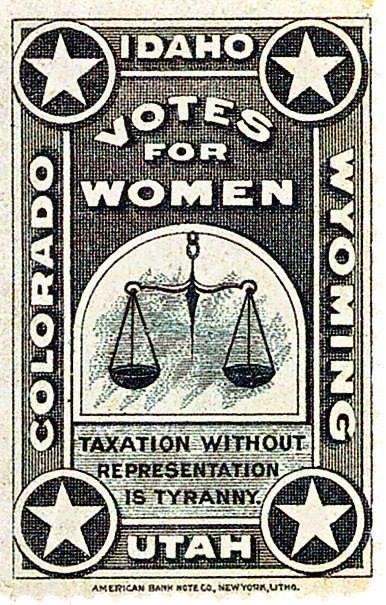
A privately-minted stamp (to be used alongside regular postage) put out by suffragists celebrating the four States in which women can presently vote on the same basis as men. (Source: National Federation of Democratic Women web site)
     In 1890, Wyoming became the first state to enter the union with women already having the right to vote in the territory.
     Three years later, the question of women’s suffrage was put up for a statewide referendum in Colorado. Carrie Chapman Catt led the effort on behalf of the NAWSA. The Colorado Non-Partisan Equal Suffrage Association, a grassroots coalition, rallied across the state in support of votes for women. The measure passed and Colorado women won the right to vote. 

     When Utah Territory applied for statehood, women convinced politicians to include women’s suffrage in the new state Constitution. This became the law with statehood in January of 1896.    

     At the 1889 Constitutional Convention held to found the state of Idaho, women’ suffrage was a highly controversial topic of discussion. Northwest suffragist Abigail Scott Dunaway and Women's Christian Temperance Union President Harriet Skelton were invited to address the convention. Consequently, temperance and women’s suffrage became linked as they were in many states. The women were unable to persuade the state founders to grant women the right to vote that year, but seven years later Idaho became the fourth state to enfranchise women.
    
     However, not all efforts to win the right to vote in western states were successful.

     Washington was one of the first territories to attempt granting rights to women. In 1854, a legislative measure was defeated by one vote. After years of trying to work with the legislature to win the vote, they next tried to secure the vote via voter referendums in 1889 and again in 1898. Both bids were unsuccessful.  
     In Kansas, suffrage for women and suffrage for blacks were both put before voters in November 1867. Both referendums failed.
South Dakota clipping
     At the South Dakota statehood convention in October 1889, after contentious discussions over full suffrage for women, politicians granted only partial suffrage, legislating that ‘any woman having the required qualifications as to age, residence and citizenship may vote at any election held solely for school purposes. As State and county superintendents are elected at general and not special elections, women can vote only for school trustees. They have no vote on bonds or appropriations.’ Later that month, the South Dakota Equal Suffrage Association was formed and Anna Shaw led the effort for the NAWSA.
     When South Dakota became a state in November, the first state legislature voted to put the issue up for a referendum in 1890. Although women campaigned diligently for full suffrage, the measure was defeated.

     Several years of concerted efforts by suffragists on the national and state levels led to the 1896 referendum on votes for women in California. That measure also failed.
     While this is not an exhaustive list of all initiatives to win rights for women to vote during this time period, these are some of the most high-profile efforts. By 1900, women in only four states had secured full suffrage.    
     After dedicating their lives to fighting for equal rights for women, especially the right to vote, Elizabeth Cady Stanton and Susan B. Anthony turned leadership of the National American Woman Suffrage Association over to a new generation at the end of the century. Stanton died in 1902. Anthony died in 1906. Neither had won the legal right to vote even in her own state. It would be thirteen years after Anthony’s death before the goal she and Stanton had spent much of their lives fighting for would finally be achieved.
Previous installments:
Voting in Colonial America:

NOW YOU CAN VOTE, NOW YOU CAN’T:

The Fight Begins:
https://prairierosepublications.blogspot.com/2020/03/the-fight-begins.html

A Rupture in the Cause
https://prairierosepublications.blogspot.com/2020/04/a-rupture-in-cause.html

Hope Emerges
 .


Wednesday, May 27, 2020

Hope Emerges


     While the fight over the Fifteenth Amendment was being waged in the east, the western states and territories were more favorable to women’s suffrage.
     The first territorial legislature of the Wyoming Territory granted full voting rights to women in 1869. On September 6, 1870, Louisa Ann Swain of Laramie, Wyoming became the first woman to cast a vote in a general election.
Louisa Swain
In 1890, the U.S. Congress demanded Wyoming rescind the right of women to vote as a condition of statehood. The Wyoming legislature responded in a telegram: “We will remain out of the Union one hundred years rather than come in without the women.” Congress gave in. Wyoming became the 44th state and the first state in which women had full voting rights. 


     Utah had a more turbulent history in relation to women’s suffrage. The territory was home to many Mormon communities that practiced polygamy. Politicians opposed to the practice of polygamy believed if women were given the vote it would help to end the practice. On the other hand, many Mormon men supported voting rights for women to prove to the nation their wives were not oppressed by polygamy.


     In 1870, the Utah territory passed legislation that enfranchised women. This lasted until 1887, when the United States Congress passed the Edmunds-Tucker Anti-Polygamy Act. The act placed restrictions on the Mormon Church, including disincorporating it and seizing its property. It required individuals to take an anti-polygamy oath in order to vote, hold public office or serve on juries. The Edmunds-Tucker Act also disenfranchised all women in the Utah Territory. Both Mormon and non-Mormon women formed suffrage organizations.
      When Utah Territory applied for statehood in 1895, women convinced politicians to include women’s suffrage in the new state Constitution. When Utah became a state in January of 1896, women were again legally able to vote.
     Meanwhile, in the rest of the country, women continued to fight for the right to vote. In a piecemeal array of states, territories, counties and towns, they won different configurations of partial voting rights. Usually, those rights allowed women to vote only for local officials such as school board members, city officers and/or county representatives. But in most of the country, woman were still excluded from participating in elections. 

      In 1872, Susan B. Anthony, voted in the election in Rochester, New York, although the state had not granted suffrage rights to women. Her sisters and eleven other women also voted in the election. They argued that constitutional language gave them the legal right to cast ballots. They were subsequently arrested for voting. Anthony was held on $1000 bail ($21,157 in today’s dollars), the rest were held on $500 bail each. The following year, Anthony was denied a trial by jury and lost her case. She was fined $100 plus court costs.
      The U.S. Congress first introduced a suffrage amendment in 1878. Four years later, the House and Senate appointed committees on woman suffrage. Both favored votes for women. Two years after the favorable reports, the U.S. House of Representatives debated woman suffrage. In 1886, the suffrage amendment finally reached the floor of the U.S. Senate. It was defeated.
  

     As women received partial voting rights in some places, they began running for public offices. Many women won positions as school board members, county clerks, state legislators, judges, and other local officials. In 1884, Belva Lockwood, the first female to be admitted to the bar of the U.S. Supreme Court, even ran for president. Although she lost handily, women had started to gain political clout. But the fight for suffrage was far from over. 

Previous installments:
Voting in Colonial America:

NOW YOU CAN VOTE, NOW YOU CAN’T:

The Fight Begins:
https://prairierosepublications.blogspot.com/2020/03/the-fight-begins.html

A Rupture in the Cause
https://prairierosepublications.blogspot.com/2020/04/a-rupture-in-cause.html


Ann Markim


 Buy Links:      Paperback at Amazon    Amazon Kindle
 .


Wednesday, April 22, 2020

A Rupture in The Cause


     After ratification of the Fourteenth Amendment, it quickly became evident that its wording was too weak to encourage many of the states (states still controlled suffrage eligibility) to encourage black enfranchisement. Congress then designed the Fifteenth Amendment to address this issue directly. It explicitly forbade the states to deny the right to vote to anyone on the basis of ‘race, color or previous condition of servitude.’ It also gave Congress the power to pass any necessary enforcement legislation. The federal government did not specifically define who was allowed to vote, but the amendment specified who could not be prevented from voting if conditions set by the state were met. African American men were protected in this amendment. Women were not.


    Frederick Douglass and other former abolition leaders backed away from their support of woman suffrage to concentrate on fight for black male suffrage. This caused a serious rift between the two movements. It also caused a split within the women’s rights activists. Susan B. Anthony and her supporters wanted women to be included with black men. Anthony and Elizabeth Cady Stanton began publishing a women’s rights newspaper called The Revolution. Lucy Stone and her followers supported the amendment as it was, believing that women would win the vote soon.

     In February 1869, Congress passed the amendment, enfranchising black men but not women.
     At a meeting of the American Equal Rights Association in May, Stanton voiced her sense of betrayal by longstanding male abolitionist allies, and her belief that "educated" women like herself were more worthy of the vote than men who had just emerged from slavery. She and Frederik Douglass had a public argument about the relative importance of black man versus woman suffrage. Stanton, Anthony and their supporters walked out of the meeting and formed the National Woman Suffrage Association.
     That same year, Lucy Stone and Julia Ward Howe formed the American Woman Suffrage Association, which maintained its ties with the abolitionists and the leadership of the Republican Party. They expected to get women’s suffrage enacted soon after black male suffrage had been fully inscribed in the Constitution.
     In 1870, the Fifteenth Amendment was ratified.
     

     Afterward, the American Woman Suffrage Association focused on winning changes in state constitutions, counting on winning over a majority of male voters.
     Meanwhile, the National Woman Suffrage Association centered its efforts on the national Constitution. They doubted that an additional federal amendment would be passed but sought a way to base women’s suffrage in the Constitution’s existing provisions.
     For the next twenty years, these two competing organizations fought for influence and for woman suffrage. Neither group suspected it would be fifty years before women finally won the right to vote.

Coming next month:  Hope Emerges 

Previous installments:
Voting in Colonial America:

NOW YOU CAN VOTE, NOW YOU CAN’T:

The Fight Begins:
https://prairierosepublications.blogspot.com/2020/03/the-fight-begins.html 

Ann Markim


 Buy Links:      Paperback at Amazon    Amazon Kindle

Wednesday, March 25, 2020

The Fight Begins


After New Jersey disenfranchised women in 1807, no women in the United States had voting rights. But organized efforts to win women’s suffrage did not begin for quite some time. Long before women were fighting for the vote, they were fighting for human rights.

The fight for women’s rights has its roots in the Abolitionist Movement. In the 1830s, many women formed and joined female antislavery associations. Although Angelina and Sarah Grimke had been raised on a slave-owning plantation in South Carolina, the sisters were among the first women to speak publicly against slavery. In 1836, Angelina published a pamphlet, An Appeal to Christian Women of the South, calling on all southern women to join the effort to abolish slavery. This did not go over well, and South Carolina leaders threatened to put Angelina in prison if she returned home.    
                                                                   
The Grimke Sisters
The next year, the General Association of Congregational Ministers of Massachusetts issued a pastoral letter, primarily directed at the Grimke sisters, denouncing women preachers and reformers. This epistle prompted the Grimkes and other female activists to crusade for women’s rights in addition to abolition of slavery.

In the same year, at age 17, Susan B. Anthony collected anti-slavery petitions. She had grown up in a Quaker family that was strongly committed to social equality. Anthony became the New York state agent for the American Anti-Slavery Society in 1856, while she was active in the women’s rights movement.

Anthony wasn’t alone in fighting for women’s rights and against slavery. In 1840, Elizabeth Cady married reformer Henry Stanton and immediately went to London to attend the World’s Anti-Slavery Convention. Upon her arrival, she was shocked to learn that women were barred from attending the assembly. She joined with Lucretia Mott and other women in objecting to their exclusion on account of their sex.

This was just the beginning for Stanton. At the first Women’s Rights convention in the United States held in 1848 in Seneca Falls, New York, she proposed a long list of reforms to protect women and to give them equal rights. Among these rights, was equal suffrage, an idea so radical that it spurred heated debate. In the end, inclusion of women’s suffrage was adopted, and this convention is often seen as the birthplace of the movement for Woman Suffrage (as it was originally called). A report of this convention was published as the Declaration of Sentiments.

Although Woman Suffrage was now on the agenda, the fight for women’s rights was much broader. And, over the next two decades, the cause became inextricably linked to temperance and abolition of slavery.

In 1851, Susan B. Anthony met Elizabeth Cady Stanton, and they formed a partnership for social reform that would last for the rest of their lives. The following year, they founded the New York Women's State Temperance Society after Anthony was not allowed to speak at a temperance conference because she was female. At the time, women were considered the property of their husbands. Consequently, women had no legal recourse when their husbands beat or abused them. Because such abuse commonly occurred when men were drunk, abstinence was seen as a way to curb intoxication and thus make women safer.

When the Civil War began in 1861, most women put aside women’s rights and woman suffrage activities to help the war effort. However, Anthony and Stanton continued their work for social justice. In 1863, they organized the Women’s Loyal National League to work for a constitutional amendment to abolish slavery. The league accomplished the largest petition drive in United States history up to that time, collecting nearly 400,000 signatures in support of the abolition of slavery.

Anthony and Stanton’s efforts intensified after the war. In 1866, they joined with Lucy Stone and Frederick Douglass to establish the American Equal Rights Association in 1866. This group campaigned for equal rights both for women and African Americans. 


Congress introduced the Fourteenth Amendment, extending the liberties and rights granted by the Bill of Rights to former slaves. This amendment included the first use of the word male in the Constitution, defining citizens as “male.” Women’s rights activists strongly objected and petitioned Congress to change the language. Elizabeth Cady Stanton wrote, “If that word ‘male’ be inserted, it will take us a century at least to get it out.”

The amendment passed Congress and was sent to the states for ratification with the qualification of ‘male’ intact. This posed a dilemma for the advocates for women’s rights. Did they support the rights of freedman citizenship at the expense of their own cause? Although they objected to the exclusion of women, they stopped short of calling for non-ratification of the Fourteenth Amendment.

 In 1868, the fourteenth amendment was ratified.


Coming next month: The women’s suffrage movement crystalizes.

Previous installments:
Voting in Colonial America:

NOW YOU CAN VOTE, NOW YOU CAN’T:

Ann Markim

    Buy Links:      Paperback at Amazon    Amazon Kindle