Search This Blog

Showing posts with label Colorado Springs History. Show all posts

Sunday, July 5, 2020

'MECCA' FOR THE CURE OR FOR THE DOCTOS


Post by Doris McCraw
writing as Angela Raines


The remedies listed below were taken from a book written in 1847 on the treatment of injuries and illnesses.

If you were suffering from asthma you might be treated with skunk cabbage root, taken as a syrup or dried, and smoked through a pipe. Earaches might be treated with the heart of a roasted onion placed in the ear. Toothaches, how about a pill composed of camphor and opium placed in the tooth, or if really bad, pulled by whoever was available.
If you were bitten by a rattlesnake you might drink a half a glass of olive oil, and apply some to the site of the bite.

Childbirth had either a female neighbor or if lucky a mid-wife present. Of course, if neither of those was available it became an individual or at most a family affair. The common practice of laying in, that is remaining in the birth bed, no clean sheets, etc. was not always practical for the woman in the West. Usually, there was too much to do to just lay around, so these hearty women were up an about more quickly than their Eastern counterparts.

Returning to the power of Manitou’s ‘healing waters’ during another pandemic
One of the Mineral Springs located in the town of Manitou Springs
In the 1800s there were three types of doctors. Most practiced homeopathic medicine which started in the 1790s, a few practiced allopathic medicines which started or were given the name in the early 1800's and a few were osteopaths, which came into being around 1874. In the Pikes Peak Region, most early doctors practiced homeopathy. This included three of the four women who were practicing in the area prior to 1880. They were Julie E Loomis, Esther B Holmes, and Clara (Clararbel) Rowe. The fourth, Harriett Leonard was an allopath.

By the 1870's Colorado was known not only for the gold and silver they were pulling out of the mountains, but also an area for invalids to come to recover. Before then the area was a place of businesses, ranching, and some farming, some in remote areas. The early days didn't have the medical doctors that began arriving in the 1870s. Instead, most folks did their own doctoring or called a mid-wife, using some of the above remedies.

It the mid-1800's hygiene and sanitation made their way into the medical field. Prior to and even during the War Between the States, many doctors still did not clean their instruments or hands between surgeries or seeing patients. Once it became standard practice the mortality rate fell, but it wasn't until the 1920's that antibiotics came into use.
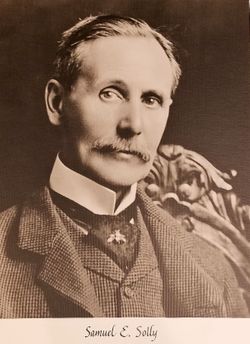
Dr Samuel Edwin Solly
Dr. Samuel E. Solly
from Find a Grave website
Dr.Samuel Edwin Solly moved from England to Manitou Springs shortly after the town was founded in the hope that the air would help cures the tuberculous he and his wife had contracted. His wife did not survive her illness, but Solly did.  After regaining his health he sang the praises of the area far and wide. The region quickly became a mecca for health seekers. Into the mix of these migratory people came a number of doctors. The area around the base of Pikes Peak, the easternmost 14,000-foot peak in the Colorado Rocky Mountain Range, grew from a population of 3,000 in 1873 to around 10,000 by 1879. Of the twenty-plus doctors who were in the area in 1879 three were the women listed above, Julia E Loomis, Esther B Holmes, and Harriett Leonard. Clara Rowe appears to have arrived in late 1879 just prior to the 1880 census.

By 1881 Colorado began licensing physicians, just a year after the death of Julia E Loomis.
Julia E Loomis was born in New Woodstock, New York. After her marriage to John C Loomis she and JC as he was known moved around a great deal. While in Iowa, her daughter died at twenty-one, about a year after her marriage. It was after her daughter's death that Julia went to medical school. Julia was around fifty-four years old when she attended the Cleveland Homeopathic College for Women in Cleveland, Ohio and obtained her M.D on February 24, 1870. By 1878 she was in Colorado Springs and working to set up a clinic for the treatment of consumption (TB). She passed away in 1880 from pneumonia. Her 'death certificate' was signed by doctor E.B. Holmes. 
.
Esther B. Holmes was born in Rhode Island and married in her mid-teens. Records indicate she also attended the Cleveland Homeopathic Medical College for Women. Dr. Holmes was one of the early doctors to receive her Colorado license, #387 in 1882. She continued to practice in Colorado Springs until her death in 1910 at the age of sixty-five and according to the family she was known as the 'baby' doctor. 

Soda Springs in Manitou Springs - 1870. Believe it or not, the big ...
Soda Springs in Manitou Springs prior to development 
The third doctor in the area was Harriet Leonard. In 1879 she was the proprietor of the Mineral Bath House in Manitou Springs. There she advertised Hot and Cold, Russian Vapor and The Electric Baths. She was a graduate of Keokuk College for Physicians and Surgeons in Keokuk, Iowa. The school came to Keokuk in late 1850 as a state-sponsored school and was a medical center until 1908 when it merged with Drake University in Des Moines, Iowa. The school was also one of the early co-ed medical schools in the nation. 

Clara Rowe, the wife of F.G. Rowe, a man involved in insurance and loans, was also a graduate of the same Cleveland school as Holmes and Loomis. Clara Rowe also was licensed in the state of Colorado, receiving her license in 1881. After her husband's death around 1890, she moved to California and died there.

Both female and male doctors continued to arrive in Colorado Springs, Manitou Springs, and Colorado City, as the area was one of opportunity for those who wanted to take the cure themselves while also caring and curing the sick.

For those who might like to know more, I have an article on Women Doctors in the Summer issue of 'Saddlebag Dispatches' Summer


Doris Gardner-McCraw -

Author, Speaker, Historian-specializing in
Colorado and Women's History
Angela Raines - author: Telling Stories Where Love & History Meet


Sunday, May 3, 2020

A REMEMBERING OF THE PAST

Post by Doris McCraw
writing as Angela Raines

View from the cemetery
Photo property of the author

One of the places I walk/hike is a cemetery close to my home. This past week I again walked by the headstone of Anna D. Chamberlain and remembered a post I'd written some time back. It reminded me how amazing she was, although like all females in the medical field in the early days, not much is known. I keep searching but wanted to share the story I wrote on her story again.


Her name is Anna D. Chamberlain. I initially found her in the 1896 Colorado Springs city directory listed with her husband Frank C. Chamberlain, also a dentist.  Their office was #12 in the bank building with a residence at 1451 N. Nevada Ave.

Anna was born in 1866 to John Shaw and Hellen B Shaw in Harlan, Page County, Iowa. Her father was from Ireland and her mother was born in Ohio. She married Frank in 1887 and they had three children by 1900. She died in 1914 at the age of forty-eight.

Cemetery in Fall
According to her obituary, she and her husband had been associated with dentistry since 1888. There are indications they practiced in Colorado Springs, Colorado City, and Manitou Springs.   She was one of the first women and in the first graduating class in the field from the University in Denver. Her husband was also an M.D. and received his license in 1892 although there is no mention of his pursuing this field in Colorado Springs. That would make sense since there were numerous physicians in the area. His brother Fred was a dentist in Cripple Creek in the 1890s and also ended up in Colorado Springs. On a side note, Fred married a woman named Anna B. 

Photo property of the author
In addition to a dental practice and raising three children, she was also active in the church and the WTCU (Women's Christian Temperance Union) and in the late 1890s was the president of the local organization of the WTCU.  She and her husband along with Wm. H. Dewey and Oscar J. Fullerton created the Fullerton Consumption Cure Company with an initial investment of $30,000. Colorado Springs was one of the meccas for those searching the cure for consumption, having clean air and lots of sunshine to mention a few of the reasons for people heading this way. Dr. Edwin Solly had traveled from England to the area with his wife seeking a cure. His wife passed, but he recovered. His writings and pamphlets at the beginning of the region probably helped in bringing invalids to the area. 

After her death her husband moved to California and remarried. After his death in 1928, his second wife returned his body to Colorado Springs. He is buried near Anna in Evergreen Cemetery.


Doris Gardner-McCraw -

Author, Speaker, Historian-specializing in
Colorado and Women's History
Angela Raines - author: Where Love & History Meet
Angela Raines FaceBook: Click Here

Sunday, February 3, 2019

MARY 'QUEEN' PALMER - FIRST LADY OF COLORADO SPRINGS #History #Women'sHistory


I return to the First Ladies Series with a piece written by my friend and Queen Palmer expert, Dianne Hartshorn.  If you wish to see the prior posts in this series, you can find them here:

Elizabeth McAllister
Cara Bell
Grace Greenwood

Lucy Maggard

Helen (Hunt) Jackson


Imagine you are a new bride of twenty one who finally received word from your husband to join him at your new home on the Colorado frontier. The reunion, however, is not at all you’d planned. Your dear husband is nowhere to be found; however, he did ask a business partner to meet you at the train. By the way, did I also mentioned, you were accompanied by your father, stepmother and several of your step-siblings? In addition, it's a March Spring day, which in the high desert plains where you’re new home is, usually means miserable snowy weather.

What would you do? Would you step back on that train and return home to your comfortable home in Flushing New York, or would you accept the challenge of the adventure?
Mary 'Queen' Lincoln Melon Palmer
as a young woman
Imagine asking yourself those questions. Mary Lincoln Mellon Palmer, who could be considered the First Lady of Colorado Springs, may have asked herself those very questions, as she stepped off the train at the Denver and Rio Grande Depot in March of 1871. It was a dismal spring day, snowing, cold and downright miserable. William Jackson Palmer, her husband, founder of Colorado Springs, the Denver and Rio Grande Railroad, and responsible for a great deal of development of Colorado's front range, was nowhere around. He had been detained on a survey expedition in the mountains. Most young ladies might have purchased a return ticket home, but not our Queen.


Mary Lincoln Mellon was born March 24, 1850, in Prestonsburg KY. to William and Isabel Clark Mellon. Isabel’s parents, Charlotte and Nathan Clark were pioneers on the Minnesota Frontier. The story is, Isabel’s sister, Charlotte, was the first white child born in MN.

Charlotte, Mary’s grandmother, is the one to bestow the nickname ‘Queen’ to Mary while still a child. Isabel, unlike her mother Charlotte, did not inherit that strong pioneer constitution. When “Queen’ was only four, her mother, Isabel, died at the age of twenty-five. When Isabel’s husband, William, remarried it was to Isabel’s younger sister, Charlotte. Through this union, Queen was blessed with seven step-brothers and sisters.

Queen’s father, a prominent player in Washington politics, served as an agent for the treasury department during the Civil War. When the war ended, Mr. Mellon traveled a great deal seeking investment opportunities. As the eldest child, Queen would accompany her father on many of these business trips. One on particular trip, she and her father made the acquaintance of the charming and dashing Civil War hero, and empire builder, William Jackson Palmer. The two fell in love and married a year later.

Pikes Peak in the Springtime
photo property of Doris McCraw
It was an exciting time for those involved in building the Fountain Colony, associated with the now Colorado Springs, located at the foot of Pikes Peak. Queen understood how important her role was, not only to her husband’s dream, but to the community as well.
Queen’s father, Mr. Mellon, was also an intricate part of the expansion of the Denver and Rio Grande Railroad. He was deeply involved in the establishment of South Pueblo, in addition to being a significant investor in Palmer’s Denver and Rio Grande Railroad.


Queen didn’t wait for things to happen, she made things happen. She’d had the opportunity of a good education and realized the success of the colony depended on its children, and their education. She started the first school, serving as its first teacher. The family lived in a beautiful estate nestled in the canons off of Camp Creek about an hour from the new town. So each school day was a two hour trip for Queen, which she gladly did.


She also worked tirelessly along with other women in the new colony. She was aided by the energy of Rose Kingsley, a friend from England. Rose's brother Maurice served as the treasurer for the Colorado Springs Land Company. Together, Queen and Rose, would put on concerts and other entertaining events to bolster the spirits of the colony’s inhabitants. She encouraged the donation of books for the colony’s reading room. One of the donors was author, Helen Hunt Jackson. Queen was also responsible for the first Christmas party.

Garden of the Gods- Near Queen's Canhon
Photo property of Doris McCraw

As you can see, Queen had a zest for life. She enjoyed sharing the beauty of the region by escorting guests on hikes and carriage rides. Many of these trips included Queen’s Canyon, Manitou Springs, and the nearby vicinity.


In early 1872, she and Rose Kingsley accompanied General Palmer and other gentlemen into the wild’s of Mexico. It was just prior to this trip that Queen learned she was expecting their first child.


Like her mother, Queen also did not inherit the strength of her pioneering grandmother. She suffered her first heart attack at the age of thirty, on a return trip from Leadville, CO. It was several months later that the Palmer’s welcomed their second child.


In the hope of regaining her health, Queen moved to England. She wanted to watch her daughters grow into young women. General Palmer frequently visited England, to see his wife and their three daughters. Despite her wish to live in the town she helped create, and to watch her daughter grow to young women, it was not to be. In December of 1894, shortly after Christmas, Queen died. She was only forty-four years old.


Doris Gardner-McCraw -
Author, Speaker, Historian-specializing in

Colorado and Women's History
Angela Raines - author: Where Love & History Meet
For a list of Angela Raines Books: Here 
Photo and Poem: Click Here 
Angela Raines FaceBook: Click Here


Sunday, December 2, 2018

First Ladies of the Pikes Peak Region - Helen (Hunt) Jackson #history #writing

View of Pikes Peak covered in clouds
photo (c) by rhe author
The next lady in the series is one many people know: Helen (Hunt) Jackson. Since there is a great deal of information on this lady, this post will cover an 'interview' and information about the writing of the book "Ramona" near the end of her life.

For information on the early ladies in the series:
Elizabeth McAllister
Cara Bell

Grace Greenwood

Lucy Maggard


Image result for images of Helen Hunt jackson
Helen (Hunt) Jackson from Wikipedia
First an 'interview':


As you were traveling to the west you made some unique observations. Would you share some of those thoughts?

Prairie, unfenced, undivided, unmeasured, unmarked, save by the different tints of different growths of grass or grain; great droves of cattle grazing here and there; acres of willow saplings, pale yellowish green; and solitary trees, which look like hermits in a wilderness. These, and now and then a shapeless village, which looks even lonelier than the empty loneliness by which it is surrounded, - these are all for hours and hours. We think, “now we are getting out into the great spaces.” “This is what the word ‘West’ has sounded like.”

You seem to like the lower elevations as opposed to the high peaks. Why do you think that?

I think that true delight, true realization, of the gracious, tender, unutterable beauty of the earth and all created things are to be found in outlooks from lower points—vistas which shut more than they show, sweet and unexpected revealings in level places and valley, secrets of near woods, and glories of every-day paths.

You are quoted as saying there are nine places of worship in Colorado Springs. What are the?

There are nine “places of divine worship” in Colorado Springs, -- the Presbyterian, the Cumberland Presbyterian, the Methodist, the South Methodist, the Episcopal, the Congregationalist, the Baptist, the Unitarian, and Cheyenne Canyon.

Helen Hunt Falls -North Cheyenne Canyon
Photo (c) by author 
What do you do when the snow covers the ground?

... winter..... memory and fancy will have their way; and, as we sit cowering over fires, and the snow piles up outside our window sills, we shall gaze dreamily into the glowing coals, and, living the summer over again, shall recall it in a minuteness of joy, for summer days were too short and summer light too strong. Then, when joy becomes reverie, and reverie takes shape, a truer record can be written....

Ruth Odell wrote one of the early biographies of Helen. It was published in 1939. Her book talks about the writing of "Ramona" and the end of Helen's life. I share some of that with you here:

According to Odell, Helen wrote Ramona in New York between Dec, 1883 and April 1884.

1883-1884

Berkeley Hotel, New York

Wrote first words of Ramona on Dec. 1, 1883

Pg 210-211 of the book says:

"The novel which Helen hoped so ardently would “tell” in a manner in which A Century of Dishonor had not was written with lightening speed. She was frightened at the intensity of her own interest, which drove her to compose at the rate of from two to three thousand words in a day. It was as if she were haunted and obsessed. So loath was she to stop writing that her concentration resulted in two serious attacks of illness. …..From time to time she drove herself to write a short story, an article....but with the feeling always that she was suffering an actual deprivation in having to turn away from the thing she wished to be doing.....By late February she had finished twenty chapters."

Below is a timeline of the release of the book.

April 12 of 1884  the 'Critic' announced that Mrs. Helen Jackson would soon publish the first long novel under her own name.

May 1, 1884 'The Christian Union' noted that it would begin in a fortnight a serial presentation of the novel Ramona.

On a side note, "Ramona" has had at least 300 printings since that date.

Time line of Helen's last months

June 28, 1884 Helen broke her hip. The fall of 1884 she went to CA .

By Feb 1885 she became seriously ill of what she believed to be “malarial poisoning”.

From Page 212 of the Odell book:

When she could no longer postpone it, the doctor sent a telegram to her husband, who arrived Aug 2. Ten days later the end came. Subsequent dispatches gave the cause of her death as cancer. Fortunately she had not known.

Evergreen Cemetery Colorado Springs
Photo (c) by the author
Helen made her home in Colorado Springs from 1873 to her death in 1885. She supported the growth of the new town, wrote glowing articles and even supported reading and libraries. Her final resting place is in Evergreen Cemetery next to her second husband William S. Jackson.


Doris Gardner-McCraw -
Author, Speaker, Historian-specializing in
Colorado and Women's History

Angela Raines - author: Where Love & History Meet
For a list of Angela Raines Books: Here 
Photo and Poem: Click Here 
Angela Raines FaceBook: Click Here

Sunday, October 7, 2018

Grace Greenwood - Honorary First Lady of the Pikes Peak Region #PrairieRosePub


As part of an ongoing series about early women in the Pikes Peak Region, October's post is about Grace Greenwood.

To read others post in this series:
Elizabeth McAllister
Cara Bell

Unlike the first two ladies in the series, 'Grace Greenwood' only lived in the area a short time, but her writings sang the praises of Colorado and the Pikes Peak area. But who was 'Grace Greenwood'?

Image result for images of grace greenwood
Image from Wikipedia
Grace Greenwood was the pen name for Sara Jane Lippincott. On September 23, 1823, Sara Jane Clarke was born to Deborah and Dr. Thaddeus Clarke in Pompey, New York. She went to school in Rochester, New York and later moved to Brighton, Pennsylvania with her family.

From an early age, Sara wrote and submitted poems and sketches, and had her first piece of prose published when she was twenty. Like others of her time she used a pen name. Once she started using the name Grace Greenwood, it became who she was. Even friends started calling her by the name Grace.

According the Inez Hunt and Wanetta Draper in their book "Colorado's Restless Ghost" Sara was "Exuberant and self-sufficient in an era when frailty was the fashion. Grace [Sara] grew too tall, was too vital, and too clever. She simply didn't fit her time nor her place; she outgrew them all."

Marrying late in life to Leander K. Lippincott, the couple had one child which they named Ann.While Grace traveled about with their daughter, Leander stayed behind. In 1876 he was indicted for land fraud and fled the country.

Image result for grace greenwood cottage manitou springs colorado
Image from Wikimedia Commons
Grace first came to Colorado in the early 1870s and it was noted in the 'Colorado Magazine' of September 1871, "Grace Greenwood is one of the literary attractions in Denver. She is here on a visiting, lecturing and observation tour, is corresponding for the New York Times and writing up the country in her most graceful style.''  After a visit to Colorado Springs and Manitou Springs she purchased land in the latter town in 1873 and set about having a cottage built for her . While the 'cottage' was being built she stayed with relatives, the Mellons, and enjoyed the company of the town leaders. After moving in, there was an attempted burglary but Grace took her Italian stiletto and went in hot pursuit. After the incident the following appeared in the local paper:
             
          We now give warning to all gentlemen of burglarious proclivities that a good and gallant friend having provided us with a six shooter, we intend to practice diligently with it, firing promiscuously from our balconies o'nights. I am not Mrs. J.B. Lippincott, and haven't any diamonds, our silver is plated, our money in the bank if we haven't over-drawn...I intend setting the shrubbery full of steel traps...no use for them to call again at Clematis Cottage [the name she gave her home] and may be slightly dangerous. P.S. another friend has lent us a brindle-bull terrier--very powerful.

Grace traveled, wrote, lectured and pursued many different causes in her lifetime. She lived in Europe for a time in the 1880s and wrote a a biography of Queen Victoria while there. She died at the home of her daughter on April 20, 1904 at the age of eighty-one.

In the end this woman who championed prison reform, woman's rights, the end of the death penalty and was staunchly anti-slavery, is little known today. To quote the Hunt/Draper book "Her brilliant flash across the Colorado skies had been meteoric and spectacular, but her flame burned out quickly and left no trace." Perhaps it is time to remember the Honorary First Lady of the Pikes Peak Region. 


Doris Gardner-McCraw -
Author, Speaker, Historian-specializing in
Colorado and Women's History
Member of National League of American Pen Women,
Women Writing the West,
Pikes Peak Posse of the Westerners

Angela Raines - author: Where Love & History Meet
For a list of Angela Raines Books: Here 
Photo and Poem: Click Here 
Angela Raines FaceBook: Click Here


Sunday, August 5, 2018

REMEMBERING THE LADIES: Elizabeth McAllister #PrairieRosePublications #Women'sHistory


"Remember the Ladies, and be more generous and favourable to them than your ancestors." Letter from Abigail Adams to John Adams, 31 March - 5 April 1776.

In a similar vein, the Uppity Women Series by Vicki Leon, Remembers the Ladies. For those who haven't read any of her work, she digs up women from history, giving us a glimpse of  who they were and the world they lived in.


Abigail Adams and Vicki Leon both encourage us to Remember the Ladies. Over the next few posts, I hope to remember the ladies who helped settle the Pikes Peak Region. Some are known, such as Helen (Hunt) Jackson and Queen Palmer. Others, such as Ann (Annie) France, Cara Bell and Mother Maggard have not had much press. With luck, that will be remedied. In this post, I will focus on Elizabeth McAllister.


Who was Elizabeth McAllister? Elizabeth was the wife of Major Henry McAllister. Major McAllister had served in the Civil War with and was a friend of the named founder of Colorado Springs, General William Jackson Palmer. Major McAllister and Elizabeth were also Quakers, like Palmer. Henry brought Elizabeth and their young son to the area in the spring of 1873 when the town was barely two years old.


Image result for images of Elizabeth McAllister
McAllister House Museum Mrs. Elizabeth McAllister approx. age 60

According to the McAllister Family Bible, Elizabeth was born January 23, 1836 in Haverford, PA. to Townsend and Mary Cooper. She married Henry in 1866. Their ceremony was performed by the mayor of Philadelphia in his office.

A son Henry was born in Pennsylvania, but died early. Another son followed who was also named Henry (whom they called Harry). After arriving in Colorado there were two more children, Mary and Matilda, the last born in 1876 when Elizabeth was around forty years of age. One reference stated her stature was so tiny a modern ten year old would barely be able to button the silk basque she wore. (A basque, for those who wonder, is a close fitting bodice or jacket that extended past the waist to or over the hips.)


The family rented rooms in the Colorado Springs Hotel, moving to one of the nearby portable houses that had been shipped in from Chicago, until their home on Cascade Ave. was built.Because of the winds in Colorado Springs, which can topple narrow gage trains, McAllister had his walls built about twenty inches thick and attached the roof  to the masonry with numerous two inch rods. He wanted his wife and family to be safe if he were not there.  It was purchase in the 1960s by the Society of Colonial Dames in order to preserve its history. It is now considered the first house of substance that was built in Colorado Springs and is on the National Register of Historic Places one hundred years after is was built.

McAllister House today, Photo (c) by Doris McCraw
What is written about Elizabeth is her kindness. She often gifted bread to the covered wagon pioneers traveling through the city. She also did the same for the passing Indians. Remember that the settlers and Indians were not always on good terms during the early days of the city.

One incident that Major McAllister wrote of concerned the Indians and Governor of the Colorado Territory, A. C. Hunt in 1874. McAllister had invited the Governor into his home, and while there approximately  thirty Indians, who were camped north of town, surrounded the house. They peered through the windows at the people inside. While it made the inhabitants uncomfortable, they merely wished to meet and speak with the Governor. He went out, spoke with them, and they returned to their camp.

While not much is written in the newspapers, we do know in March of 1881, Elizabeth transferred property with an estate value of $2,000 to a Q.A. Gillmore. This was not as uncommon as most might believe. There are numerous reports of property transfers that involved women in the city.

Elizabeth McAllister- Evergreen Cemetery, Photo (c) by Doris McCraw
Elizabeth passed away in May of 1912, at the age of 76.

As you wander through the pages of history, Remember the Ladies, for without them history would be incomplete.

Bibliography: Henry McAllister, Colorado Pioneer by Polly King Ruhtenberg & Dorothy E. Smith
                       Colorado Springs Gazette
                       History of McAllister House


Doris Gardner-McCraw -
Author, Speaker, Historian-specializing in
Colorado and Women's History
Member of National League of American Pen Women,
Women Writing the West,
Pikes Peak Posse of the Westerners

Angela Raines - author: Where Love & History Meet
For a list of Angela Raines Books: Here 
Photo and Poem: Click Here 
Angela Raines FaceBook: Click Here