Post by
Doris McCraw
writing as Angela Raines

The remedies listed below were taken from a book written in 1847 on the treatment of injuries and illnesses.
If
you were suffering from asthma you might be treated with skunk
cabbage root, taken as a syrup or dried, and smoked through a pipe.
Earaches might be treated with the heart of a roasted onion placed in
the ear. Toothaches, how about a pill composed of camphor and opium
placed in the tooth, or if really bad, pulled by whoever was
available.
If
you were bitten by a rattlesnake you might drink a half a glass of
olive oil, and apply some to the site of the bite.
Childbirth
had either a female neighbor or if lucky a mid-wife present. Of
course, if neither of those was available it became an individual or
at most a family affair. The common practice of laying in, that is
remaining in the birth bed, no clean sheets, etc. was not always
practical for the woman in the West. Usually, there was too much to do
to just lay around, so these hearty women were up an about more
quickly than their Eastern counterparts.
 |
| One of the Mineral Springs located in the town of Manitou Springs |
In the 1800s there were three types of doctors. Most practiced
homeopathic medicine which started in the 1790s, a few practiced
allopathic medicines which started or were given the name in the early
1800's and a few were osteopaths, which came into being around 1874.
In the Pikes Peak Region, most early doctors practiced homeopathy.
This included three of the four women who were practicing in the area prior to
1880. They were Julie E Loomis, Esther B Holmes, and Clara (Clararbel) Rowe. The fourth, Harriett Leonard was an allopath.
By
the 1870's Colorado was known not only for the gold and silver they
were pulling out of the mountains, but also an area for invalids to
come to recover. Before then the area was a place of businesses,
ranching, and some farming, some in remote areas. The early days
didn't have the medical doctors that began arriving in the 1870s.
Instead, most folks did their own doctoring or called a mid-wife,
using some of the above remedies.
It
the mid-1800's hygiene and sanitation made their way into the medical
field. Prior to and even during the War Between the States, many
doctors still did not clean their instruments or hands between
surgeries or seeing patients. Once it became standard practice the
mortality rate fell, but it wasn't until the 1920's that antibiotics
came into use.
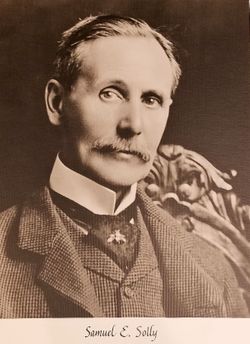 |
| Dr. Samuel E. Solly from Find a Grave website |
Dr.Samuel Edwin Solly
moved from England to Manitou Springs shortly after the town was founded in the hope
that the air would help cures the tuberculous he and his wife had contracted. His wife did not survive her illness, but Solly did. After regaining his health he sang the praises of the area far
and wide. The region quickly became a mecca for health seekers. Into
the mix of these migratory people came a number of doctors. The area
around the base of Pikes Peak, the easternmost 14,000-foot peak in
the Colorado Rocky Mountain Range, grew from a population of 3,000
in 1873 to around 10,000 by 1879. Of the twenty-plus doctors who were
in the area in 1879 three were the women listed above, Julia E
Loomis, Esther B Holmes, and Harriett Leonard. Clara Rowe appears to
have arrived in late 1879 just prior to the 1880 census.
By 1881
Colorado began licensing physicians, just a year after the death of
Julia E Loomis.
Julia
E Loomis was born in New Woodstock, New York. After her marriage to
John C Loomis she and JC as he was known moved around a great deal.
While in Iowa, her daughter died at twenty-one, about a year after
her marriage. It was after her daughter's death that Julia went to
medical school. Julia was around fifty-four years old when she
attended the Cleveland Homeopathic College for Women in Cleveland,
Ohio and obtained her M.D on February 24, 1870. By 1878 she was in
Colorado Springs and working to set up a clinic for the treatment of
consumption (TB). She passed away in 1880 from pneumonia. Her 'death
certificate' was signed by doctor E.B. Holmes.
.
Esther
B. Holmes was born in Rhode Island and married in her mid-teens.
Records indicate she also attended the Cleveland Homeopathic
Medical College for Women. Dr. Holmes was one of the early doctors to
receive her Colorado license, #387 in 1882. She continued
to practice in Colorado Springs until her death in 1910 at the age of
sixty-five and according to the family she was known as the 'baby'
doctor.
 |
| Soda Springs in Manitou Springs prior to development |
The third doctor in the area was Harriet Leonard. In 1879 she was the
proprietor of the Mineral Bath House in Manitou Springs. There she
advertised Hot and Cold, Russian Vapor and The Electric Baths. She
was a graduate of Keokuk College for Physicians and Surgeons in Keokuk, Iowa. The school came to Keokuk in late 1850 as a state-sponsored school and was a medical center until 1908 when it merged
with Drake University in Des Moines, Iowa. The school was also one of
the early co-ed medical schools in the nation.
Clara
Rowe, the wife of F.G. Rowe, a man involved in insurance and loans, was also a graduate of the same Cleveland school
as Holmes and Loomis. Clara Rowe also was licensed in the state of
Colorado, receiving her license in 1881. After her husband's death
around 1890, she moved to California and died there.
Both female and male doctors continued to arrive in Colorado Springs, Manitou Springs, and
Colorado City, as the area was one of opportunity for
those who wanted to take the cure themselves while also caring and curing the sick.
For those who might like to know more, I have an article on Women Doctors in the Summer issue of 'Saddlebag Dispatches' Summer
Doris Gardner-McCraw -
Author, Speaker, Historian-specializing in
Colorado and Women's History
Colorado and Women's History
Angela Raines - author: Telling Stories Where Love & History Meet
