Search This Blog

Tuesday, December 15, 2015

Pray, Feast, Give

I’m often asked what medieval Christmases were like, which is a hard question to answer. Just as Christmas celebrations in 1815 were very different than our present-day festivities, the holidays in 953 vs. 1153 vs. 1353 were just different from each other. Early Christmas celebrations were marked by piety, prayer, and religious services. By the 10th century, Dec. 25th had become known as Christes Maesse. Feasting and gift giving were established customs, but our medieval counterparts still attended three masses on Christmas day.


And though the birth of a child was at the center of celebrations, children were not focus of holiday festivities as they are now.

In fact, aside from the rare “boy bishop,” children were seldom the center of anything medieval, leading many some historians to speculate that “childhood” didn’t exist in the Middle Ages and medieval parents didn’t bond with their children until they were fairly certain the child would reach adulthood.

The conclusion is not without merit. Estimates for child mortality rates in the Middle Ages are between 30 percent and 50 percent (compared to 4.38 percent in 2015 in the UK).  Additionally, some historians postulate the high rate of infant mortality was indicative of a lack of interest in a child’s welfare, the parents’ inability to provide proper care, or out-and-out infanticide.

One example often cited to support this theory about lack of interest is the statement made by William Marshal’s father made when he broke his treaty with King Stephen. William Marshal was a hostage in the king's court to guarantee the elder Marshal’s good behavior. “Do with him what you will,” the father allegedly said when reminded that his actions endangered his son. That Stephen didn’t hang the boy was considered a failing by his nobles.

But this example tells us more about the Marshal than it does about medieval childrearing. If parents didn’t care for their children, using a child as hostage to make parents behave is pointless. In fact, when Henry I (King Stephen’s predecessor) allowed his two granddaughters to be mutilated in a hostage situation, his daughter Juliane drew a crossbow and attempted to assassinate her father in revenge. (Does that sound like a mother who doesn’t care about her daughters?)

But I digress (a common habit). Getting back to Christmas celebrations... Children and adults received presents on 12th Night—the Feast of the Three Kings—in honor of the Three Wise Men who brought gifts to Jesus. By the end of the Middle Ages, Protestants removed the saints' days from the calendar and our gift-giving tradition moved to Christmas.

Not to ignore 2000 years of tradition, I will give away a copy of ANAM CARA to one commentator on the blog. Merry Christmas.

Keena Kincaid writes historical romances in which passion, magic and treachery collide to create unforgettable stories. You can find out more about her books at: http://prairierosepublications.com


Monday, December 14, 2015

MERRY almost CHRISTMAS


This is the first year in recent memory that has me approaching Christmas with my gift-buying complete. Of course, if I don’t get the gifts wrapped and mailed, all my “early” will disappear like last year’s eggnog.

Every Christmas is different--but every one is the same. For me, Christmas is memories of midnight church services with a hundred voices singing Silent Night by candlelight; playing the flute with my mother at the organ; with champagne and fudge at home afterward, celebrating the joy of Christmas. We still welcome Christmas this way, from our candlelight service with Silent Night to gathering with the family afterward.

As I write stories set in the Old West, I think about how our ancestors celebrated Christmas. Alone on a patch of ground, the nearest neighbor a mile or more away, with work that must be done regardless of the holiday, did Christmas become just another day? How did the mother of five add all the holiday baking and decorating and gift making to her already too busy schedule?

Pioneers and soldiers in remote forts decorated their homes with what was at hand: evergreens, pinecones, holly, nuts and berries, popcorn or paper strings, and homemade decorations like dolls made of straw or yarn; cookie dough ornaments and gingerbread men. Women would start their holiday baking weeks ahead of time. Gifts were homemade, things like sachets from the roses, carved wooden toys, embroidered handkerchiefs, and knitted hats, scarves and socks.

In my short story, Her Christmas Wish, my heroine, Katie, kept her family traditions alive by making the special foods of her childhood.

What about you? What traditions do you have that mean Christmas to you?

Saturday, December 12, 2015

A few little Christmas snippets.

Brought to you by - The English Rose.

Hello fellow Roses. 

I don’t have an up-coming release to tell you about, I’m sorry, but I have seen some really good ones coming up, lots more to add to the TBR list. You ladies are such prolific writers! I really need to get my finger out. As this is the season of good cheer, I thought I would just share my very personal views of this time of year with you.

Here in UK, people have been filling their windows with Christmas decorations since the beginning of November. There is a craft channel on tv which even has a Christmas in July spot, and each week after that they are selling Christmas items for crafters!
I sometimes wonder just exactly why people think they are decorating their houses and shops? And why on earth over such a long period? I saw something last week which really tickled me, it was a picture of a grumpy looking Santa and the caption was ‘There are twelve days of Christmas and none of them are in November.” Hear, hear!


Why do people decorate for so long before the 12 days? It’s a puzzle to me. My own decorations go up on Christmas Eve, and come down before twelfth night. No, I’m not a Scrooge, I actually started doing that when my daughter was tiny, for no other reason than that I wanted her to recognize the magic of the moment, so despite everywhere else being decked out, I put our decorations up whilst she was asleep on Christmas Eve, so that when she woke up in the morning the place was filled with warmth, color, glitter, balloons and good food.  
We had a large open fire then, so we would get up early and light it, and place a huge ‘Yule Log’ on it, which we tried to keep burning for as many days as we could, (I don’t think we ever managed a full 12 days though.) The look on her little face those first few years was totally priceless. I can never forget it. Of course as she grew older and realized what was happening she started to decorate her own room with my spare decorations a long time before Christmas Eve, but I kept to my own personal tradition. And still do, for the grandchildren, except I don’t have an open fire any more, so the poor old Yule log has had to give way to a few candles and a gas fire!


When I think about it, my way of doing it is closer to the original ’12 days of Christmas’ than most people’s, in reality within the Western Church, the 12 days actually begin on December 25th and end on January 5th, the beginning of Epiphany (when the Magi brought the gifts to the baby, if that is your belief.)

Our tradition of giving gifts on Christmas Day actually seems to come from a festival of Pagan days named Saturnalia where people gave gifts in honor of the ones who had died during that year. They would exchange ‘lucky fruits’ and have a big feast, as we still do today.
Holly and mistletoe were Pagan and Druid symbols of fertility and the colorful lights we decorate everything with are descended from the Pagan ritual of lighting fires and candles to chase away the darkness of winter and bring back the sun.
The star on top of the tree is not a Star of David, in fact it is two triangles, which represent the perfect union between male and female into one entity. The upturned triangle represents the male, whilst the downturned one is the female. We place a fairy or angel on our trees because, traditionally, fairies and angels are supposed to grant wishes.


Santa Claus/Father Christmas/Kris Kringle (and many other aliases) is a very old tradition indeed, it can be actually dated right back to a monk who was born into a noble family in Turkey, around 280 AD. He gave away all his vast inherited wealth and travelled the country helping the sick and poor. In one town he is supposed to have saved three sisters from being sold into slavery by their father, by giving them all a good dowry so they could be married. He later became known as the protector of children and sailors. He died on December 6th which was then considered a very lucky day to get married.

Now here’s a shock, I have only just found out that Rudolf the red nosed reindeer was actually born in 1939 in America! A copywriter named Robert L May, who worked for the Montgomery Ward department store wrote the story to try and drive custom to the store, in that year, he sold almost two and a half million copies of his book and since then, it has been translated into twenty-five languages (we can only wish on our fairies for figures like that, eh ladies?)

                                  Here's a beautiful Christmas Rose for all you lovely Roses.


Well, I don’t want to keep you all from your tree decorating and mince pie eating, so I’ll go now, wishing you all a peaceful, healthy and happy holiday time, whatever your persuasion, and a very good New Year.  Catch you all on the other side!

Wednesday, December 9, 2015

Remembering Marty Robbins by Kaye Spencer

Yesterday, December 8th, 2015 marked the 33rd anniversary of Marty Robbins’ death. He’d suffered his third serious heart attack a few days prior, but he didn’t survive the surgery to repair the damage. I recall clearly where I was when I heard of his death. I was living in Cleveland, Ohio and running thoroughbred race horses at Thistledown Racetrack when I heard it on the radio. The DJ broke down and cried. I cried along with him.

Martin David Robbins was born in Glendale, Arizona on September 26, 1925. When WWII broke out, Marty joined the Navy. While serving, he taught himself to play the guitar. When the war was over, Marty returned home and embarked upon a singing and performing career around Phoenix in nightclubs, on the radio, and on television.

During his early club-playing and performing days, “…he heard a country singer featured on the local radio station KPHO. [Marty] was convinced that he could do better. He drove right down to the station and earned a place on the show.”

By the end of the 1940s, Marty had his own radio program, “Chuck Wagon Time”, and a television show, “Western Caravan”. By the mid-1950s, he was invited to the Grand Ole Opry radio show and was a regular performer for many years. He signed with Columbia Records in 1951 with his first Number 1 song coming in 1956: “Singing the Blues”. “El Paso” released in 1959, and it garnered him his first Grammy Award. With the 1960s came, he pursued racing with such a passion that he progressed to NASCAR racing. It was in 1969 that he suffered his first heart attack. He recovered quickly and wrote, “My Woman, My Woman, My Wife”, which earned him his second Grammy. His second heart attack occurred in 1981.

Marty was inducted into the Country Music Hall of Fame in 1982. His last song was a single that same year—“Some Memories Just Won’t Die”—a bittersweet irony. Over the span of his career, he recorded over 500 songs and 60 albums.

When he was growing up, Marty wanted to be a cowboy singer like Gene Autry, and he credits his grandfather, “Texas Bob Heckle”, a traveling medicine show salesman and story-teller, as the main inspiration for many of the songs he wrote later. In an interview, Marty said, “…I’ve done what I wanted to do… I’m not a real good musician, but I can write [a song] pretty well. I experiment once in a while to see what I can do. I find out the best I can do is stay with ballads.”

When I was growing up and listening to Marty’s music, I wore out at least two 45 rpms of “El Paso” on Side A and “Strawberry Roan/160 Acres” on Side B. Marty’s gunfighter ballads influenced my love of the Old West.

He was (still is) so influential to my writing that my upcoming early-2016 release with Prairie Rose Publications, “The Comanchero’s Bride”, was inspired by his song, “Meet Me Tonight in Laredo”. My story was originally published years ago as a novella that I rewrote and expanded to novel length. I think of this book as my little way of paying tribute to Marty and how much his gunfighter ballads meant to me. I sprinkled hints to many of his gunfighter songs throughout the story.

Since the release day for “The Comanchero’s Bride” hasn’t been finalized, I'll hold off sharing the cover, blurb, and excerpt until the official 'unveiling', but I will share this video for your Marty Robbins listening pleasure.


References:
http://www.biography.com/people/marty-robbins-20651271
http://www.martyrobbins.com
http://www.cmt.com/artists/marty-robbins/biography/

Until next time,

Kaye

Writing the West one romance at a time
www.kayespencer.com


Amazon.com

Tuesday, December 8, 2015

Rattlesnakes

By Kristy McCaffrey

I live near open desert north of the Phoenix metropolitan area in Arizona and we have frequent interactions with rattlesnakes. I thought I’d share a few pictures with you all and perhaps dispel a few myths.

A baby rattler we found near a water puddle beside our house during a hot
summer morning. They sometimes look like a cow patty when sitting
in the dirt. My husband captured it to show our children, then we
released the little guy.

We have Western diamondback rattlers. Their distinguishing feature is a series of black and white rings on the tail. This has helped me to quickly identify a snake I encounter, since bull snakes appear almost identical in markings but aren’t poisonous. Western diamondbacks aren’t aggressive unless cornered and will try to escape you at the first possible opportunity. However, when we find them on our property we do capture and relocate the reptiles since we have dogs.

We found this one buried in our backyard garden.

One myth is that snakes hibernate. We’ve not found this to be the case. In colder weather, they are less mobile but we’ve nevertheless seen them. If we’re in the desert, these encounters are benign because the snake is too cold to coil and can’t strike. But if the snake is near our house—usually resting against a wall to get warm—they can be a bit more feisty.

Rattlesnakes are pit vipers. They have a heat sensing pit located behind each nostril that can detect temperature differences, sometimes only a fraction of a degree apart. The heat given off by an animal can be sensed by the snake to determine if it is predator or prey. In captivity, they can live as long as 20 years. Their main source of food is mice, rabbits, lizards, gophers and other small animals.

Once we begin handling them, they usually get quite mad.

Another myth dispelled—you can tell the age of a rattlesnake by counting the number of rattles it has. Each time a snake sheds its skin, a new rattle is added. However, these can break off. Also, the frequency of shedding varies from snake to snake, so counting rattles isn’t a reliable way to confirm age.

How do we capture such a strong and dangerous creature? My husband uses a long stick with tongs at the end. He wrangles the snake, then lifts it into a tall garbage can with a tight lid. In the past, we've loaded the can into our truck, driven several miles away, and let the snake go while remaining in the truck bed to avoid it slithering toward us. But we’ve recently learned that this can be a death sentence for the rattler because it will be unable to find its water source. We now transport the snakes about a mile away, but still within their territory.

My husband grabs the snake with a snake catcher and deposits him into a
tall garbage can with a tight lid.
There's a snake inside there. We're trying to coax it to leave
and escape to the desert.
When trying to wrangle a snake, it's best to clasp as close to the head
as possible to avoid the snake striking.
Snakes will flatten their body (as seen here) as a means of escape. It was a cold
November night when we found this rather large rattler against our
garage door trying to get warm.
My husband trying to stay as far away from the snake as possible!
We released this one from the bed of our truck.

I’m sure you’re wondering—why don’t we kill them? Many of our neighbors do. While they aren’t my favorite desert critter to encounter, they do have every right to be here. Moving them from our property allows my husband and I to honor their presence as an important link in the desert ecosystem.

A western diamondback rattlesnake.
********
Looking for a short read this holiday season? These novellas are only 99 cents.


Connect with Kristy


Monday, December 7, 2015

SHARING CULTURE THROUGH TALES AND MYTHOLOGY..... BY Gail L. Jenner


Yurok Tales

With a degree in anthropology, I've always found it fascinating to study the tales and mythology of other cultures. I thought perhaps I'd share a couple regional tales here. These are tales from the Yurok who live along the northwestern coast of California, along the lower Klamath River.  These enterprising people lived in and around the great redwood forests and along the coast.

"Yurok" actually means "downriver" -- which came from the language of the Karuk who are the Yurok's inland neighbors. Today the Yurok are the largest tribe in California. Sadly, as in the case of so many many tribes across California and the nation, the Yurok were attacked by the miners and settlers who rushed west. 

Indeed, a little known fact reveals that more than 90% of the native tribes of California were killed or died from disease during the 19th century.

As writers, looking to myths and historical tales can provide inspiration as well as insight into cultural traditions. Since many historical romance writers find incorporating Native American heroes or characters into their stories, that's all the more reason for those doing historical research into a tribe's important mythology.

One of the most important ethnographers and anthropologists to study the various California tribes, and, in particular, the Yurok, was Professor A. L. Kroeber.  He collected the tales and stories told by the Yurok during the early part of the 20th century. A professor at UC Berkeley, these writings are an important collection and continue to give writers, historians, and readers a real glimpse into the lives and culture of this important coastal nation.

The tales Kroeber related were called tales of the woge [woe-gee] times -- that time when mythological heroes lived on earth.

This first tale was related by Johnny Shortman, who was born circa 1840, and related a story about why payment had to be made whenever a killing occurred. This is what he said:   
                They [the woge] made it that when a man kills a person, he pays for him. And if the one that killed the other has a sister, he must also give her as part of the payment. And if he who was killed has relatives, one of those relatives will marry the sister. As a result, any children will be like those of the “man killed”, and it will be as if he were alive again. They do this because the woge left these instructions “that everything might go well.” 
                And if they do not pay, it was believed that others would think to themselves,“I, too, will kill.” But since they must pay, everyone is afraid. “Therefore few kill.”

*******
Here's another tale:
How Thunder and Earthquake Made Ocean

Thunder lived at Sumig. One day he said, “How shall the people live there is just prairie there? Let us place the ocean there.” He said to Earthquake, “I want to have water there, there so that the people may live. Otherwise they will have nothing to live on.” He said to Earthquake, “What do you think?”
Earthquake thought. “That is true,” he said. “There should be water there. Far off I see it. I see the water. It is at Opis. There are salmon there and water.”

“Go,” said Thunder. “Go with Kingfisher, the one who sits there by the water. Go and get water at Opis. Get water that is to come here.”

Then the two of them went. Kingfisher and Earthquake went
to see the water. They went to get the water at Opis. They had
two abalone shells that Thunder had given to them.
“Take these shells,” Thunder had said. “Collect the water in them.”

First Kingfisher and Earthquake went to the north end of the world.
There Earthquake looked around. “This will be easy,” he said.
“It will be easy for me to sink the land.” Then Earthquake ran around.
He ran around and the ground sank. It sank there at the north end of the world.
Then Kingfisher and Earthquake started for Opis. They went to the place at the end of the water. They made the ground sink behind them as they went. At the Opis they saw all kinds of animals and fish that could be eaten there in the water at Opis. Then they took water in the abalone shells.
“No we will go to the south end of the world,” said Earthquake.
“We will go there and look for water. Thunder, who was at Sumig,
will help us breaking down the trees. The water will extend all the way
to the south end of the world. There will be salmon and fish of all kinds and seals in the water.”
Now Kingfisher and Earthquake came back to Sumig.
They saw that Thunder had broken down the trees.
Together the three of them went north.
As they went together they kept sinking the ground.
The Earth quaked and quaked water flowed over it as Kingfisher
and Earthquake poured it from their abalone shells. Kingfisher emptied his shell and it filled the ocean halfway to the north end of the world. Earthquake emptied his shell and it filled the ocean the rest of the way.
As they filled in the ocean, the creatures which would be food swarmed into the water. The seals came as if they were thrown in handfuls. Into the water they came, swimming toward shore. Earthquake sank the land deeper to make gullies and the whales came swimming through the gullies where the water was deep enough for them to travel. The salmon came running through the water.

 
Now all the land animals, the deer and elk, the foxes and minks,
the bear and others had gone inland. Now the water creatures were there. Now Thunder and Kingfisher and Earthquake looked at the ocean. “This is enough,” They said. “Now the people will have enough to live on. Everything that is needed is in water.”
So it is that the prairie became ocean. It is so because Thunder wished it so. It is so because Earthquake wished it so. All kinds of creatures are in the ocean before us because Thunder and Earthquake wished the people to live.   

 
**********

Here's a third simple tale: 

Once upon a time, the Foxes were angry with Sun. They held a council about the matter. Then twelve Foxes were selected - twelve of the bravest to catch Sun and tie him down.
They made ropes of sinew; then the twelve watched until the Sun, as he followed the downward trail in the sky, touched the top of a certain hill.
Then the Foxes caught Sun, and tied him fast to the hill. But the Indians saw them, and they killed the Foxes with arrows. Then they cut the sinews.
But the Sun had burned a great hole in the ground. The Indians know the story is true, because they can see the hole which Sun burned.

From:
 Myths and Legends of California and the Old Southwest
Compiled and Edited by Katharine Berry Judson, 1912
 
 ***********

Why Coyote Has a Scraggly Tail....


Long ago, at a council meeting, the animals decided to ask the Great Creator for tails. He agreed and promised to give each animal a tail the next morning. The first animal to get up would have first choice. Coyote built a big fire and tried hard to stay awake all night, but, at last, he fell asleep. In the very early morning, the animals awoke, and each picked a tail; Gray Squirrel, Beaver, Deer, Grizzly Bear, Black Bear, Raccoon, Fox, Skunk, and Rabbit. Then, Coyote awoke with a start. There was one beautiful tail left. But Coyote was so angry about sleeping late that he dragged his tail through the fire. And that is why Coyote has a scraggly tail.  


**********************
Gail L. Jenner, a past history and English teacher, began writing at age 9. Inspired by so many writers, one of her greatest thrills is having WON a WILLA Award for Best Softcover Fiction from Women Writing the West, for ACROSS THE SWEET GRASS HILLS, re-released by Prairie Rose Publications in 2013.    For more, visit: www.gailjenner.com OR: http://www.amazon.com/Gail-Fiorini-Jenner/e/B005GHR47O Her newest releases from Prairie Rose include JULY'S BRIDE and JUST IN TIME FOR CHRISTMAS! She is the author of several stories that have also been included in the PRP anthologies, PRESENT FOR A COWBOY LASSOING A BRIDE, and COWBOY KISSES. She is the coauthor of 5 regional histories and edited and contributed to ANKLE HIGH AND KNEE DEEP, an anthology of Western rural women's stories. 

Sunday, December 6, 2015

Who Me, Write a Medieval Romance?


Post by Doris McCraw/Angela Raines-author

When the call went out for a Christmas Medieval Anthology, "One Christmas Knight" I thought, why not? Then reality set in. What did I know about Medieval History? It turns out more than I realized.

For years I've been fascinated by Hildegard of Bingen, the 12th century nun who, in my belief, if she had been a man, would have been right up there with DaVinci. I first became aware of her through her music. For a sample of her work, here is a link on YouTube: https://youtu.be/Dehwp_dRlYQ. The whole beautiful video is over an hour long, but it will give you a sample of what drew me to her.

Cloister Rupertsberg, on the Rhine River near Bingen Germany: Hildegard Von, Bingen Day

From that first taste of her talent, I wanted to know more. The tenth child of a free lower nobility family in Germany. She was tithed to the church at around the age of eight and spent her life with the church. There are many stories and books about her now, but when I first started researching her about twenty years ago, information was just making its way out of Germany.

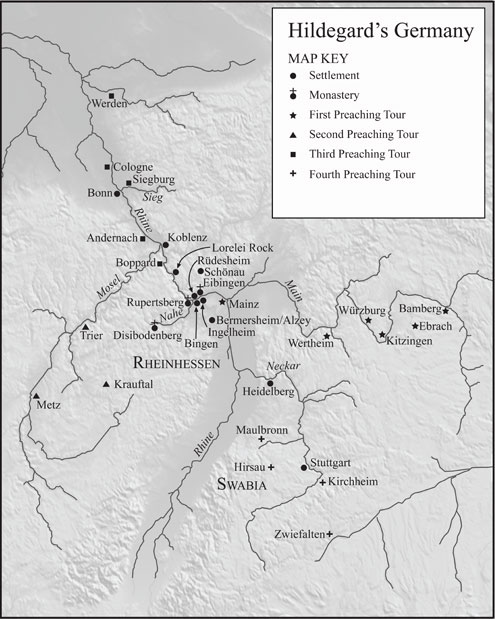
Hildegard also had visions, wrote about healing, and was an artist. In addition she started the first stand alone convent. Prior to that, nuns were attached to a monastery. Hildegard also went out and preached, something no woman did in that time. For more information on Hildegard here are a two links" https://en.wikipedia.org/wiki/Hildegard_of_Bingen and http://justus.anglican.org/resources/bio/247.html

Hildegard's preaching tours

As you can see, I had a bit to work with. With some additional research into life in Germany in 1151 and I soon had my story idea. The hardest thing was getting my hero to cooperate. Once he was in line the story wrote itself.

I hope you enjoy Lost Knight, Out of Time in the "One Christmas Knight" anthology. I'm thrilled to be in the company of such wonderful authors as Deborah Macgillivray, Keena Kincaid, Livia J. Washburn, C. Marie Bowen, Tanya Hanson and Lindsay Townsend. 


http://amzn.com/B017Z2BLH6


Angela Raines is the pen name for Doris McCraw. Doris also writes haiku posted five days a week at :http://fivesevenfivepage.blogspot.com and has just passed one thousand haiku. Check out her other work or like her Amazon author page:  http://amzn.to/1I0YoeL


http://amzn.to/1P4JVV8