Join me here for a year of movie trivia fun as I post dance
scenes from movies set in historical time periods. I will give a brief summary
of the movie’s plot and an equally brief set-up to the scene. Each month on the second Wednesday, I will post a movie clip
and link back to previous movie scene articles here on the blog.
This is the criteria
by which I'm choosing movie scenes:
>In a
non-musical movie, the dance scene is important to the storyline and not just
visual and auditory filler. >In a
musical drama, the characters in the dance scene don’t sing to each other. >In a
musical drama, the dance scene is important to the storyline and not just
visual and auditory filler. >The
historical cut-off is 1960, because that date works for me. ;-)
Side note: The
article “Classic Literature is Not Necessarily Historical Fiction” on the
BookRiot website offers an interesting explanation on what constitutes historical
fiction and where various historical date lines are drawn.
https://bookriot.com/what-makes-a-book-historical-fiction/
Onward to the May movie scene.
Name of Movie: Chocolat Historical Time Period: 1959 Location: France Occasion: Birthday Celebration Type of Dance: Tango
Chocolat is a 2000 movie starring Juliette Binoche, Johnny
Depp, Judi Dench, Alfred Molina, Carrie-Anne Moss, and Lena Olen.
The story revolves around the arrival of Vianne Rocher who
settles in a fictional French village with her six-year-old daughter, Anouk.
The conflict involves Vianne’s arrival at the beginning of Lent and her
subsequent opening of a chocolaterie.
The mayor of the town heads a community vendetta to ostracize Vianne and Anouk,
because their lifestyle and beliefs differ from the community’s. When a
river-traveling band of Romani set up camp near the village, Vianne, Anouk, and
a handful of villagers are the only ones to welcome and accept them. The rest of the town
joins together to run the Romani out of town.
Scene Set-up:
Vianne and Roux, the Romani leader, develop a mutual
attraction that is clearly shown in this short dance scene. The dance occurs on a Romani boat during a birthday party
for one of the village’s citizens. Roux prompts Vianne to finish cleaning up
the dessert dishes later, because he wants to dance with her.
The close-up filming to
focus on their expressions and the music, “Caravan”, sets a sexy mood that needs no explanation. Vianne
is uncomfortable with the intimacy. She laughs nervously. Roux encourages her
to just ‘be in the moment’ with him. He never takes his gaze off of her. He is gentle, patient, and encouraging, which puts her at ease. This is such an intimate dance that we feel a bit like
voyeurs with how near we are to the raw emotional attraction between Vianne and
Roux.
The few words and the intimate filming strategy lets us know that the unspoken attraction between Roux and Vianne is about to
take a very personal turn.
Blogger hasn’t been playing nicely with the comment and
reply feature for a long time...at least for me. I am unable to leave comments and/or
replies on the Prairie Rose Publications’ blog. Therefore, I am responding now
to the commenters on my April article of the dance scene in the movie Shakespeare in Love.
C.A. Asbury wrote: Superb analysis as ever. I am so enjoying this series of
posts, with your searing insight of the interplay between the dancers and the
plot. And this is another winner. A wonderful movie, and expertly choreographed
scene. I look forward to the next one.
My Response: Thank you. I’m glad the articles are
entertaining. Shakespeare in Love is a fabulous movie in so many ways.
Lindsay Townsend wrote: Great choice, Kaye! The volta dance is superb way of showing
romantic intentions, as you reveal. I remember another Volta in the film of
Elizabeth as well. Thanks again for this excellent blog series.
My Response: Whew! I’m glad I was right about the dance
being a volta. I’m iffy on the finer details of that particular time in
history.
Renaissance Women wrote: Such a classic. Love your post on this one.
My Response: Thanks, Dori, I appreciate that.
Until next time, Kaye Spencer Lasterday Stories writing through history one romance upon a time
Welcome to the rabbit warren which is my journey through the early classic TV Westerns. I will place the link to the previous blog post at the end.
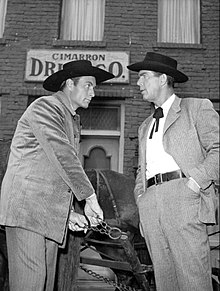
I will say that 'Cimmaron City' caught my eye because of its star George Montgomery. There was always something that I found fascinating about the man and his performances. Standing at 6'3" he was an imposing figure. Born in Montana in 1916, he passed away in 2000. One thing I found interesting about Montgomery, born Goerge Montgomery Letz, he was the youngest of fifteen children born to Ukrainian immigrants.
In addition to his staring role in the TV show, he also starred in numerous films. In addition to acting, Montgomery also was a writer, director, producer, stuntman, sculptor, painter, and was a 'furniture craftsman', in other words, he created hand-made' furniture.
George Montgomery & Fred MacMurray on the TV show Cimarron City (photo from Wikipedia)
The show ran from 1958 to 1959 and was an hour-long show. The basis of the show was about Matthew Rockford, played by Montgomery, who was the Mayor of Cimmaron City, a town situated in the Oklahoma territory in the late 1800s. (Remember this is television it takes from history but doesn't always get it right.)
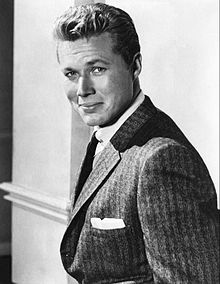
John Smith (photo from Wikipedia)
The show also had some early performances by actors who later went on to find fame and other TV shows. The deputy to Montgomery's Rockford was Lane Temple played by actor John Smith, 6'2", who went on to find fame in the TV show 'Laramie'. You would also find Dan Blocker, 6'4", who played the town's blacksmith, Tiny Carl Budinger. For those who may not remember Blocker went on to find fame in the show 'Bonanza'. Yes, the show had a lot of tall men in the cast.
The show also had Audrey Totter, 5'3", as the local newspaper owner Beth Purcell. (I won't say token female, for she had an interesting part in the show)
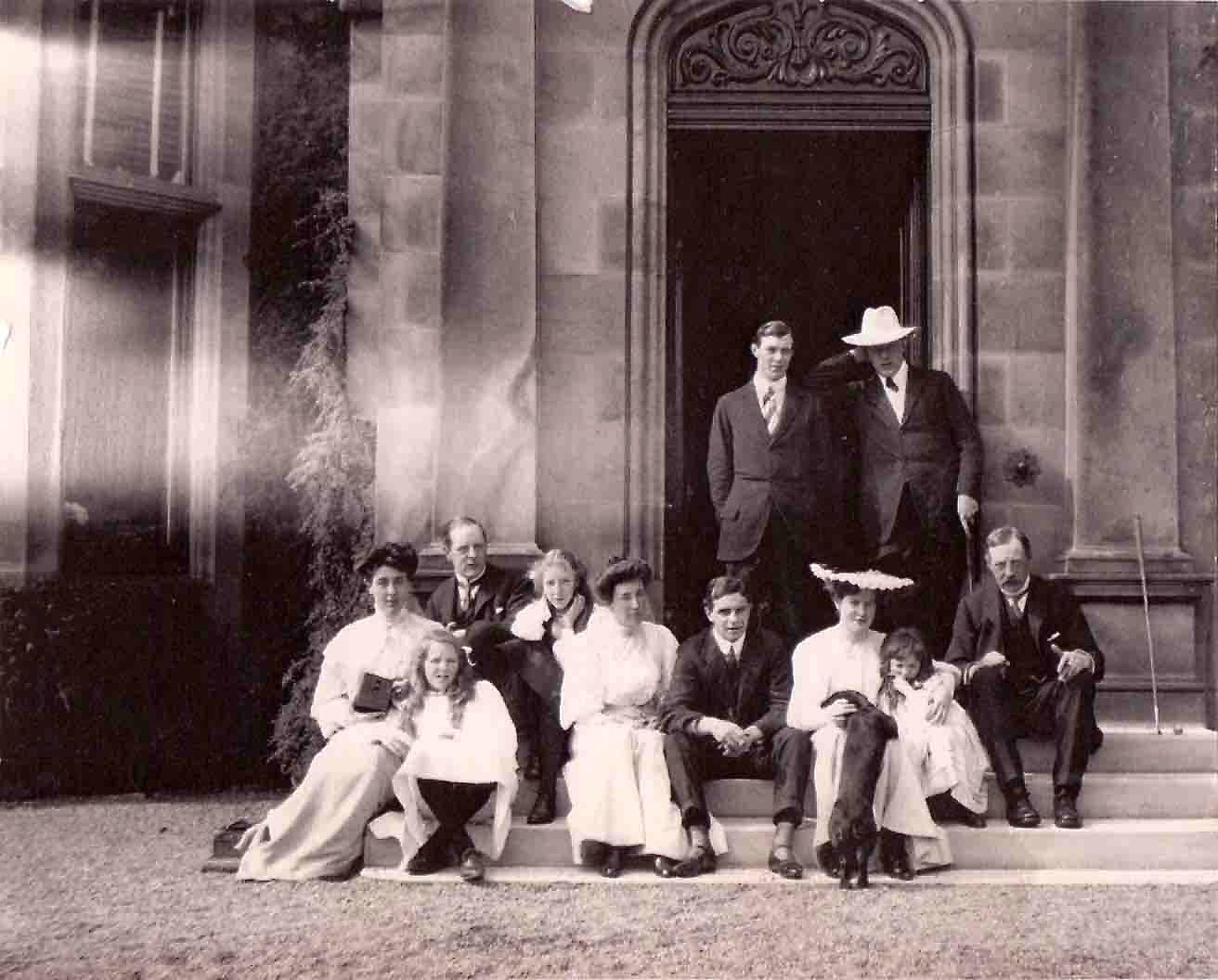
A wealthy merchant built Clerwood House on twenty-six acres of land for his family, and it was a grand affair. The conditions of the feu stipulated that any dwelling house erected on this land must cost a minimum of £1,000 sterling with Coach house, Stables, Lodge, and offices extra. To put that in perspective, the average dwelling house cost roughly £75 to build, so the house alone was more than thirteen times as extravagant than an average four bedroomed house.
It was still under construction when the Tod family moved in 1864, bringing their staff with them, and it's likely that their need to move into an uncompleted house was precipitated by a brutal murder in their previous home in Ratho. That house, then known as Ratho Villa, but later changed its name to Kirtonhill, still stands, and when I started as a young police constable, it was on my first beat.
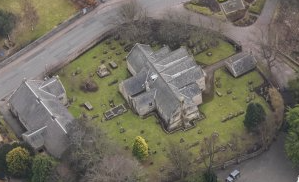
An Aerial View of the Scene of the initial Attack
George Bryce was born in the village of Ratho, just to the west of Edinburgh, one of fourteen children. His father ran the local inn. He was described as dark-haired, heavy set, and none-too bright, with a reputation for drunkenness and fighting. A very poor scholar, the family were later to point to a history of feeble-mindedness in the mother's family to seek a defence of insanity. Bryce also had a history of disappearing for days, with no explanation of where he'd been or what he'd been doing. When he returned from these trips, he was dishevelled and haggard, as though he'd been on a bender. Dr. James Craig, the local doctor, said that Bryce was addicted to alcohol, and had been consulted by the Mr. Bryce senior about his son's drinking. He was locally referred to as 'Daft Geordie', and was known to be a soft touch for spending all his money entertaining others in bars. The carter had been paying court to a local cook, Isobel Brown, for several months, but one of her friends, Jeanie Seaton, had warned the young woman of her paramour's bad reputation and had finished with him. And his reputation was appalling. Mrs. Tod had already warned against allowing visitations to the house by such drunken persons, and he had been banned from the house. The trial transcript notes numerous testimonies from local men who had been threatened by Bryce, armed with a knife, on the least provocation—both sober and drunk.
It's clear that Bryce had some kind of learning difficulty, and had problems in processing his emotions. The tales recounted by family and locals of finding him 'taking a walk to himself 'in Gogar Woods for days on end show that he often withdrew, with or without alcohol. It is possible that he used drink as a way to escape obsessive and intrusive thoughts. James Meikle, the station-master at Gogar, stated that Bryce appeared to have a speech impediment, and that may have impacted his self-esteem. However, Professor Laycock described Bryce's speech as 'thick and indistinct,' but in glorious Victorian style declared that to be 'often the case among persons of low organisation'. Laycock did not consider Bryce to be of 'sound senses'. Meikle also describes annoying behaviour that displayed a startling lack of insight and empathy, while others describe capricious irresponsibility for his horse, having left it tied up so long that it was taken away to be cared for by the men at the local quarry.
George Bryce was furious with the woman who had destroyed his relationship by labelling him a 'drunken blackguard.' He had gone on another drunken escapade, not returning home on Thursday 14th April, but was put to bed by his father on the evening of Friday 15th April having passed out through drink.
George was up and about at six o'clock in the morning, and was seen loitering in the yard of his father's house, which was a pub, for about an hour. His uncle saw him crossing the canal bridge around seven o'clock, and asked where he was going. George replied, "To the station." William Binnie, a local joiner, also saw him. They discussed a new building in the local doctor's garden, a 'photographic house', and Binnie noted that Bryce was sober and rational. He also noted that Bryce was wearing his light shoes, which indicated that he was not working that day, as working men wore boots. Bryce then turned towards the Tod Villa, and Binnie knew no more until after the murder.
Illustration from a 1934 story about the case in the Illustrated Police News
It's clear that many people had the same opinion of him. It's also clear that the lady of the house had held that view strongly enough to ban him, and similar callers from the house. What isn't clear is why only one woman should be singled out to be responsible for the view held widely, one held even by his own family—even if she had repeated it to others. But hold her responsible, he did, and all his revenge was focussed on her.
Bryce was seen to hop the low wall to the villa and walk to the back of the building. Once inside he pushed past Isobel Brown, his ex-girlfriend, and proceeded into the house. Witnesses say that he had ascertained that Mr. Tod was not at home. He stormed upstairs, followed by the cook and another servant, looking for Jeanie Seaton. They found Byce on top of her, his hands around her throat, and Mrs. Tod beat him off with an umbrella and told Jeannie to run. She did, as the servants pulled him away from the victim.
She ran to the nearby cottage of Binnie the Joiner, directly opposite seeking refuge, but Mrs. Binnie was at church and nobody was in to help her evade her attack. Bryce leapt the wall, cut her off, and slit her throat in full view of numerous witnesses.
Bryce ran off, but was quickly captured by locals. His crime was so public he had no option but to plead guilty, depending on insanity and feeble-mindedness as defences—both acceptable at the time.
Nowadays, Bryce would have been considered not merely on whether he was sane or insane at the moment of the crime. He would have had a defence of diminished responsibility due to his poor cognitive functions and low intellect. The old Scottish law term of Dole was an equivalent of mens rea— Latin for guilty mind—explained in 1753 by Chambers Cyclopedia: "Under Dole are comprehended the vices and errors of the will, which are immediately productive of the criminal act, though not premeditated, but the effect of sudden passion. In this respect Dole differs from what the English law calls malice."
The court ruled that Bryce was sane at the time of the murder and the authorities were having none of the excuses put forward on his behalf. Evidence of premeditation came in him establishing that Mr. Tod was not in the house that day, obtaining the razor, and in the various reasoned conversations he had immediately before the murder. They simply did not believe that he had an instant of maniacal excitement, and was perceived as functioning to a sufficient level to be able grasp right from wrong in life in general. It was a world without the nuance of today, and the judge even expressed concern that should he be committed to an insane asylum, that Bryce would be would be back on the streets through the possibility of "subsequent restoration to society." He was sentenced to be hanged.
The only known Picture of George Bryce
Most poor people at that time didn't get photographs taken, and no known pictures of George Bryce were thought to exist, until crime writer https://twitter.com/es_thomson posted pictures she came across doing research. A Dr. John Smith, founder of the Edinburgh Dental Dispensary and the Hospital for Sick Children, did drawings of bodies brought into the morgue, and she found them in the records.
Let's take a moment to note a few details here. It's ten in the morning, the pinioning straps lie off to the side, but most of all—the thing I noted right away as being most unusual in a working man in 1860s Scotland— the corpse is wearing shoes with the fashionable square toes of the time, and not boots. Most working men of the period wore boots even to church, but shoes for a carter were likely to be his Sunday Best, if he had any at all. These were probably the same 'light shoes' noted by the witness William Binnie in the precognition statements. They were unusual enough to be noted, and commented on, for that day and time. Did Bryce wear those shoes to be lighter on his feet that day? We'll never know, but it was clearly not his usual footwear for a Saturday morning.
The Bryce family moved to Currie after this, and many emigrated to Canada and America, but those who stayed behind worked hard and did well, running many local businesses. One descendent was dismayed to find that George's uncle had also been hanged for murder in 1844, when a destitute uncle James had robbed and then finished off his brother-in-law.
“Oh, my goodness.” Beryl Clutterbuck held open the front door. Her blue eyes blinked at Vida, fixating on her top hat. “I’ve never seen a lady dress like you before.”
Vida smiled. “That’s because I’m not a lady. I’m a doctor. Doesn’t your doctor wear a coat and hat like this?”
“Oh. There are women doctors? I didn’t know that was allowed.” The older woman’s lips twitched into wide grin. “The hat is just perfect for a doctor, although I’d like to put a flower in it.” She paused. “Or a great big feather. A peacock feather would look lovely.”
Beryl stepped aside to allow Nat and his oddly-dressed companion to enter. “I’m an adherent of the rational dress movement.” Vida swept into the hall. “Women wear clothes which are far too restrictive. I do the same job as a man, so I will dress in much the same way. I would wear pants, too, but that just causes far too many problems.”
“Rational dress?” Beryl’s little mouth pursed into a raspberry, as though unfamiliar with either word. “What’s rational about dressing like a man?”
“Rational dress refers to everything women wear. Surely, you’ve heard of bloomers? They’ve gone out of fashion now, but the union suit has remained with some of us. I’m wearing one now.”
“Union suit?” asked Beryl as Nat groaned in the background.
“Yes. Combination underwear.” Vida propped her hands on her hips, betraying a thicker waist than Mrs. Clutterbuck. “Corsetry is the work of the devil. It constricts the organs, the breathing, and is there to serve no purpose other than male titillation. I have no time for it.”
Beryl gasped before whispering in theatrical horror. “You don’t wear a corset? Isn’t that indecent?”
“Of course not. I’m a professional woman. I’m not here to attract men. I’m here to do a job of work.”
“My Charles always said that professional women were the worst at dressing provocatively, but I suppose it depends on the profession. Speaking of which, Catherine French is here to see you, Mr. Dunvegan.” Beryl led the way to the drawing room. “You are welcome, anyway. I do hope you can help poor Abigail, Mrs. Doctor. She’s so depilated.”
“She’s what?”
“You know, floppy, no energy.”
“Oh, debilitated.”
Beryl nodded. “Yes. That’s what I said.”
“Depilated means she had her hair removed.”
“Oh, no. That would be silly. She has beautiful hair. Why would she do that?” Beryl opened the door.
Vida darted a look at Nat who shrugged and whispered in her ear. “I did tell you that Mrs. Clutterbuck’s unusual. She means well. She speaks without thinking.”
A young woman with glistening brown hair stood as they entered the room. Vida noted that her hazel eyes fixed immediately on Nat.
“Mr. Dunvegan.” She trilled in delight. “I came to see how your wife is today.”
“This is Mrs. France,” said Beryl in flat, bored tones. “She’s here a lot now.”
“Call me Catherine.” The visitor extended her hand. “I try to help wherever I can. Such tragic events demand that a neighbor should step in, don’t you think?”
“Yet, you are in the lounge. Not even in the kitchen,” said Vida, raising her eyebrows. “What kind of help?”
“Well, moral support.”
“Well, I’m here now. You can get back to your husband.” Vida removed her hat to reveal short curly hair. “Thank you for your support.”
“She doesn’t have a husband,” said Beryl. “She’s a widow.”
Vida nodded. “I’m sorry for your loss. You aren’t wearing black. I take it he died some time ago.”
“A year in February,” Catherine replied. “He was ill for some time. Sadly, it wasn’t unexpected.”
“Just over a year?” Vida’s brows arched. “You’ve slighted the mourning early?”
The young woman’s chin tilted in challenge. “Why, yes. Life goes on. My Rodney would have wanted it that way. He was full of life.”
“He was full of whiskey.” Beryl chuckled. “He was rarely sober. It was the drink that took him. Poor Catherine had a lot to put up with, but I suppose his money robbed her trials of their sting.”
“I loved him. He had a kind heart.” Catherine sniffed. “He found great joy in life.”
“He certainly did. He never stopped celebrating,” said Beryl. “I remember your wedding. He could barely stand upright. You were a beautiful bride, though. All dressed in white organdie. Very vaginal.”
Catherine’s eyes widened. “I think you mean virginal.”
Vida grinned, her grey eyes twinkling like polished steel as she looked Catherine up and down. “I think we all know what she means. Now, I must get up and see Abigail.” She paused, slapping away Catherine’s hand which had ventured over to Nat’s lapel to pick away a piece of lint. “He’s a married man, young woman, and his wife is my dearest friend. If you think for one second that your machinations are beyond me, you are sadly mistaken.”
“I was only—”
“I know what you were only doing. You were leaving, Mrs. French.” Vida glowered at Nat. “And I’m ashamed of you, allowing this.”
His jaw dropped open. “I haven’t done a thing.”
“Good. Keep it that way.” Vida strode over to the door. “Show me up, Mr. Dunvegan. Lovely to meet you, Mrs. French. We don’t need your help any longer.”
“Brewster” used to mean a female brewer of ale. In the
early 1300s brewsters were common. As water was rarely safe to drink, ale,
created by a barley or oat mash, boiling water, yeast and herbs, was a staple.
Everyone, men, women and children, drank it. Larger medieval houses made their
own, so in 1333 Elizabeth de Burgh, Lady Clare, brewed 8 quarters each week,
around 60 gallons of ale. Since a household of 5 might drink 1 ¼ gallons a day,
this output needed to be ongoing, especially as ale soured quickly, within a
few days. The plus side was that once made, ale was quickly ready to drink,
within a day.
Brewing of ale was done at home, using everyday tools
– a large tub, a brush, a ladle, forks. Women did it in tandem with other
household tasks. Any excess a brewster might sell to her neighbours. Locals
would be alerted that ale was available by the sign of a branch or bush pinned
over the household door. Neighbour sold to neighbour and customers brought
their own pails to collect the fresh ale. Another way womenfolk were employed
were as Tipplers, who carried the freshly brewed ale in vessels on their backs
to various household clients. Overall it was a small-scale business, with
modest profits. Married women, widows and unmarried spinsters all brewed and it
was a means of independence. In 1379, in Howden, 9 single women supported
themselves by brewing. In Norwich, women of the chief families all brewed ale
and sold it to their friends.
Barley water could be made by boiling a small quantity
of fresh barley in a volume of water and then the liquid strained off. Herbs
used in the ale included briar, rosemary, coltsfoot and balm. Water from
different wells produced different flavours of ale. “Dredge”, a mix of oats and
barley, was in as common use in the production of ale as it was of bread.
Ale was sweeter in taste than beer, since the hops in
beer preserve the drink for longer but also make it more bitter.Modern beers in the “Gruit” style, where hops
are not used and herbs are used as flavouring, give an idea what such ales
tasted like. An ale called “Mycria”, flavoured with sweet gale, used to be produced
by Hanlons in Devon.
Hops, introduced from Europe, was used to brew beer.
Beer lasts longer than ale and so can be transported greater distances and made
in larger batches. After the Black Death, beer began to be drunk and produced
in England as well as ale, though female brewers were gradually pushed out of
the trade by men, who had greater access to capital. The Brewers’ Guild was
closed to women. The laws favoured men over women in brewing, although women
often had more practical experience. Brewsters began to be seen as sinful,
wanton and unclean. In 1413 brewster Christine Colmere in Canterbury lost her trade
when Simon Daniel falsely told her neighbours that she was leprous.
See “Ale, Beer and Brewsters In England” by Judith
Bennett for more details.
For myself, I am sorry the more bitter beer took over
from ale, and sorry that women were thrust out of a business where they had
thrived for many years. One day, I may write a story where a brewster is my
heroine, but in the meantime, if you are interested in learning a bit about
medieval feasts, medieval sweets, cooks and menus, please see my novel “The Master
Cook and the Maiden” and my novella, “Amice and the Mercenary.” Both are
published by Prairie Rose Publications and both are free to read with Kindle
Unlimited.
Join me here for a year of
movie trivia fun as I post dance scenes from movies set in historical time
periods. I will give a brief summary of the movie’s plot and an equally brief
set-up to the scene.
Each month on the second
Wednesday, I will post a movie clip and link back to previous movie scene
articles here on the blog.
This is the criteria
by which I'm choosing movie scenes:
In a non-musical movie, the dance scene is important to
the storyline and not just visual and auditory filler.
In a musical drama, the characters in the dance scene
don’t sing to each other.
In a musical drama, the dance scene is important to the
storyline and not just visual and auditory filler.
The historical cut-off is 1960, because that date works
for me. ;-)
Side note: The
article “Classic Literature is Not Necessarily Historical Fiction” on the
BookRiot website offers an interesting explanation on what constitutes
historical fiction and where various historical date lines are drawn. https://bookriot.com/what-makes-a-book-historical-fiction/
Onward to the April movie
scene.
It is altogether fitting
and proper that I highlight a movie with a Shakespearean theme for April, since
William Shakespeare was baptized on April 26 (likely born on April 23), 156,
and he died on April 23, 1616.
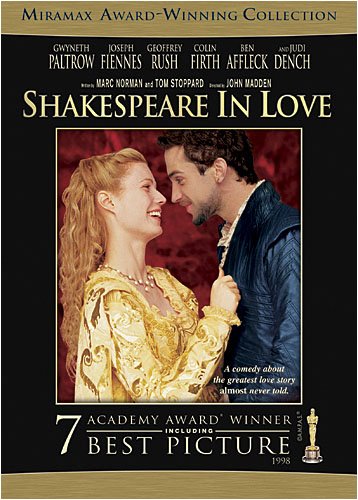
Name of Movie: Shakespeare
in Love
Historical Time Period: c. 1593
Location: London, England
Occasion: Formal dance at Sir Robert de Lessep’s estate
Type of Dance: Renaissance
Background
Shakespeare in Love is a period romantic comedy-drama (1998). The story is a
fictional love affair between William Shakespeare and Viola de Lesseps. During
this intense, short-lived affair, Shakespeare is inspired to write Romeo and Juliet , which closely mirrors
their star-crossed, and doomed-from-the-beginning relationship. This movie is a
play-within-a-play.
Dance Scene Set-up
William Shakespeare sneaks into a ball at the de Lesseps estate.
During the ball, Viola’s father arranges her betrothal to a nearly bankrupt
Lord Wessex. Viola is passingly familiar with who Lord Wessex is, but she has
no interest in him as a person, let alone as a husband. She also doesn’t know a
marriage pact is being made for her. Viola is enamored with all things
theatrical, and she has a secret admiration for William Shakespeare, although
they’ve never met.
Don’t look to this movie for historical accuracy. It is
Hollywood-generated, not a documentary. This includes this dance scene. Keep in
mind that movie dance scenes are created for optimum cinematography and
choreography. As such, there is often have a conglomeration of dance movements
to achieve those goals. This is the case here.
The purpose of this dance scene is to get Will and Viola
together, just as Romeo meets Juliet at the party at her house. Shakespeare and
Viola are from different social classes, and they would not have had
opportunity to interact any other way than within this dance.
I’m iffy on dances of the Elizabethan era, but I’m fairly
confident in saying that this dance is a combination of the Almain, which is a
processional dance in which you do some specific movements with your partner
and a Volta, which is a ‘toss the ladies” movement. It’s also a ‘mixer dance’ in
that people can enter and leave the dance sort of like someone tapping your
partner on the shoulder and taking their place as your new partner.
The dance scene…
Sir Robert de Lesseps and Lord Wessex have evidently sealed
the deal on the marriage agreement. Will Shakespeare is hanging out with the
musicians, just watching the dancing. Viola de Lesseps is in the midst of the
dancers.
Will’s disinterested perusal of the dance is suddenly
interrupted when he sees Viola from across the crowded room.
0:29 – Will is instantly awe struck, and he asks one of the
musicians who she is. He’s told, “Dream on, Will.”
The camera cuts back to Viola dancing. You’ll notice she has
a new dance-partners-in-passing in the Almain.
1:00 – We see the Volta (toss the ladies). Will is on the
move. He’s got his eye on Viola as he’s crashed the dance, so to speak.
1:18 – Viola looks directly into Will’s face, and she gasps.
She is visibly stunned to see him. “Master Shakespeare,” she breathes.
Viola and Will separate as they move around the dance
circle. Viola encounters Lord Wessex again, but her gaze is locked on Will as
he dances away from her. She and Lord Wessex exchange a few words in which she
flippantly, and naively, disregards his meaning.
1:42 – Will and Viola come together again. They twirl to the
side of the circle, where they stop and talk. This is an instance of the the
world revolving around them, while they have eyes only for each other. You can
see the blurred figures of people in the background.
Viola speaks, but Will is struck speechless, ‘a poet of no
words’, she says. Wessex drags Will off the dance floor. Will utters words of
admiration for Viola, which prompt Wessex to put a knife to Will’s throat.
Viola watches, also too enamored with Will to think of anything but how she
feels right then.
Wessex (aka a combination of Paris and Tybalt from Romeo and
Juliet), turns back to Viola with an expression that foreshadows the
confrontation between Viola and himself that will happen later in the movie.
While this dance scene is brief, the ‘meaningful looks’,
words spoken haltingly, make it clear to us that Viola and Will have fallen in
love at first sight. It’s one of those sigh-worthy romantic scenes for those of
us who are hopelessly, hopeful romantics, despite knowing how it turned out for
Romeo and Juliet…and Will and Viola.
But if you so much as dare to speak, a cloud come over the sunlit arch,
And wind comes off a frozen peak,
And you're two months back in the middle of March."
Robert Frost, Two Tramps in Mud Time, 1926
April is the beginning of spring. Even its name reflects the change of season. In Latin aperio means 'I open' referring to the buds and sprigs burgeoning with life in the northern hemisphere at this time of year. As people were historically so dependent on a good crop, it was a time of year that was very important to our ancestors. The spring season is rife with superstitions and folklore.
The birth flower for the month of April is the common daisy, Bellis Perennis. It's commonly thought that the name comes from a corruption of an older name 'Day's Eye' due to the fact that it closed in the evening and opened in the morning. Chaucer was known to call it 'the eye of the day'. In medieval times it was called 'Mary's Rose' or the 'Bone Flower.' In Scotland and the North of England it is also known as gowan. It grows all over the old world, needing little or no care, and has one of the longest blooming seasons in the plant calendar. Ancient daisy decorations on pottery and ornaments have been found in excavations in Crete, Egypt, and all over the Middle East going back at least 4,000 years. The Bellis part of the name is thought to mean pretty, but it could also relate to the Latin for war - bellum. This theory is supported by the medicinal use for the plant in treating injuries. Also known as bruisewort, and occasionally woundwort, it was used for healing wounds and treating bruising. Other medicinal uses suggest that a strong solution had anti-spasmodic properties that helped menstruation, bowel problems, and a decoction of the roots can treat eczema.
The heads are edible can be scattered over a salad to make it pretty, along with other edible flowers.
Freya Bringing the Daisies
In Norse mythology Freya, goddess of love, beauty and fertility, declared the flower to be sacred. Also linked to Venus, the Roman goddess of love and beauty. It led to simple rituals, still carried out today where the petals are plucked off one-by-one by young women across the whole of Europe repeating "he loves me, he loves me not". Other fortune-telling games relating to the daisy has girls trying to predict the occupation of her future husband as the petals are removed. The verse takes many forms, but one of the oldest was, "Tinker, tailor, soldier, sailor, rich man, poor man, beggar man, thief, doctor, lawyer, merchant, chief."
Daisies in Ophelia's Death Scene
Goethe had a pregnant Margherita plucking a daisy to tell her how Faust felt about her, but he wasn't the only artist to weave the flower into their work. Shakespeare used it in Ophelia's death scene, and in Love’s Labour’s Lost said that ‘daisies… do paint the meadows with delight’. Wordsworth wrote 'To the Daisy', and Keats and Emily Dickinson also mentioned the flower.
In Celtic legend, when babies died, daisies were said to be sprinkled over the child's grave by the gods to ease the suffering of the parents. The perennial nature of the plant meant it grew everywhere, and certainly on graves. It lead to the euphemism 'pushing up the daisies.' Linked to the spring equinox, the appearance of the daisy showed that the land was fertile, but in the triple deities of the Celts it related to the maiden, not the mother or the crone form, and as such, it was linked to innocence. It was also a sign of resilience, returning after being trampled and surviving throughout the summer. A daisy chain was said to protect a child from being abducted by the fairies.
A horse that didn't lift its hooves high enough was nicknamed a daisy-cutter, and this term spread also to sports. In 1889 an English newspaper used the term for a low fast ball running along the ground. It wasn't long before that term was used in Baseball for the same thing.
A 19th century slang term that's gone out of fashion is 'it's daisy'. Meaningless to us, but to Victorian Brits it meant it was superb.
It it very well might be superb. Modern studies on the plant has found that a strong scientific basis for its reputation for healing wounds. Dried daisy flowers, powdered and extracted in n-butanol, accelerated wound-healing and decreased scarring on skin wounds. A later study found seven new saponins that promote collagen synthesis (constituents that have soap-like attributes and lower surface tension) in daisy flowers. Collagen is the main structural constituent of skin, which would explain how they contribute to wound healing. One type of saponin in Daisy flowers has also been found to inhibit tumours, so maybe it's time to look at the humble daisy in a new light?
Excerpt
“That’s my drink,” said Tibby.
The stranger turned a smug sneer on Tibby. “It can’t be. It’s in my hand.” “It’s mine.”
Tibby appealed to the barman for help. “He’s got my drink.”
The server rolled his eyes. “Have you seen how busy it is in here? I ain’t got time to watch everyone’s stuff. Look after your own drink.”
“I’m trying to. Give me that.” Tibby reached up but the taller man held the glass up high, way out of the reach of the tiny man. “You know that’s mine.”
Tibby jumped and stretched, huffing in his exertion in a game of alcoholic-keep-away much to the amusement of the ring of bullies who sniggered and jeered. “Look at the size of him. He’s a midget.”
“I am not.” Tibby jumped once more. “Midgets are medically four-foot-ten. I’m five-foot-one.”
“Five-one,” guffawed a vacant-looking goon. “You is a giant midget.”
“Please, I’ve had a terrible day. Just let me have a drink in peace. Give me my glass.”
“Yeah, give ’im his glass, Fred,” scoffed the large one with greasy hair sticking out from under a tatty cap.
“Sure.” The stranger swilled back the contents before he held out the empty glass. “Here.”
Tibby pulled back his reaching hand, his bottom lip growing and trembling beneath great blue globes which glistened with tears. “You drank it?”
The men threw back their heads and guffawed, slapping one another on the backs and seeking support for their helpless mirth at this unexpected reaction. It was beyond anything they’d hoped for.
“Yeah, get yourself another.” The bully snickered.
Tears streamed down Tibby’s face. “I don’t want another drink. I wanted that one. It was special.”
Fred leaned forward, leering into Tibby’s face.
“Well, you can’t have that one. I drank it.”
“He’s cryin’. Can you believe this?” asked the smallest bully. “A grown man sobbin’ like a baby.”
“I don’t believe this.” Tibby leaned over the bar, his shoulders heaving with deep sobs. “First of all, I get taken to jail for a crime I didn’t commit. Then I get fired, and to top it off, my wife told me she’s leaving me.” He backhanded away glistening tears as the band of bullies fell quiet. “This has been the worst day of my entire life. I come in here for a quiet drink and now, I meet you. Why do you want to stop me from committing suicide? It’s too cruel.”
“Suicide?” a small voice murmured from the gaggle of miscreants. “
Yeah.” Tibby turned on the bully, pointing an accusing finger. “He drank my poison. A man can’t even kill himself in peace anymore.”
Tibby kept right in character and watched Fred grasp his throat. “Poison?”
“I tried to tell you, but you kept pulling it away from me. I came in here to kill myself, but now you even took that from me.”
“He’s bluffin’,” cried one of the crowd.
“Ya think?” demanded another. “How often d’ya see a grown man cry in public?”
“He ain’t exactly a grown man,” answered his friend. It wasn’t helping though, Fred’s eyes bulged and he doubled over thrusting his fingers down his gullet.
Fred’s friend grabbed Tibby by the lapels and shook him violently. “What kinda poison was it?” The journalist wailed and whimpered as Fred buckled at the knees. “What kind?”
“Strychnine,” Tibby sniveled. “What have I got left to live for?”
“Strychnine?” “Yeah, that’s why I had with whiskey. It kills the taste.” Tibby paused. “Along with the crushing pain of my pointless existence. I guess your existence has been rendered meaningless, now.”
“I need a doc,” Fred bellowed, running for the door.
“A doctor won’t be able to help,” Tibby called after the departing crowd. His tears had dried up and his smile returned with suspicious alacrity. “But get your stomach pumped, just in case.”
The barman wiped the bar with a grubby cloth and eyed Tibby with caution. “I ain’t gonna have no trouble in here.”
“Hey, if you’d adopted that stance a minute ago, I wouldn’t have been driven to subterfuge.”
The barman frowned. “There ain’t nowhere around here called Subterfuge. This is the Flying Horse.”
Tibby sighed. “Two more whiskeys, please.” His face lit up at the sight of Jake returning from the latrines. “Ah, you’re back. I just ordered some more drinks.”
Jake’s brow met, picking up on the undercurrents and sideways glances going on around them. “What’s goin’ on?”
“Nothing.” Tibby smiled his most innocent smile. “Some bullies took my whiskey but I toldthem how tough my day had been and they left.” He lifted the shot glass replete with amber liquid. “I ordered us some more. Now, about Callie. I’ve had a few thoughts.”
I'm continuing my journey through some of the old, lesser-known, Western TV shows. This month I'm looking at Audie Murphy and his starring role in the TV show "Whispering Smith" a Denver Police Detective in the 1870s or close to that time.
The show ran for one season from 1961 to 1962. However, the show was filmed in 1959 but did not premiere until 1961. One of the stories I read was that Guy Mitchell, Murphy's costar, had broken his shoulder. They delayed production so that scripts could be rewritten to adjust Mitchell's screen time, and even after that you will notice him in a cast. One of the other stars, Sam Buffington, who while looking older was actually only 26 at the time they started filming the series, committed suicide after only sixteen episodes.
A couple of other things of note are: there was a novel, written in 1906 by Frank H Spearman, that was said to be an adaptation of the true life adventures of the Union Pacific railroad detective by the name of James "Whispering" Smith. That novel was the inspiration for four different silent movies and four different "sound" movies. The movie I remember seeing was "Whispering Smith", the 1948 movie with Alan Ladd and Robert Preston. Second: Murphy, in talking about the TV show, called the show, "Dragnet on horseback". And in watching this series you will hear Murphy narrating much like Jack Webb did on the Dragnet series. Third: Only 20 of the 26 episodes aired after the Senate investigated the show as being too violent with Senator John Carroll stating, "Not only bad for children, it's bad for adults."
Guy Mitchell - Left, Audie Murphy - Right From Wikipedia
As for the stars of the show, Audie Murphy as many may remember was the most decorated American soldier in World War II. He saw combat service for three years, was in nine major campaigns, was wounded three times, and earned 33 awards and decorations for his service. What makes this even more interesting is he had joined at the age of 16 which means by the time he left the service in 1945 he was still under 21 years of age. (I have listened to the audiobook of his memoir, "To Hell and Back", and have seen the film in which he starred as himself. It did more to help me understand World War II that a lot of the other reading I had done.)
Murphy's costar, Guy Mitchell, was known as a singer and this was one of his early roles. Mitchell was also in the service during World War II, having served in the Navy. After serving Mitchell was a singer with the bandleader Carmen Cavallaro. This may explain why you periodically will hear him break out into song in the police station that is part of the show.
The show can be streamed on YouTube or like me you can purchase the series. I confess, I enjoy the show and haven't found it to be as 'violent' as some say. Perhaps I'm a bit more tolerant of the depiction of the West. I would leave it to others to make their own decision.