Search This Blog

Wednesday, April 11, 2018

Why is Friday the 13th unlucky? by Kaye Spencer #PrairieRosePubs @PrairieRosePubs #superstions #Fridaythe13th


Friday the 13th — A date for the superstitious to keep a low profile.

According to that model of excellence in accuracy, Wikipedia, Friday the 13th occurs at least once a year, and can occur up to three times in one year. For 2018, the dates are April 13th and July 13th. Also, according the Wikipedia article, there are many origin stories for the superstition surrounding Friday the 13th.

It appears that, historically, there is ‘…evidence of both Friday and the number 13 being considered unlucky, [but] there is no record of the two items being referred to as especially unlucky in conjunction before the 19th century”*. This article also states that an estimated 21 million people in the U.S. are seriously affected by this day and they are unable to go about their normal activities.  Businesses, particularly airlines, report millions of dollars in lost revenue on any given Friday the 13th.

While Friday the 13th is a superstition, it is not a worldwide superstition. Other days of the week are associated with the number 13 in different cultures.

Apparently, the origins of the superstitions surrounding Fridays and the number 13 are found in the ancient world. Here are a few of the more interesting examples from an article on the website National Geographic News, Reporting Your World Daily – April 12, 2004**:

  • In a Norse myth, 12 gods had a dinner party at Valhalla. In walked the unlucky number 13 guest: Loki. Loki wreaked havoc by “…arranging for the blink god of darkness, Hoder, to shoot Balder the Beautiful, the god of joy and gladness, with a mistletoe-tipped arrow… Balder died and the whole Earth got dark. The whole Earth mourned. It was a bad, unlucky day…From that moment on, the number 13 has been considered ominous and foreboding”.
  • Biblical reference to 13 as unlucky in that Judas was the 13th guest at the Last Supper. There are numerous other biblical references.
  • Ancient Rome’s superstitions for the number 13 involve the belief that witches gathered in twelves and the thirteenth was the devil.
  • Numerology: There is a negative association with the number 13. As 12 is considered a complete number (12 months in a year, 12 signs in the zodiac, 12 gods on Olympus, 12 labors of Hercules, 12 tribes of Israel, 12 apostles of Jesus), 13 is considered ‘a little beyond completeness…restless and squirmy’.
  • High rise buildings often skip the 13th floor.
  • Airports will avoid having a 13th gate.
  • Hospitals and hotels tend not to have a room marked 13.
  • In some countries/cities, if a house address should be 13, it will be designated 12½.
Two older literary sources regarding Friday and/or the number 13 as unlucky are:
  • Chaucer wrote of Friday being an unlucky day to undertake a journey or to begin a new project in the Canterbury Tales*.
  • Thomas W. Lawson's 1907 novel Friday, the Thirteenth in which “…an unscrupulous broker takes advantage of the superstition to create a Wall Street panic on a Friday the 13th”*.
The origin story that I find the most intriguing is the persecution of the monastic military order the Knights Templar. In 1307, King Philip IV of France in collusion with Rome and the Pope ordered the arrest of hundreds of members of the Knights Templar, which resulted in their ultimate demise, so to speak. Here is an oh-so-painfully brief and white-washed summary:

As the Crusades came to an end, the Templars had gained wealth and power. King Philip, as head of an impoverished kingdom, and in collusion with the Pope in Rome, not only viewed the Templars with suspicion of their intentions to gain even more European power, they viewed their wealth as a ‘get out of debt card’. So, ‘evidence’ of Templar heresy toward the church popped up and, in an amazing feat of clandestine planning and orchestration, King Philip and the Pope had hundreds of Templars simultaneously arrested in diverse locations. They were charged with all manner of heresy, blasphemy, and sacrilegious offenses, none of which were ever proven. All of the accusations were fabricated and confessions were gained under duress and torture. Nonetheless, the Templars’ assets were seized in a masterful move fueled by  jealousy of their wealth and fear of their power.

The date was Friday, October 13, 1307.


So, if you’re worried about staying safe from the unluckiness of the upcoming Friday the 13th in two days, here are ways people throughout the ages have protected themselves:

  • Wake up on the right side of the bed
  • Sleep facing south
  • Carry an acorn in your pocket
  • Avoid black cats


  • Wear your clothes inside out
  • Pick up a penny (heads up or tails up)
  • Don’t walk under a ladder
  • Make a wish on a wishbone
  • Don’t open an umbrella indoors

  • Don’t step on cracks in the sidewalk
  • Throw salt over your left shoulder
  • Stand on your head and eat a piece of gristle
  • Sprinkle salt in the corners of rooms and underneath windowsills
  • Burn sage in your house


  • Climb to the top of a mountain or skyscraper and burn all the socks you own that have holes in them
  • Light a white candle in a white dish with a cup of water nearby – candle burns, negative energy is absorbed into the water
  • Wear red
  • Carry a rabbit’s foot (obviously not so lucky for the poor rabbit)
  • Knock on wood (doesn’t bring good luck, but keeps bad luck away)
  • Hang up a horseshoe (ends pointing up) – iron, not aluminum – iron counters all evil and keeps harm away


And the number one safety precaution to take on Friday the 13th is NOT to break a mirror, because the broken mirror represents the broken soul, and a mirror is said to reflect a person’s soul. Hence, your soul, which is now in pieces, will bring you seven years of bad luck and misery in its desire for vengeance for breaking it into pieces.


Do you have Friday the 13th superstitions or favorites you’ve heard of? Share them…if you dare.


Until next time,

Kaye Spencer
Writing through history one romance upon a time

Website/Blog- https://www.kayespencer.com
Instagram - kayespencer
Twitter - http://www.twitter.com/kayespencer
Pinterest - http://www.pinterest.com/kayespencer
Facebook - https://www.facebook.com/kayespencer23
Amazon - http://www.amazon.com/author/kayespencer
LinkedIn - https://www.linkedin.com/in/kayespence
Prairie Rose Publications - http://prairierosepublications.com/
YouTube Channel - https://www.youtube.com/c/kayespencer0203


Images from Morguefile.com:
Clover: Michelle Bulgaria
Horseshoe: Seeman
Cat: lisaleo
Mirror: Dee

Knights Templar image:
Public Domain: https://commons.wikimedia.org/wiki/File:Knights-templar.jpg


References:
-NPR: https://www.npr.org/tags/136274257/friday-the-13th
-The Criminal Element website:
https://www.criminalelement.com/blogs/2013/09/friday-the-13th-evolution-of-a-thirteenth-superstition-history-myth-literature-deborah-lacy
-*Friday the 13th: https://en.wikipedia.org/wiki/Friday_the_13th
-**National Geographic News: https://news.nationalgeographic.com/news/2004/02/0212_040212_friday13.html
-*Knights Templar: https://en.wikipedia.org/wiki/History_of_the_Knights_Templar

Tuesday, April 10, 2018

Creativity (An 8-Part Series): Part IV - Forbearance

By Kristy McCaffrey

Don't miss
Part I   - Imagination
Part II  - Domestication vs. Wildness
Part III - Shape-Shifting


Forbearance is the act of patience, restraint, and tolerance. To forbear is to endure. Another interpretation is to refrain from a harsh judgment. In the Old Testament, one translation of forbear is to keep silent or to be still.


How does this relate to creativity?


There is a time for everything, and a season for every activity under the heavens. ~ Ecclesiastes 3:1


Creation can’t be rushed. It must unfold in its own time. It’s the difference between ‘Lord of the Rings’ and ‘Keeping Up With The Kardashians.’ When a creative endeavor has been given the proper time to percolate, a depth and authenticity will emerge that will be undeniable. If rushed, the project will only be a toe-dip in the soul-creating cauldron. The result will be a pale façade, a shallow rendering, and one that is easily consumed and digested, leaving no lasting fullness.


How long is long enough? Only you can know this. However, understanding the need for forbearance can ease the stress of thinking I must get this done NOW. For the painter, the writer, or the filmmaker, this time should be spent learning the fundamentals. Then, when the BIG story comes, or the BIG canvas, the skills will be in place to filter the highest quality of work.


In today’s world, there’s a need to rush. We’re all guilty of it. We release a work, an idea, before it’s reached fruition. Learning forbearance is a crucial skill if we hope to fully develop our talents, and even more importantly, to understand the way our process unfolds, for this is as individual as the person.


Don’t miss Part V in the Creativity series: Maiden/Mother/Crone

Until next time…


Connect with Kristy


Monday, April 9, 2018

Fun With Easter Eggs: Tapping, Shackling, Dancing


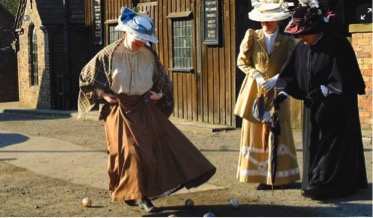
I had such fun Easter Sunday watching the kids running around our outdoor chapel area hunting for Easter eggs. So, of course, I had to begin hunting for what games my characters might have enjoyed on Easter Sunday—or any other Sunday in the 1800s, for that matter. Imagine my surprise when, besides the normal egg hunting, I discovered egg tapping, egg shackling and egg dancing. 


Egg Tapping

The rules are simple: pick an egg, face your opponent and tap eggs until one breaks. The person with the unbroken egg wins and moves to the next players. The egg still intact at the end is the winner. A single elimination tournament with no age limit and guaranteed laughs.

Egg Shackling

In the Victorian Era, egg shackling was a favorite game. It’s origins go back to medieval days. Children wrote their names on an egg and put it in a basket with all the others. The basket was shaken until all eggs cracked. The last egg to crack or remain intact was the winner.

The Egg Dance

The egg dance or the hop-egg, is a dance done in small, hopping steps through a minefield of boiled eggs. Blindfolded. If you manage to do the dance without breaking an egg, there will be chocolate! Since the Saxon word hoppe means “to dance,” hopping was probably brought to England from Germany by the Saxons as early as the 5th century.


In my latest release, WILD TEXAS HEARTS, the heroine, Lizzie, is caught teaching the hero’s young son poque, or poker.

“Remember, the ace can be a high card or a low card. Depends on where you need it.”
Calvin laid his two cards down, counted on his fingers, and picked them back up to be sure he saw them right. “If I have it as my high one, that counts eleven, right?” His lips moved as he recounted his hand. “That’s too many. I think.”
“Then count it as one point and ask for another card. You want to get close to twenty-one, but not go over. Remember, though.” She hesitated before dealing. “If you have more than fifteen points, another card will probably be too many.”
Calvin huffed in frustration. “I don’t understand.”
“Didn’t I tell you studying your figures in school was important?” Lizzie folded her own cards and set them aside. “Let’s have a look at what you have. We won’t count this hand.”
Calvin turned over a black jack, followed by an ace of hearts.
A shiver ran her spine at the reminder of her attacker. “That’s twenty-one. You would have won, boy.” Lizzie learned across the table and slapped his shoulder.
“Durn it!” Cal shoved his chin forward in a pout. “We didn’t count that one.”
“That’s all right. We’ll just deal again.” She gathered the cards and started to shuffle. “We’re just practicing anyway.”
“But if I win, you’re gathering the eggs tomorrow, right?”
Lizzie laughed at the hope in his eyes. “And if you lose, you wash and dry the dishes all day.”
Cal straightened in his seat. “I’m gonna win this time.”
“Don’t count on it, swabbie. I’m pretty good at this poque stuff, too.”
“What’s poque?” Cal picked up his cards, one at a time, and started adding, his lips forming the numbers so clearly Lizzie didn’t even have to see her hand to bet.
“It’s a fancy French term for poker. At least, that’s what the sailor told me when he taught me to play.” She laid the homemade deck of cards aside and glanced at the two she’d dealt herself.
“Those sailors sure taught you lots of stuff.”
“There wasn’t much else to do once my chores were done. Or when the wind quit blowing. What you gonna do?”
“I’ll take…uh…one more. I think.”
She bit back a chuckle and dealt Cal another card. “I’ll hold on these. Show your hand.”
Cal turned over a king, a ten, and seven.
“Twenty-seven is six too many.” She flipped over her hand. “Nineteen for the dealer. I win and you have to wash the supper dishes.”


A broken man…
Revenge has driven Wolf Richards since the brutal murders of his wife and young daughter. Returning home with his son, Cal, he faces memories and loss at every turn. Raising Cal alone seems to be more of a challenge than he can handle. He can never replace his perfect Emily—until a rough-edged female falls into his arms—and living becomes a new adventure.

An unlikely woman…
Lizzie Sutter is as rough as a cowboy and as compelling as a stormy sky. Dressing as a man allows her to hire on with a cattle drive, only to be discovered and set adrift near Civil, Texas. When she stumbles onto an abandoned cabin, she makes herself at home. Then the owner of her newfound home shows up and Lizzie discovers just what’s missing from her life—and her heart.

Two wild hearts tamed…
Lizzie hasn’t a feminine thing about her, yet she calls to something deep inside Wolf, something he can’t deny. Being a woman has always left her feeling lacking, until he shows her their WILD TEXAS HEARTS belong together…

Sunday, April 8, 2018

Book Review Part 4: Mail Order Brides for Sale: The Remington Sisters

This week I'm featuring Celia Yeary's Lola.


Blurb:
Brought up in the wealth and comfort of Eastern “old money” in staid and proper Philadelphia, the Remington sisters are forced to scatter to the four winds and become mail-order brides. In order to gain a fortune, their sinister step-father, Josiah Bloodworth, has made plans to marry them off in loveless marriages. Time is running out, and no matter what lies ahead in their uncertain futures, it has to be better than the evil they’re running from…

LOLA: Sensible Lola Remington, the eldest of the four sisters, must be certain the others are on their way to safety before she can think of fleeing Philadelphia herself. With the help of a local bridal agency, Lola finds the perfect husband for herself—in the wild countryside of Texas. Jack Rains owns a ranch and he’s in need of a bride—and children, of course! But just when Lola starts to believe there might be a future for them, she discovers a hidden letter from another woman…Jack’s first wife.

My Review:
What a fun concept!! Four sisters find themselves being sold off to four men by their unscrupulous step-father. And these men don't appear to be the most upstanding of gentlemen either. So instead of facing a future bought and paid for, they gamble on an unknown future as mail order brides, hoping they didn't land in a worse situation.

Lola finds herself married to a Texas rancher and thrown into the adventures of ranch life during a range war. She also finds herself in a war for her husband in more ways than one. As Lola and Jack struggle to find their happily-ever-after together, more dangers arrive threatening to take their future away.  Hang on! It's quite the adventure!!  And you may find yourself wanting to snuggle under the stars too!

Want a little bit more?  Check out an excerpt!

Purchase link:

Friday, April 6, 2018

Book Review Part 3: Mail Order Brides for Sale: The Remington Sisters

This week I'm featuring Cheryl Pierson's Sabrina.


Blurb:
Brought up in the wealth and comfort of Eastern “old money” in staid and proper Philadelphia, the Remington sisters are forced to scatter to the four winds and become mail-order brides. In order to gain a fortune, their sinister step-father, Josiah Bloodworth, has made plans to marry them off in loveless marriages. Time is running out, and no matter what lies ahead in their uncertain futures, it has to be better than the evil they’re running from…

SABRINA:  Impulsive Sabrina Remington, the youngest, weds a man she knows her family would disapprove of. Though Cameron Fraser’s family owns a ranch in lawless Indian Territory, he’s made his way in the world with a gun, living barely on the right side of the law. With everything on the line as Bloodworth and his henchmen close in, will Cam be able to protect Sabrina from the desperate man who means to kidnap her for his own wicked purposes?

My Review:
What a fun concept!! Four sisters find themselves being sold off to four men by their unscrupulous step-father. And these men don't appear to be the most upstanding of gentlemen either. So instead of facing a future bought and paid for, they gamble on an unknown future as mail order brides, hoping they didn't land in a worse situation.

Sabrina's story starts with a mistaken identity that flows into a new life on a ranch in Indian territory. Intense family drama leads to healing, along with old feuds settled. Sabrina and Cam's life starts up fast and doesn't let up! I adored their story!! 

Want a little bit more?  Check out an excerpt!

Purchase link:

Wednesday, April 4, 2018

Bringing A Story Back From The Dead by Sarah J. McNeal


My first published story came out in 1996. I didn’t know as much about writing then as I do now, and I am still learning. I was a member of Romance Writers of America back then. A few years later, I joined my local chapter of Carolinas Romance Writers and took the job of Workshop Coordinator for all the different educational offerings RWA provided. I realized I had hit a gold mind of knowledge. Although the classes are open to all writers, I got to take all the classes for a discounted rate because I was an RWA member. Although I had taken 2 correspondence courses (they are called “on line” studies now) and I had taken several college courses in creative writing, I still had a lot to learn. The RWA classes are numerous and specific in their topic, so if a writer has difficulty in a certain area, they can sign up for a particular class to address their need.

Presently, I am deep in edits on a trilogy from my earliest published work. It’s slow going because the first book in the trilogy contains all the mistakes a new writer can make. I mentioned in a blog earlier how my big prologue was shocking and unnecessary to the core of this story. The huge chunks of passive voice are disturbing enough, but the lack of deep POV (point of view) is desperately lacking. The majority of you are well acquainted with deep POV, but for the purpose of this blog I will explain that deep point of view is when the writer gets into the character’s head and shows the reader what that character is thinking and feeling in such a way that the reader can relate to that character.

RWA had a class on writing deep POV. A writer must eliminate all the distractions that take a reader away from the story. The following are some tips I learned from this class. I regret that I do not remember the name of the instructor for this class, but I’m certain she must still be teaching classes through RWA.

Getting Into The Character's Mind (Deep POV)

1. Limit your character’s knowledge.
The character cannot know everything. They can’t hear conversations of other characters unless they are present in the scene. They can’t know about events or actions unless they learn it from another character or witnessed it for themselves.
2. Cut out all filter words.
Filter words are those descriptive words like thought, saw, wondered, and so on, and show the piece was authored. The character has to experience these things first hand.
Instead of writing, He saw the sun rise above the horizon, write the experience. The sun rose up from the hills and its brightness blinded John.
3. Limit your dialogue tags.
What really works here is to put the character’s actions with dialogue.
Instead of writing, “He is no longer any use to me,” she said, “if he amuses you I shall not end his worthless life…yet,” I changed it to “He is no longer any use to me.” She shrugged her shoulders. “If he amuses you I shall not end his worthless life…yet.”
4. The ultimate “show, don’t tell”
Boy oh boy, we’ve all heard this piece of advice a gazillion times. In deep POV it is imperative to stick to the “no show” advice. Deep POV is a very present, in the moment style. To keep in the character’s mindset, a writer must steer clear of lengthy expositions, info dumps, backstory, and descriptions. All these elements must be exposed in natural ways throughout the story using only the POV character’s thoughts, actions, senses, and conversations.
5. Do NOT use passive voice.
This is the difference between having the characters take some action instead of being acted upon. 

Some of you may have heard this passive voice message before, but here goes: If you can write “by zombies” after a sentence, it is written in passive voice.
Example: She was imprisoned…by zombies.  Change it to action: She became a prisoner despite her efforts to avoid those zombies.
There are a whole bunch of zombies going on in my present revision of The Dark Isle. I’m still hunting them down.


Introducing new characters

6. Be careful when identifying characters.
When a new character comes along, he still has to be introduced so the reader knows the relationship between him and the other character. In deep POV the character narrative cannot state, “There stood his brother.” See how tricky deep POV can get? Instead, the character in deep POV either has to state it in dialogue or through active thought.
Dialogue: “Look, Ralph, there’s my brother standing on the hill.”
Active thought (always in present tense and italicized): For Pete’s sake, there is my brother standing on the hill.
Or have the new character identify himself. “Finally, I found you, sister. I’ve been looking for you everywhere.”

There are instances in which deep POV is not an advantage. The writer must determine when to use it and when to back away.

1. Relate backstory in memories
Because of the deep POV character mindset, all the important backstory can be relayed through flashes of memory. Just keep in mind not to do this too frequently since flashbacks do slow the pace of the story.
2. Relay mental distance.
If your character is going through a traumatic situation such as being stabbed or robbed and mentally freaking out, the character isn’t going to be able to process the situation clearly. This would be an instance in which the writer could tell the story more powerfully by backing out f deep POV. It’s not something that should happen very often—no more than two or three times is enough.

Painting by Claude Monet

3. Paint a hyper-vivid picture.
This is one of those glorious times when deep POV allows the writer to bring all the senses together the way an artist uses color to paint a scene. Get all the details in there from all five senses to emotions and memories. I love when I come across these passages of complete emersion into a writer’s story. I hope I can bring these deep POV scenes as well.

Do you find yourself looking at your older work and discovering the lack of deep POV? Is deep POV something you strive for in your writing? There are famous authors who did not write from deep POV like Jane Austin and many of us certainly loved her stories, so not all of us are trying to write from deep POV.
Well, I’m discovering a great deal about my writing style from my first work and where I want to go from here. Editing and revising are becoming an enlightening journey of discovery for me.


Sarah J. McNeal is a multi-published author who writes diverse stories filled with heart. She is a retired ER and Critical Care nurse who lives in North Carolina with her four-legged children, Lily, the Golden Retriever and Liberty, the cat. Besides her devotion to writing, she also has a great love of music and plays several instruments including violin, bagpipes, guitar and harmonica. Her books and short stories may be found at Prairie Rose Publications and its imprints Painted Pony Books, and Fire Star Press and Sundown Press. She welcomes you to her website and social media:


Sunday, April 1, 2018

WHAT TO DO, IT'S APRIL FOOLS


As I sat down to write this months post, I was beset with so many options for a post this month. Today is Easter Sunday, and April Fools Day. April is national poetry month. And lest we forget, April is also known as the 'growing' month, the month where dormant plants begin to show signs of growth.

April 1 is also national one-cent day and national sourdough day. You can view a list of national days in April here: April National Holiday calendar

So let's see if I can find a way to incorporate some of the options for this day and month.

I will start with Helen (Hunt) Jackson's sonnet April:

No days such honored days as these! While yet 
Fair Aphrodite reigned, men seeking wide 
For some fair thing which should forever bide 
On earth, her beauteous memory to set 
In fitting frame that no age could forget, 
Her name in lovely April's name did hide, 
And leave it there, eternally allied 
To all the fairest flowers Spring did beget. 
And when fair Aphrodite passed from earth, 
Her shrines forgotten and her feasts of mirth, 
A holier symbol still in seal and sign, 
Sweet April took, of kingdom most divine, 
When Christ ascended, in the time of birth 
Of spring anemones, in Palestine.