Search This Blog

Showing posts with label #TracyGarrett. Show all posts

Monday, November 14, 2022

Thanksgiving Will Soon Be Here—What Are We Going to Eat?


In just a few days—okay, eleven—here in the States we will celebrate our annual food and football orgy called Thanksgiving. I’m sure you know the history, or at least the history we were all taught about the origins of the feast. And I’ll readily admit, my family is no different than others. Our menu on this big day is the longest of any we ever do, except perhaps New Years Eve, but that’s a different blog.

As my mother, sister and I began listing the foods we wanted to prepare, it started simply enough: turkey, ham, sage dressing (my great-grandmother’s recipe), gravy, cranberry sauce, green beans. Ah, but how do we want the green beans? The way I usually do them, with bacon and chicken broth? Or in a casserole with creamed soup and French fried onions on top? We still haven’t settled that one. Then, there are the pies…

My point is this annual feast with family and friends must include our favorites. For me, it’s scalloped corn or corn casserole, and cranberry sauce. I use Alex Guarnascelli’s RECIPE.

When we were in graduate school, my husband and I usually stayed in town for Thanksgiving, rather than traveling the twelve hours home and twelve hours back. We issued invitations to our fellow music students who were also staying, and when they asked “what can I bring” I said ‘anything it wouldn’t be Thanksgiving without.’

What’s you’re it-absolutely-cannot-be-Thanksgiving-without recipe?

Have a happy and blessed Thanksgiving!


Monday, September 12, 2022

The Hat Makes The Man

As the old cowboy saying goes, “It's the last thing you take off and the first thing that is noticed.”

Whether a top hat, derby, tam, fedora, beret, bowler – a hat does more than cover a man’s (or woman’s) head. They make a statement about the person.

If I say Bogart, can you see him, fedora pulled down low, collar turned up?

Or Charlie Chaplin in his bowler?

How about President Abraham Lincoln? 

Hats say a lot about the personality of the man - and some, like President Lincoln’s black stovepipe hat, will be forever linked with the man who wore it.

I believe the most recognizable type of hat, hands down, is the cowboy hat.

Did you see John Wayne in the movie Quiet Man and wonder where the heck his Stetson was? I did.

How about the hat Clint Eastwood wore in Pale Rider?

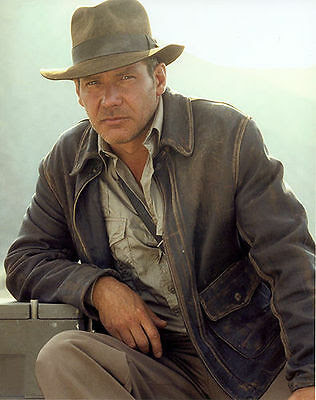
Or Indiana Jones in his battered Stetson fedora?

John Stetson was the creator of what we think of today as the cowboy hat. The son of a master hatter, John made his first cowboy hat as a demonstration to his buddies about making felt from fur. The wide-brimmed hat was so useful in keeping off the sun and rain, his companions wanted one of their own. And an empire was born.

Stetson started his company in 1865. By 1866, the “Hat of the West” or “Boss of the Plains” set the John B. Stetson Company on the path to becoming the most famous hat in the world. Originally sold in one grade (2 ounce felt) and one color (natural), that original Stetson hat sold for five dollars. The equivalent hat today would cost close to $1,000.

Made of a blend of rabbit, wild hare and beaver fur, today’s Stetson sets the mark for cowboy hats. You can get your Stetson in felt or straw, black, white, grey, tan; choose your style, for casual or dress, for outside wear or for going to church.

Stetson isn’t the only hat maker in the U.S. In Dallas in 1927, the Byer-Rolnick company began making the Resistol hats, so named because they were made to “resist all weather.” But, in spite of the lasting success of Resistol, Stetson is the name most associated with the west.


“Even after the wild aspect of the West was somewhat tamed, the cowboy hat never really lost its ability to lend that reckless and rugged aura to its wearer.”


Tracy

Monday, August 8, 2022

The Pearl Button Capital of the World--In Iowa

On a recent trip to visit my in-laws, I noticed a brown historical marker just outside Muscatine, Iowa: "Pearl Button Capital of the World." Such an unlikely designation for a landlocked town. However, research shows it's not as unlikely as I first thought.

For much of the 1800s, people harvested freshwater pearl mussels mostly for their pearls. The shells were used on the roads and the meat--which was not fit to consume--was dumped.  Turns out, this section of the Mississippi, where there is a northerly swing which slows the water, is prime for freshwater mussels. Hence, it was perfect for mussel harvesting.

In 1887, German button maker John Frederick Boepple (that's him on the right), arrived in the United States and settled in the Mississippi River town of Muscatine, Iowa. New tariffs on his buttons in Germany had cut drastically into his profit and he decided to relocated to the United States. Armed with maps of the rivers of America, he began to search for new supplies of mussel shells. He found what he was looking for in Muscatine when he waded into the muddy waters and pulled up a mussel the size of a baby elephant’s ear.

Boepple opened a mother-of-pearl button factory in 1891, supplied by an abundance of thick-shelled American pearl mussels from nearby rivers and streams. By 1900, this small Iowa town had earned the right to call itself the "Pearl Button Capital of the World," out-producing more established button-making centers in Europe. By 1905 button makers in Muscatine produced 1.5 billion buttons—almost 40 percent of the buttons produced in the entire world.

They held their distinction in the world until the plastic button industry undercut them. With the decline of the button business, most of Muscatine’s mussel fishers began sending their shell to factories in Japan and other foreign shores where bits of the shells were turned into nuclei used to seed marine pearl oysters for cultured pearls. At its height in 1993, the industry exported nearly 7,000 tons of shells. This region remains the major source of nuclei for use in pearl culturing worldwide.

On a rather sad side-note, Boepple died of a blood infection after cutting his heel on a mussel shell while wading in the Mississippi. He was working with the Fairport Federal Hatchery biological station in Muscatine to re-seed the rivers and help salvage the marine creatures and the local shell industry that had long supported this small Iowa river town.

Want to see how a pearl button is made? Check it out: https://www.youtube.com/watch?v=DI_eyCNj-M0


Tracy

Monday, July 11, 2022

Taking the Stage--Coach, That Is

One of my favorite John Wayne movies is Stagecoach. Do you remember the scene where, after three days in very close quarters with strangers, the passengers descend the steps, the gentlemen tipping their hats as they walk away, the ladies fanning at the unexpected heat, though they look as fresh as if they’d just left the tender ministrations of their maids.

Yeah. Right.

Nothing could be further from the truth. Stagecoaches were open air affairs where passengers were crammed together onto barely padded benches, some inside, some riding the “rumble seat” on the top of the coach, shoulder to shoulder with strangers, with no privacy from those who were less careful about their personal hygiene. If it rained, oil cloths were lowered over the window frames to keep out some of the water, but that meant less ventilation. Passengers climbed out of those hot boxes with crumpled and stained clothing, sweaty and cranky, with dust in places no one should have to abide dust.

Still, traveling by stagecoach was preferable to making the trip on horseback, or, heaven forbid, walking. And since the trains stopped halfway across the country, in places like St. Joseph, Missouri, or Memphis, Tennessee, the stagecoach picked up their passengers and took them to all points west.

Government mail contracts were the impetus and the financing for many of the stagecoach lines. And a lot of different companies ran stage lines across the west to Texas, Arizona, or California, to take advantage of those contracts. Here are a few examples.

Butterfield Overland Dispatch--two trails, a southern route, established in 1858, ran from Springfield, Missouri and Fort Smith, Arkansas, southwest across Oklahoma, Texas, and New Mexico to California, and was the first to carry mail; the other trail ran from Fort Riley, Kansas, to Denver, Colorado, beginning in 1865.

NOTE: John Butterfield’s company had the southern route, David Butterfield’s the Kansas/Colorado route--and the gentlemen were not related.

Visit this site if you’d like to see all the stations on the Kansas/Colorado route, as well as the approximately mileage between each: http://www.santafetrailresearch.com/research/bod-dispatch.html

Butterfield Overland Stage Company--this was probably the most famous of all stagecoach companies, certainly in Texas. Butterfield proposed the southern route because the mail could continue to run, even through the winter months.

“Butterfield's route headed southwest from St. Louis and Memphis, crossing the Red River at Colbert's Ferry (qv) in Grayson County and continuing across Texas for 282 miles to Fort Chadbourne via Jacksboro, Fort Belknap, and Fort Phantom Hill. The next 458 miles to El Paso swung south across a barren plain between the Concho and Pecos rivers, where water was in short supply, past Horsehead Crossing (qv) on the Pecos, up the east bank to Pope's Camp, (qv) where it crossed the river, hugged the west bank northwestward to Delaware Spring, and then turned westward through Guadalupe Pass to Hueco Tanks and El Paso. The line continued westward through Tucson and Fort Yuma to San Diego.” http://www.tshaonline.org/handbook/online/articles/SS/ers1.html

Butterfield ran the stage lines until they were seized by the Confederate Army at the beginning of the Civil War. When he could no longer operate in the south, he moved his operation north and made use of the “Central Overland Route.”

Central Overland Route (aka “Central Overland Trail", "Central Route", "Simpson's Route", or the "Egan Trail")--This trail was scouted by Howard Egan and used to move livestock between Salt Lake City and California. When the Army heard about the route, they sent an expedition to survey it for military use. It was opened to stagecoach lines and settlers in 1859. In 1860, the Pony Express made use of the trail, followed soon by the laying of lines for the Transcontinental Telegraph.

Cheyenne-Black Hills Stage and Express Line went from the Black Hills of South Dakota to Cheyenne, Wyoming. The Cheyenne-Black Hills line covered just over 300 miles, “…and for the most part the stations were located about 15 miles apart. The daily travel was about 100 miles and three days were necessary to make the entire trip.”

Black Hills Dead Wood Stagecoach went to--you guessed it--Deadwood, South Dakota. And William “Buffalo Bill” Cody rode shotgun and later drove for the company.

In February, 1866, Ben Holladay took over the Butterfield Overland Mail Company, renaming it Holladay Overland Mail and Express Company. Mr. Holladay sold out to Wells, Fargo in November of the same year.

There were specialized coach companies, too, like the Yellowstone Park Stage Coach Line, who had a fleet of bright yellow Concord stagecoaches as sightseeing vehicles in the park in 1886. 

And that most famous of all stagecoaches? Believe it or not, Wells, Fargo and Company didn’t own their own stagecoach line until 1866, when they purchased Ben Holladay’s company. Until then, they rented space from other lines as they needed it. “By 1864, Wells Fargo, and Company were selling over two million envelopes a year for the Wells Fargo mail service and the public was using Wells Fargo green mailboxes throughout California.”

Check out this link for lots more information on these and other stage coach companies:
http://www.legendsofamerica.com/we-stagecoachlines.html


Not all stages were the big coaches, drawn by six horses or mules. Concord made what they called a “Celerity Wagon,” a light, durable vehicle made for travelling over rough roads. But from what I read, it wasn’t any more comfortable, it just held together longer.

“The Butterfield Overland Mail transferred passengers and mail to light, durable vehicles for travel over rough roads.  From Frank Leslie's Illustrated Newspaper, October 23, 1858.”

Whether a Celerity Wagon or a Concord Stage Coach, the trip west was certainly not for the faint of heart.


Tracy G.


Monday, June 13, 2022

HISTORY OF THE DRINKING STRAW

Whether paper, plastic, bamboo or glass, people have been sipping through hollow tubes for centuries. Between 6000 to 7,000 years ago, the ancient Mesopotamians invented the very first straws, usually made from wood and, sometimes, gold to reach the beer sitting below fermentation byproducts floating on top.

The first patent for a drinking straw was filed in 1888 by Marvin Chester Stone, a paper cigarette holder manufacturer. The legend goes that he was drinking a mint julep when the piece of rye grass he was using as a straw disintegrated. Determined to make something better, he wrapped and glued strips of paper around a pencil, coming up with the first prototype of paper drinking straws. By 1890, Stone Industrial was mass producing them. Stone promised his customers “health, cleanliness and economy,” with his straws, which reassured some of those who were concerned about catching the myriad diseases of the time. Paper straws allowed them to avoid making direct contact with the glass while drinking. At one point, Stone was producing two million paper straws a day in his factory. 

Bendy straws were created in the 1930s when inventor Joseph Friedman inserted a screw into the straw, wrapped floss around the screw's grooves, and took out the screw. With indentations, the straw could easily bend without breaking and his young daughter could then easily drink her milkshake.

Straws have been made from precious metals, grains like wheat and rye, paper, plastic and lots more.

Tracy


Monday, May 9, 2022

1848 Colt Dragoon

In my 2019 short story WANTED: THE SHERIFF, the hero, Sheriff Matthew Tate, carries a matched pair of 1848-Model 3 Colt Dragoons.

The Dragoon grew out of the problems with the Colt Walker revolver, a 4.5 pound, 15” long hunk of steel. The Dragoon was only 4 pounds, 2 ounces. And, where the Walker’s barrel was 9” long, the Dragoon’s was only 7.5”.  The Walker was a powerful weapon, but its size meant it was used mostly as a saddle-mounted weapon. It was just too long and too heavy to wear around your waist and draw from a holster.

And there was the propensity for the Walker to explode when users put in too much powder. Where the Walker held 60 grains of powder, the Dragoon held only 50 grains—less powder, less danger.

Also, the Walker’s loading lever tended to fall during firing, locking up the revolver and rendering the weapon useless. Not a good thing when you need a working gun. The Dragoon added a lever latch to hold it in place. Problem solved.

“Three major-production Dragoon models were produced between 1848 and 1860. The First Model had oval-shaped cylinder notches, no wheel on the rear of the hammer and no pins between the nipples. Colt produced about 7,000 First Models between 1848 and 1850. The Second Model had rectangular cylinder notches and a "wheel" on the hammer. First and Second models both had square-back trigger guards. The company made about 2,550 Second Models in 1850 and 1851. Approximately 10,000 Third Model Dragoons were made from 1851 through 1860, with many variations. All Third-Model Dragoons had a round trigger guard. Records show 8,390 Dragoons were ordered by the U.S. government.” (quoted from article on website of Cabella's)

The Dragoon revolver helped transform Samuel Colt's young pistol-making business into one of the most dominating forces in firearm history.

Monday, April 11, 2022

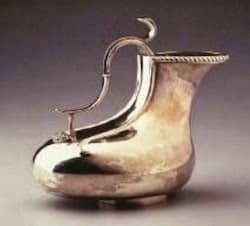
COFFEE, TEA, AND CHOCOLATE--POTS, THAT IS

I started this blog after seeing a photograph of a really cool chocolate pot. I had a preconceived idea that a tea pot, a coffee pot and a chocolate pot were very different items, and I set off into research to prove my hypothesis. Soon I was deep into a rabbit warren of Limoge and pottery and Colonial Williamsburg and dyeing wool and gunsmithing and mincemeat recipes and this truly amazing… I'm sure many of you have been there, too.
Anyway, I discovered that, while the shape of some pots is better for tea than coffee, and the placement of the spout is the only major difference, they can be—mostly—interchangeable.

For instance, a tea pot is usually shorter and rounder, to give more surface area on which the leaves can steep, while the coffee pot is normally taller and narrower, with a strainer of sorts built into the spout to keep the grounds in the pot. And often sometimes, the spout is further up the pot, so you don’t get those nasty dregs in your cup.

The chocolate pot is almost always tall and straight, to make stirring the chocolate easier. There’s sometimes a hole in the lid for the stirring stick, and the pitcher-like spout is shorter than that of a coffee pot and up at the top… But not always. [That's one of Thomas Jefferson's chocolate pots to the left.]

About the only thing I discovered that makes perfect sense? The pots are different shapes—whatever that shape may be—so the hostess doesn’t pour the wrong drink.

Regardless of your favorite drink or pot of choice, enjoy!
Tracy

Facebook: Author_TracyGarrett

Monday, March 14, 2022

Those Lovable Little Lap Dogs

The other day I was really missing my border terrier, Wrigley. [There’s a picture of him at the end of this article] To give me some ‘doggy time’, without the food, walks and visits to the vet, I went on a research “trip” to try and determine when it became popular to own a lap dog.

A lap dog or lapdog is a breed of dog that is both small enough to be held in the arms or lie comfortably on a person's lap and temperamentally predisposed to doing so.

Lap dogs are animals with no purpose other than companionship. The tiny dogs, bred for their size, have been around since at least the 8th century in China. 

In the 18th century, both in Britain and in the rest of Europe, it became popular to own a lap dog, especially by those who had the leisure and resources to keep an animal that wasn’t working or used as a food source.

These little canines were considered members of the family, some people even going so far as to formally grieve the passing of their pint-sized pooches. In 1887, Ludwig van Beethoven composed an elegy on the death of a poodle, Elegie auf den Tod eines Pudels.


In addition to their being kept as a pet and providing warmth, lap dogs have been fashion accessories and status symbols, and even to attract fleas away from their owners.

Recent genetic study confirms that the Pekingese lapdog, bred in ancient China to fit inside the sleeves of a man's robe, is one of the oldest breeds of dog. For centuries, they could only be owned by members of the Chinese Imperial Palace. Similarly ancient are the lapdog ancestors of the modern breeds of Tibetan Terrier, Lhasa Apso, Pug, and Shih Tzu. 

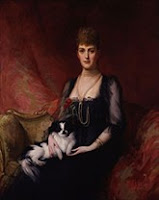
In the book De Canibus Britannicis published in English in 1576, lapdogs are described as a type of dog, such as the "Spaniel Gentle” or “Spaniel Comforter". Ancestors of the modern breed of Cavalier King Charles Spaniel [seen in this portrait of Mimi, Madame De Pompadour's lap dog] were a type of "Spaniel Gentle" kept by English nobility in the 17th century. Modern breeds of lapdog also include the Bichon Frise, Japanese Terrier, Maltese, Pomeranian, Yorkshire Terrier and many others.


Tracy Garrett (and Wrigley)


Monday, February 14, 2022

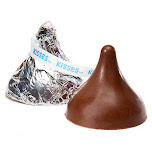
VALENTINE’S DAY & A BOX OF CHOCOLATES

Conversation hearts, truffles of all kinds, and heart-shaped boxes of chocolates are the symbols of Valentine’s Day for us. But where did this tradition come from? While the roots of Valentine’s Day go all the way back to Roman times and the springtime fertility festival called Lupercalia, candy-giving isn’t nearly that old.

Valentine’s Day is believed to be named for two different Roman saints, both called Valentine. Neither had anything to do with romantic love. The first mention of St. Valentine’s Day as a romantic holiday appeared in 1382 in the writings of Geoffrey Chaucer. With the medieval period came a new focus on illicit but chaste courtly love, and a couple of the familiar images of the day begin to appear—knights giving roses to their maidens and celebrating their beauty in songs from afar. But sugar was still a rare item in Europe, so no chocolates. Yet.

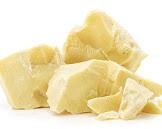
The 1840s was Cupid’s heyday. In the Victorian period, the idea of giving elaborate cards and gifts fit their notion of courtly love. Into the fray came Richard Cadbury, of the British chocolate makers. Cadbury had recently improved its technique of extracting pure cocoa butter from whole beans, producing a much better drinking chocolate, the craze of the day.

But this process resulted in a lot of excess cocoa butter. Richard recognized a great marketing opportunity for eating chocolates made from all that cocoa butter, so he began selling them in beautifully decorated boxes that he himself designed.

It didn’t take long for the idea of adding Valentine’s Day images of cupids and roses to the boxes and marketing them as keepsakes. The boxes grew more and more elaborate until the rationing of sugar in World War II forced the making of chocolates to be scaled back.

Victorian-era Cadbury boxes are treasured heirlooms in many families to this day.

Happy Valentine’s Day!
Tracy

Monday, January 10, 2022

COCOA POWDER & THE CHOCOLATE CAKE


When researching a story, something I read started me wondering if my 1870s heroine would bake a chocolate cake for that church social she was planning to attend. Since cocoa manufacturing was being done in the American colonies by 1765 in Dorchester, Massachusetts, she just might have.

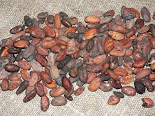
Cocoa is the chocolate powder made by pressing most of the cocoa butter from ground and roasted beans, leaving behind powder and cocoa butter. In 1847, Fry and Sons, an English company,  combined cocoa butter with chocolate liquor and sugar to produce what we know today as chocolate.
In 1876, Daniel Peter of Switzerland added dried milk to make milk chocolate. Milton Hershey, after seeing the German’s chocolate processing machinery at the World's Columbian Exposition of 1893, started his own chocolate company. And the rest is history.

Monday, December 13, 2021

Who's That Tapping on My Window?

What did you do before alarm clocks to wake up and make it to work on time?

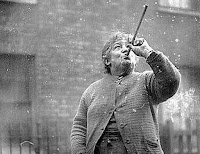
In towns across England, workers would be roused from sleep by the sound of someone tapping at their bedroom window. On the street outside would be a figure wielding a long stick—the knocker upper.


The "knocker upper" was a common sight, in the towns where people worked shifts, in mining communities, even in London where dock workers, ruled by the tides, kept unusual hours.


In order to have a knocker-upper wake you, you could either put a note on your door saying when you wanted to be “knocked up,” or contact the knocker-upper directly in person and let them know when to bang on your window. Some houses had small slates attached to the outer wall where notes could be left requesting knocking up.


Caroline Jane Cousins, known by many as "Granny" Cousins, was born in Dorset in 1841 and became Poole's last knocker upper, waking brewery workers each morning until retiring in 1918.


Mrs. Bowers was a familiar sight in Sacriston, County Durham, where she and her dog, Jack, woke the miners working the early shift. She began knocking up during World War One and continued for many years. [Beamish, the Living Museum of the North] Take a look at the club she used.


Mary Smith, who used a pea shooter to pelt the windows of her clients, was a well-known knocker upper in east London in the 1930’s. She earned sixpence for each knocking up. Her daughter, Mary, followed in the family trade. Mary the younger is believed to have been one of the city’s last knocker uppers.


Though the trade continued in a few places until the 1970s, the spread of electricity and affordable alarm clocks meant knocking up died out in most places by the 1940s and 1950s.


Knocking up was immortalized in songs such as this one written by singer-song writer Mike Canavan, "The Knocker Upper Man":

   "Through cobbled streets, cold and damp, the knocker-upper man is creeping.

   "Tap, tapping on each window pane, to keep the world from sleeping..."


Tracy

Thursday, November 18, 2021

Rules for a Wagon Train

 RULES AND REGULATIONS, BY WHICH TO CONDUCT WAGON TRAINS. (DRAWN BY OXEN ON THE PLAINS) by TOM C. CRANMER

Likewise setting forth the Duties of Wagon Master, Assistant Wagon Master, Mounted Extra-Hand, Teamsters, Night Herders, Caviyard Driver, &c., &c.


The short pamphlet by the above name was first published in 1866. It was endorsed by fourteen gentlemen who knew Mr. Cranmer "to have had sufficient experience to render him capable of forming The Regulations..."

I found a reprint at the National Frontier Trails Museum in Independence, Missouri. We happened upon the museum quite by accident. We were spending the weekend in Kansas City, and since we both love history and will turn every opportunity into a research trip, we traveled to nearby Independence. A quick search showed a restored train depot, which we enjoyed. But as we were driving away, the Frontier Trails Museum caught our eye. And what a find!

Recreations of frontier settings, wagons, general stores, lists of supplies recommended for a family undertaking the journey west, a pictorial timeline of westward travel… It was a treasure trove of information. We even topped off our visit with a ride in a covered wagon, pulled by a pair of silky-eared mules.

This little pamphlet gave me the idea for Coming Home, my story in Prairie Rose’s “Hearts and Spurs” anthology. While I took the liberty of adding a security guard as one of the train’s company, Mr. Cranmer provides some amazing details for writers like me who love all this history.

TG

Monday, October 11, 2021

Since this is the month of “Trick or Treat,” I’m sharing a blog I wrote a few years ago for the celebration. I hope you enjoy it.

Most everyone knows that Halloween, October 31, is the day before All Saints or All Hallows Day. But did you know that some of our modern traditions grew from the ancient Celts more than 2000 years ago? The Celtic festival of Samhain, or the Feast of the Dead, celebrates the day when summer ends and winter begins. It is believed to be the day when the dead revisit the mortal world.

Carving pumpkins—or jack-o-lanterns—dates from the 18th century, when a blacksmith named Jack consorted with the devil and was condemned to wander the earth as punishment. He begged the Devil for some light and was given a burning coal, which he placed inside a hollowed-out turnip. When the Irish came to the United States during the great potato famine, the practice of keeping a turnip with a candle in it in the window to ward off the Halloween demons came with them. Since pumpkins were easier to get here than turnips, the substitution was made and a new tradition was born and shared.

Wearing costumes also dates back to Celtic times. On Samhain night, when the living and the dead were at their closest, the Celtic Druids would dress up in elaborate costumes to disguise themselves as spirits and devils to avoid being carried away by the real thing at the end of the night. To this day, witches, goblins, and ghosts remain the most popular choices for the costumes. I’m not sure many demons would be frightened off by Iron Man or Hannah Montana.

And the masks? From earliest times people wore hideous masks when disasters struck, believing they would frighten away the demons that had brought the misfortune upon them.

So, when you venture out to ring doorbells and threaten tricks to get treats, beware! The spirits of the past will be looking over your shoulder. I suggest you share your candy.


Tracy Garrett

Monday, September 13, 2021

LOVE STILL REMAINS

While driving one day, a song came on the radio. The lyrics were about how good it is to know love still remains, that some things never change. That’s certainly true for romance readers. We believe—we know, in spite of everything, love still remains.

That’s why I write and read romance. Love is always there, in the story, and at the end. You know the bad guy will get his come-uppance and the good guy will get the girl. (I do write westerns, after all.)

In my novel, TEXAS ROSE, published by Prairie Rose Publications, the good guy isn’t really a good guy—at least not to begin with. But there’s nothing like the love of a good woman to show him the light. And if she leads him on a merry chase along the way, so much the better. He should have to work to have her, don’t you think?

Let me introduce you to Jaret and Isabel from TEXAS ROSE.


A TEXAS PROMISE…
Texas, 1847. Jaret Walker is a loner, a gun for hire with a heart of ice. He’s never had anyone to call his own, and he likes it that way. But when a promise made to a friend leads him on a ride through the desert and to remote Two Roses Ranch where he meets Isabel Bennett, the woman he’s supposed to protect, all he can think of is making her his. She’s the kind of woman a rough-riding cowboy like him can never have. But her hot gaze tempts him like no other woman has before…

A SCORCHING DESIRE…
The moment Isabel Bennett lays eyes on Jaret Walker, she remembers the dreams she’s denied for so long. She’s sworn never to marry. It’s the only way to protect her ranch. But when Walker rides into her life, she decides to let herself taste what she’s giving up—a passion that burns through her with each kiss—and a desire that won’t be denied…

Now I don’t know about you, but I’m a sucker for a good “meet” – that moment when the hero and heroine see or meet each other for the first time. That first glance that you and I know starts them down the path to happily-ever-after. Here’s the scene where Jaret Walker and Isabel Bennett first encounter one another:


EXCERPT from TEXAS ROSE:

Rising again, Isabel pushed the curtain aside to take a closer look at the stranger. He was tall, sitting easily in the saddle of an equally leggy buckskin horse. He’d been on the trail for a while, judging by the dust on his clothes and the sheen of sweat on the animal’s coat.

The sun sharpened the angles of the man’s face, making his high cheekbones and square jaw look as if they’d been carved of granite. A long mustache framed his upper lip, setting off his sharp, straight nose.

The muscles in his arms shifted beneath his black shirt as he brought the horse to a stop. His sleeves were turned back to combat the rising heat, and tanned skin showed below the roll of fabric. Then he tipped back his hat with one finger and turned toward the window where she stood.

“Oh, my,” she whispered. Even from this distance she could see his eyes were the icy blue of a winter lake, and his hair was the color of the sable fur her mother had loved, dark brown and luxurious. It brushed the collar of his shirt and she was embarrassed to find she wanted to run her fingers through it. Unfamiliar warmth that had nothing to do with the sun washed over her.

Straightening with a jerk, she stepped away from the window and smoothed her skirts. Her hands were shaking. Who was this man? How could he affect her with only a look? She shook her head to try and break the spell he’d cast over her. Whoever he was, he was a guest on her ranch. She should be welcoming him, not ogling from behind a window curtain. Hoping her upset didn’t somehow show, she followed her uncle outside to greet him.

Jaret Walker set up a stir among the ranch hands when he rode his dun-colored mare into the yard. The horse’s dark mane lifted with each step as he guided her toward the house. Without moving more than his eyes, he counted a dozen. There should be ten more working close to the house and another thirty or so out with the herds, if his friend’s information was accurate.

He ignored the urge to turn back to the east and ride hard to get far away from this remote spot on the Texas desert. Being among people made him itchy. Give him the wide open prairie and his horse for company, and he’d ask for nothing more. But he was here because of a promise, and he always kept his word.

One of the ranch hands stepped out of the shadows, directly into his path. Jaret stopped his horse with a slight tug on the reins. Though he was taller than most men and broad enough to intimidate people just by being, this man looked to be nearly his equal. When he reached up to grab the bridle to hold the horse in place, Jaret moved the animal out of reach with a touch of one heel.

“Afternoon.” He nodded in the general direction of the other hands who’d stopped what they were doing to size him up. “I have business with Nick Bennett. Would he be around?”

“Perhaps I can be of assistance?” A short, rather round man separated from the shade of the porch. “I am his uncle, Don Enrique Antonio Ferdinand de la Rosa.” The man puffed up with importance and lost his balance, staggering into the porch railing. “I run the estate in his absence.”

Estate? The man had a pretty high opinion of this plot of dirt in the Texas desert. While it looked like decent grazing land with the only water he’d seen for hours, it was still only dirt. True, someone had put a lot of caring into the place. The dusty wagon road leading to the house had been lined with smooth-cut fence rails that were placed with precision for nearly a quarter of a mile. And the fence was nothing compared to the house.
It looked like it had started life as a small, stone and mud shotgun house, with a door at each end of the hallway to let the breeze through. But the structure had been added to over the years. The two-story extension in front of him was part wood, part native rock, and sported large glass windows and lace curtains.

There was a stone building off to the right of the main house and the dozen or so structures spread out on both sides were probably the homes of the ranch hands and their families. Each building was painted a different color, bright splotches on the dry brown land offering plenty of places to hide, and lots of eyes to see you, too. He turned away from the layout of the homestead. It wasn’t his problem at the moment. The man watching him from the porch steps was.

“Jaret Walker.” He touched the brim of his hat but didn’t bother to take it off. “No offense, Mr. de la Rosa, but my business is with Nick Bennett.”

“My nephew is not here, nor, sadly, is he expected to return. You’ll have to take your business up with me.”

“Any business on this ranch will be handled by me, Uncle.”

Though Jaret couldn’t see who was standing in the shadow of the doorway, it was definitely a woman who spoke. Her warm, rich voice carried the authority of one accustomed to being in charge.

“Welcome, Mr. Walker. Won’t you come inside? I want to hear how you know my brother.”
Jaret pulled the dusty hat from his head automatically as she stepped into view. She was a sight worth a three-day ride. Eyes the color of obsidian sparkled in the sunlight. Her long black hair was tied back with a silk scarf and looked as rich and soft as the fabric that bound it.

The light yellow dress she wore made her skin glow like sun-warmed honey. Its puffed sleeves accented her straight shoulders and made her waist seem small enough for his hands to span. She was taller than the man she called uncle and well formed, with enough curves in all the right places to get a man’s attention. She met his stare with a look of confidence and more than a little arrogance, to his thinking.

She was going to give him trouble.


I’m glad TEXAS ROSE has a home here at Prairie Rose Publications. Now it’s your turn. Of all the books you’ve read, which “meet” is your favorite?