"Summertime and the livin' is easy ..." Well, I don't know that for sure, but I've always loved this song from "Porgy and Bess". I love shows, be they stage, screen or television. With the plethora of options these days, I find myself going back to the old shows. Lately, I've been on the hunt for shows I watched when younger and ones I may have missed. Two have been on the playlist lately.
From Wikipedia
The first: "A Man Called Shenandoah", which first aired in September of 1965. It starred Robert Horton as a man who has lost his memory and is traveling the West trying to find someone who knows him. The tag line- Doomed to Wander. Of course, Robert Horton is a joy to watch, and the episodes are fairly well written, but the show didn't last but one season. In the first episode, the doctor who treats him gives him the name Shenandoah, telling Horton the name means 'land of silence'.The remaining episodes are a journey through the Western Tropes. Still, if you get the chance to watch some episodes, it's a wonderful way to while away a hot afternoon when you want a break from reading or writing. Who knows, one of the episodes may trigger your next story. As an added bonus, Horton sings the theme song. Here is a link to that song: Shenandoah by Horton
From Wikipedia
The second show: "Overland Trail", first aired in February 1960. It starred William Bendix and Doug McClure. Bendix owns a stage line and McClure works for him. What a joy it is to watch the Bendix character manipulate McClure's. The other fun piece to this show, other than the chemistry between the two leads is McClure's character name: Flip Flippen. If you'd like to watch an episode, here's a link to a Youtube video. The quality isn't very good, but ...: Overland Trail - Perilous Passage
Tony Young - from IMDb
The other show I've searched for is "Gunslinger" starring Tony Young. I've not had much luck finding that one but always loved Frankie Lane's singing the theme song: Gunslinger - Frankie Lane
Since this Sunday is July 4, have a wonderful day, be safe, and for those who don't like the loud noise of fireworks, you can always put the headphones on and listen to Robert Horton sing, or watch a young Doug McClure do what he does best.
As a trivia nerd, I was delighted to realize these four movies are crafted around the same premise of villagers hiring warriors to defend their village from returning marauders.
A little more about each movie:
Seven Samurai – 1954
Japanese movie nominated for two Oscars
Epic samurai drama film that takes place in 1586 during the Sengoku Period of Japanese history.
Considered a motion picture masterpiece.
Interestingly enough, Seven Samurai has achieved a Rotten Tomatoes approval rating of 100%. For the curious amoung us, and for what it’s worth, here is a link to a list of movies with the Rotten Tomatoes 100% approval rating: Rotten Tomatoes Ratings
Trailer
The Magnificent Seven – 1960 version - traditional western
In 2013, this movie was selected for the U.S. National Film Registry by the Library of Congress as being “culturally, historically, or aesthetically significant”.**
Trailer
¡Three Amigos! – 1986 – western comedy set in 1916
Steve Martin was a co-screenwriter. Originally, he, Dan Aykroyd, and John Belushi were the Three Amigos and Steven Spielberg was going to direct, but he wanted Steve Martin, Bill Murry, and Robin Williams. Also, Rick Moranis would have played Ned had Martin Short been unavailable.***
Contemplate this movie with Robin Williams and Bill Murray in it. Over-the-top comes to my mind.
Trailer
A Bug’s Life – 1998 – computer-animated comedy (Pixar Animation Studios)
While the film was purportedly inspired by the Aesop fable 'The Ant and the Grasshopper', the underlying plot is the same as Seven Samurai.****
I love a book or a movie that has a prologue and an epilogue. It's like getting mini-stories within the larger story. Prologues set me up right at the get-go with background information that kick-starts the story and gives a mind-set for what's to come. Epilogues wrap-up the story in a nice tidy package with information about what happened later.
I like that. I really, really do.
In the prologue, I love to read what happened to the heroine that brought her to the doorstep of Chapter One or about the terrible angst in the hero's childhood or teenage years that molded him into the gunfighter or drifter he is when I meet him in the story.
Prologues that foreshadow or are the ending of the book as a way to begin the book (hope that made a sort of weird sense) are my favorite. This preference probably stems from the way I read books and watch movies. I read the end of the book or watch the end of the movie BEFORE I decide to read and/or watch. I don't like surprises. I want to know how it all turns out before I start, so I know whether to invest my time or not.
A famous example of prologue and epilogue is found in William Shakespeare's play, Romeo and Juliet.
Two households, both alike in dignity, In fair Verona, where we lay our scene... A pair of star-cross'd lovers take their life...
We know how this ends right up front, but we still go along with the story any to its epilogue finale.
A glooming peace this morning with it brings...
For never was a story with more woe
Than this of Juliet and her Romeo.
Clive Cussler writes great prologues, sometimes two in one story, and they're stuffed full of historical background necessary to the contemporary plot. A prologue within a prologue. It makes me just a bit giddy when he does that. (example: Cyclops, Sahara)
Michael Crichton wrote great prologues, too. (example: Congo)
The Killer Angels, by Michael Shaara, caught my attention in the prologue with the way he introduced the Battle of Gettysburg's commanders and officers, and how he brought the bigger picture of the American Civil War full circle with a brief "and this is what happened to each of them after the war" in the epilogue.
My favorite book, The Mists of Avalon, by Marion Zimmer Bradley, begins with a prologue and the words, Morgaine speaks... It ends 876 wonderful pages later with an epilogue and a last sentence: Her work was done.
Even western author Louis L'Amour, who disdained the use of prologue and/or epilogue, did squeeze in a form of epilogue in a few of his books. You'll recognize is by the scene break followed by a few paragraphs to tidy-up the story. An example is in Dark Canyon. If you should come, after the passing of years, across the sagebrush levels where the lupine grows, and if by winding trails you should come to the slopes of aspen and pine, you might draw rein for a while among the columbine and mariposa lilies and listen to the wind. Do not look there, at the foot of the Sweet Alice Hills, for the house of Riley, for it is gone... Rimrock is gone... Gaylord Riley and Marie moved to California when the children were old enough to attend school...
Pretty slick way to sneak in an epilogue if you ask me. *wink*
Randomly, here are other books with notable prologues and epilogues:
K-PAX and On a Beam of Light by
Gene Brewer
The Alchemist by Paulo Coelho
The Pianist by Wladyslaw Szpilman
The Phantom of the Opera by Gason Leroux
Lost Horizon by James Hilton
Stranger in a Strange Land by
Robert Heinlein
Dan Brown's Robert Langdon thrillers/mysteries/drama
(pick your genre) :-)
Several of Don Coldsmith's
historical fiction novels (The Spanish Bit Series and related, extended novels)
Anne McCaffrey's fantasies
J.R.R. Tolkien's The Hobbit is, in
a fashion, a novel-length prologue
As for a few movie prologues...
The Fellowship of the Ring (J.R.R. Tolkien) opens with a lengthy expository prologue
Disney's Beauty and the Beast - we know right away how the beast was cursed
Star Wars. In a galaxy far, far away... Those words rolling away on the big screen to give the history... Brilliant
Opening minutes of National Treasure when we find out how the "Charlotte" message was handed down through the Gates family
James Bond movies
Phantom of the Opera
Terminator - opening shows Los Angeles in 2029 then the story returns to the present
Citizen Kane
So, why are prologue and epilogue on my mind? I'm glad you asked.
I have a completed historical family saga that I am caught in a cycle of edit/rewrite/repeat. However, the one thing that hasn't changed over the years of working on this story is its prologue, which is a flashback to the events at the end of the book, and the epilogue, which is the aftermath of those events. When I publish this book, and even though I know many readers will skip the prologue and epilogue, I'm going to keep them in the story anyway.
Why?
Because I love them. I really, really do.
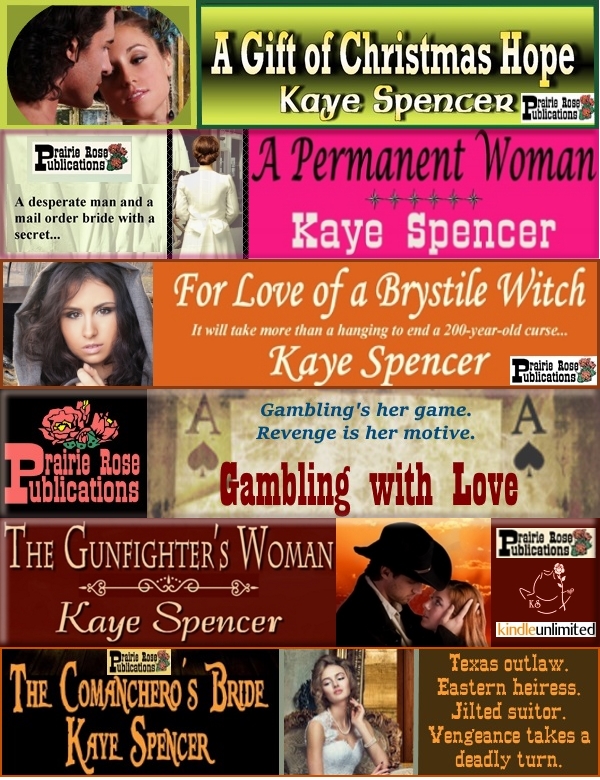
My stories are available on Amazon.com. Kindle - KindleUnlimited - Print
Until next time,
Kaye Spencer Writing through history one romance upon a time
Website/Blog- https://www.kayespencer.com
Instagram - kayespencer
Twitter - http://www.twitter.com/kayespencer
Pinterest - http://www.pinterest.com/kayespencer
Facebook - https://www.facebook.com/kayespencer23
Amazon - http://www.amazon.com/author/kayespencer
LinkedIn - https://www.linkedin.com/in/kayespence
Prairie Rose Publications - http://prairierosepublications.com/
YouTube Channel - http://www.youtube.com/user/kayespencer?feature=mhee