Search This Blog

Showing posts with label Into The Land Of Shadows. Show all posts

Tuesday, December 11, 2018

My Fourteen Rules Of Writing


By Kristy McCaffrey

Many an author has posted such a list, and there’s much good info out there if seeking guidance in the writing arena. I’ve been at this inscribing thing now for nearly twenty years (more like forty if you consider my childhood scribbles—yes, they do count), so it goes without saying that I’ve learned a few things along the way.

Here they are.

—Watch ‘Romancing the Stone’, a wonderful movie about romance author Joan Wilder. It’s incredibly accurate, right down to the sticky notes all over her kitchen reminding her she needs to do this and that. When writing, we writers forget everything.

—I’ve given up trying to write before I’ve checked email, blogs, Facebook, Twitter, and Pinterest. I write in the afternoons and evenings, which pretty much ruins dinner every night.


—Get an iPod to block out the kids and husband. I make playlists for each story, offering me one more avenue to procrastinate on my writing. (Never mind that no one uses iPods anymore. I will never give mine up.)

—Buy bookshelves to hold research books but know that it won’t matter. You’ll still run out of room, so make peace with tomes strewn all over the floor.


—When I’m stuck on a scene, I’ve found the most effective method is to stop writing and wait for inspiration. Three days later when nothing hits, I return to the computer pissed off and write a scene in frustrated anger. But, hey, I’ve finally moved forward.

—I rewrite any sentence that contains ‘lie’ or ‘lay’ because I’m unable to remember the rule and too lazy to look it up.


—I always keep a thesaurus and dictionary handy. My trade is words, and my work is to make ’em count. (By the way, this doesn’t count for ‘lie’ or ‘lay’—a loathsome trickery in the English language.)

—Don’t name an animal after a color. If you decide to change the name later, a ‘search and replace’ in Word will make you realize how many times you used the word ‘white’ within your manuscript (because it will replace all the wrong ‘whites’). Now, it becomes apparent that the thesaurus has been neglected.

—I refuse to feel guilt when I use an adverb.

—I have a tendency to put spectacles on my heroines in every first draft, which I must later delete. It’s the oldest trick in the book to make my ladies appear ‘smart’. Did I mention that I wear glasses?

—I’ve learned to trust my muse. She’s a sneaky little devil, never making things clear until the end of a project. By then I’ve eaten too much ice cream and moped around believing I’ll NEVER make this story work.

—I’m a writer, not a brain surgeon or a rocket scientist, and therefore there’s no sense dwelling on bad prose (mine or anyone else’s). Move on. I can always do better next time. (This is my pep talk after bouts of insecurity and lots of ice cream.)


—I obsess constantly about where to put commas, which has led to more than one restless night. I will edit year-old blog posts if I realize I missed a critical comma. And no, I'm not obsessive-compulsive, hyper-focused, or anal. (I will probably re-edit this post next year...)

—I keep writing until the heart of a story can be excavated. It always exists, and it’s my job to clear the dirt and debris so that it can shine. I’m simply a translator of myth and symbolism into something others can enjoy. It’s my gift, and my curse. I imagine brain surgeons feel the same way.

So, to recap. Writing is exhilarating, but also crappy. (I can't find ‘crappy’ in my thesaurus, so have no other word to use. Sorry.)


Since it’s December and the season of giving, I want to send one lucky commenter an autographed print copy of INTO THE LAND OF SHADOWS, a standalone historical western romance with humor and paranormal elements. It’s also a little on the steamy side. If you would like to be entered, please include your email address in the comments so that I don’t have to crawl the web to find you. Unfortunately, the print copy is for U.S. addresses only. If you’re international, the prize will be digital. Winner chosen on December 14, 2018.


Connect with Kristy


Wishing you all a blessed and bright 2019!!


Tuesday, March 14, 2017

Indian Boarding Schools

By Kristy McCaffrey

During the 1800’s, when many Native Americans were forced onto reservations, the American government agreed to provide money, food, and education for their children. While this exchange proved to be largely detrimental to the Indian population, it was still believed that if they could learn to speak English, become Christian, and farm the land as European Americans did, then they would become successful in life. To this end, Christian churches began to open mission schools on reservations. Later, boarding schools were created with the idea that it would be easier to teach children a new way of life if they were taken from their own families and people. Boarding schools were established in 15 states or territories including Pennsylvania, Michigan, Nebraska, Oregon, California and Idaho. Children stayed anywhere from four to ten years.


While some parents readily agreed to send their children, believing they needed to learn English and new job skills, others refused. In many instances, the government forced the children to go. In 1895, a group of Hopi leaders were sent to Alcatraz Island for seven months because they wouldn’t send their children to a boarding school.

New students were stripped of their native clothing and given uniforms. Their hair was usually cut short, and they were given English names. They were punished if they used their native language. Their spiritual traditions were forbidden, replaced instead with church services and the observance of Christian holidays. The schools were often over-crowded and many children became sick, contracting influenza, tuberculosis, and measles.


While overwhelmingly negative for most children, one positive aspect was that many built lasting friendships with Native Americans from other tribes while at school together. It wasn’t until the mid-1900’s that most boarding schools were closed.

* * * * *

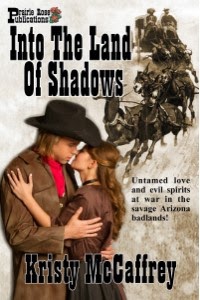
In my book, Into the Land of Shadows, a historical western romance set in the Arizona Territory, Ethan Barstow and Kate Kinsellawhile searching for Ethan's brother, Charleyfind three Hopi children hiding in the desert, on the run from nearby Keams Canyon Boarding School.


A steamy historical western romance set in 1893 Arizona Territory.

Carolyn Readers’ Choice Award Finalist


FREE in Kindle Unlimited

“…as if ‘Romancing The Stone’ and ‘The Good, the Bad and the Ugly’ and ‘Dances With Wolves’ got together and had a kid.” ~ Armenia, Reading Alley Reviewer

Into the Land of Shadows is a must read. Kristy McCaffrey tells a story that is engaging and edge-of-the-seat gripping. Her vivid descriptions and great cast of characters, with exceptional dialogue, bring this story to life.”

            ~ Cherokee, Coffee Time Romance & More


Excerpt
Frustrated from enduring Kate’s close proximity for hours, Ethan decided it was high time he broke Brandy of her overwhelming fondness for her mama. How was he supposed to keep his distance if Kate rode so close to him all day? It was his own damn fault, of course, for not being stricter with his favorite mare. Ethan had a soft spot for Whiskey and honestly saw no problem allowing her to dote on her offspring. But it was a problem now. Kate Kinsella was a problem.

Movement off to the right caught his eye. An object flew toward him and he jerked forward in reflex as Kate screamed.

Ethan turned to see the rock smack her in the face and push her from Brandy. He struggled with Whiskey’s reins as the horse snorted and stepped backward. She wanted to bolt, but Ethan held her steady with one hand while pulling his gun with the other.

He shot in the direction of the hidden attacker. Or attackers? It couldn’t be the three bastards who wanted their donkey back. If it was, they were damn persistent. Ethan decided he would pay for the damn animal and be done with it.

He slid off Whiskey’s back and crouched low. He shot three more times as he rounded Brandy’s backside, hoping she wouldn’t kick him in the head.

As he reached Kate’s side Whiskey and Brandy bolted, leaving a cloud of dust in their wake and Ethan and Kate without cover. Fred was nowhere to be seen. There was no return gunfire so Ethan scooped Kate into his arms and ran quickly behind a rocky outcrop, keeping his gun pointed and ready. As he released her to the ground he saw blood oozing between her fingers where her hand covered her left eye.

“Jesus, Kate, are you all right?

“What was that?” She looked dazed.

“I think it was a rock,” Ethan replied. “Move your hand and let me have a look.” She complied and Ethan saw an open gash but luckily it had missed her eye. Still, it was nasty and needed immediate attention.

“You’re gonna be fine,” he said soothingly. She was going to have a humdinger of a scar, especially if he didn’t get it stitched up, but he didn’t really want to break that news to her yet.

“I’m bleeding a lot,” she said, staring at her bloodied hand.

“I know.” Ethan reloaded his gun. “Face wounds do that. I’m gonna take care of these sonsofbitches,” he said, anger filling his thoughts. “Stay here. I’ll get you cleaned up in no time.”

“Ethan—” He ignored Kate’s plea, stood and advanced on their attackers.

“You worthless scumbags!” he yelled. “Come on out and show yourselves.”

With his arm stretched long, he fixed his gun on the last known location of the rock thrower. No more shots in the legs or shoulders. If they didn’t surrender this time, he would kill them. Kate’s safety demanded it.

He heard the scuffle of rocks and dirt as someone, or several men, started to retreat. Ethan made a wide arc and moved quickly to the assailant's hideout.

“I’ll shoot,” he warned, his finger resting on the trigger and close to doing just that. He stopped short at the faces that stared back at him, wide-eyed and innocent.

The attackers were three young Indian children.

Connect with Kristy


Tuesday, April 12, 2016

Flagstaff, Arizona

By Kristy McCaffrey

Located in northern Arizona, Flagstaff lies at the base of the highest mountain range in Arizona—the San Francisco Peaks. Since the mid-19th century, the town has been a popular tourist destination due to its close proximity (75 miles) to the Grand Canyon.

The San Francisco Peaks. Mt. Humphreys is the tallest
mountain in Arizona at 12,637 feet.
On July 4, 1876 a group of campers at the base of the San Francisco Peaks stripped a pine tree and used it to raise an American flag. This tree inspired the name “Flagstaff.”

Flagstaff circa 1882.
The early economy of Flagstaff consisted of timber, sheep, and cattle. The Atlantic and Pacific Railroad arrived in 1880. When the Santa Fe Railroad purchased it in 1885, Flagstaff became the largest town between Albuquerque and the Pacific Ocean.

The Babbitt sons arrived in 1881 with $17,000 and eventually settled in Flagstaff, creating the famous CO Bar Ranch which still exists today. The establishment of the Babbitt Brothers Trading Company in 1889—along with several other businesses in northern Arizona—greatly aided the growth and development of the area.

The Babbitt brothers.
Flagstaff suffered its share of criminal activity. “Cattle rustling was rampant and only conquered by stringing the culprits to a limb of a tree and riddling the bodies with bullets. Many were the shootings in the town….They write about Tombstone and other early settlements, but Flagstaff was as bad as any of them.” (from A Brand From the Burning by Charles C. Stemmer, 1959)

The Northern Arizona Normal School was established in 1899. In 1966, it was renamed Northern Arizona University.

Flagstaff circa 1899.
Massachusetts astronomer Percival Lowell established Lowell Observatory in 1894, naming Flagstaff an ideal location due to its elevation. Pluto was discovered here by Clyde Tombaugh in 1930, and in 1978 Pluto’s moon, Charon, was also identified.

Lowell Observatory, 1897.
Today, Flagstaff still has a strong tourism economy due to its location to the Grand Canyon, Historic Route 66, the Arizona Snowbowl Ski Area, Sedona and Oak Creek Canyon, Meteor Crater, and the Navajo and Hopi Indian Reservations.


***********

My novel, Into the Land of Shadows, begins and ends in Flagstaff.

Kate Kinsella has no choice but to go after Charley Barstow and talk some sense into him. After all, he's skipped town, leaving a string of broken hearts and his pregnant fiancée, Agnes McPherson. But Kate didn't count on being kidnapped by a band of criminals along the way!

Ethan Barstow is hot on his younger brother's trail, too. He rescues Kate, believing her to be Charley's fiancée, and suggests they try to find him together. Kate's reluctance has him baffled.

All hell breaks loose when they discover Charley in search of a copper mine—not wishing to be found by anyone; certainly not Kate! But, then, Kate was always trouble—and now she's brought it to his doorstep, with tales of a pregnant fiancée and his brother Ethan, who he hasn't seen in five years.

Can Ethan and Kate ever find their own love and happiness with one another through the dark deception and hurt? Or will they both return INTO THE LAND OF SHADOWS...


Kristy McCaffrey has been writing since she was very young, but it wasn’t until she was a stay-at-home mom that she considered becoming published. She’s the author of several historical western romances, all set in the American southwest. She lives in the Arizona desert with her husband, two chocolate labs, and whichever of their four teenaged children happen to be in residence.

Connect with Kristy


Tuesday, August 12, 2014

Native Americans: The Navajo

By Kristy McCaffrey

The Navajo have been located in the Four Corners region of the American Southwest since the 12th century. Primarily hunters and gatherers, they were forced to fight—along with many other Indian tribes—the progression of the white population during the early 1800’s, which eventually led to the Long Walk. This arduous journey, which encompassed well over 50 separate treks led by the U.S. Army to the Bosque Redondo in New Mexico Territory, occurred from 1863 to 1866.

The accounts of death by starvation, sickness, or violence left an indelible trauma on the people. Although they were allowed to return to their land in 1868, they would never forget this painful period of their history.


Navajo lore states that a skinwalker is a man (occasionally a woman) who has gained supernatural powers that allow them to assume an animal form, usually a coyote, wolf, owl, fox, or crow. Such individuals practice evil over good, choosing to curse others rather than heal. It is believed that skinwalkers have the ability to steal the “skin” or body of another person. Because of this, most Navajo avoid the use of bear, coyote, wolf and cougar pelts, instead preferring sheepskin or buckskin.

For illnesses and other maladies, it is customary to consult a Navajo medicine man. A typical ceremony lasts for four days, and involves chants and specific herbs that have been collected for the patient. Sometimes a sand painting is utilized, which is later destroyed. The premise of the work of the medicine man is to restore balance to an individual’s spirit.


Known for their weavings, Navajo textiles are highly regarded and have been traded for over 150 years. Initially, weavings were used for cloaks, saddle blankets, sashes and other similar items, but after the 1880’s the Navajo began making them for tourists. Strong geometric patterns are an earmark of their work.


During World War II, Navajo Code Talkers were employed to confuse the enemy. Navajos were inducted and trained in the U.S. Marine Corp and placed on the front lines. The code was never broken.


Today, the Navajo are the largest federally recognized tribe of the United States.

The traditional Navajo home is a hogan, an 8-sided
dwelling with a doorway always facing east toward
the sunrise.
Don't miss Kristy's historical western romance novel, Into The Land Of Shadows, which features several Navajo characters.


In the land of the Navajo, spirits and desire draw Ethan and Kate close, leading them deeper into the shadows and to each other.

For more info, visit Kristy's website.


Works Cited
Iverson, Peter. Diné: A History of the Navajos. University of New Mexico Press, 2002.

Photo Credits
www.crystalinks.com
http://captivatedby.com/four-corners-four-states/
http://mprofaca.cro.net/navajo.html
Shutterstock


Tuesday, February 11, 2014

The Intuitive Process Of Writing


Post by Kristy McCaffrey

I didn’t begin my writing career until I was 33 years old, when I decided to write a book (called a manuscript until it’s published—I knew so little). I’d been writing all my life, but at that moment I made a conscious decision to refine the process. The difference between a published and an unpublished writer is really the desire to trim, tighten, and tuck that mash of creativity into something coherent. Working with a story, I believe, involves a great deal of intuition. As a writer, I’ve had to learn how to trust the process, and it’s not always easy. This element of faith is not unlike a religious leaning—you simply don’t have all the answers. If you’re lucky, they come at the end of the work, but sometimes they don’t. Writing is nothing if not a learning process.

My first book (yay, it was published so went from ‘manuscript’ to ‘book’) took four years to write. The Wren, a historical western romance, features a Texas Ranger reunited with a woman he thought was murdered by Comanche as a child. The seeds of this story came to me when I was 15 years old. There wasn’t much—just a girl who knew two brothers, and a ranch (which I assumed was in Arizona since that’s where I’ve lived most of my life). The characters became Molly and Matt, and his brother Logan, but when I decided to refine the story I had to become more specific. I soon realized the setting wasn’t Arizona, and after reading an entire tome on the history of Texas (Lone Star: A History of Texas by T.R. Fehrenbach), I knew I’d found the locale. It continued to be a back-and-forth process, however, between research and following the inherent thread of the story, a thread I wasn’t always aware of. (Often this becomes the underlying theme of a work. In The Wren it was the idea of home, and the many ways we define that.) But I trusted, and this book is still the most well-received of any of my stories.

My second book, The Dove, was a bear to write, which is probably why it’s the shortest novel I’ve published. In this story, Logan, the brother, decides to track down Claire Waters, who, it turns out, lives in a brothel but hopes to become a doctor one day. Looking back, I didn’t trust my intuition enough, which I think is why I ran out of story. I tried to manhandle my characters too much, of which I had too many to begin with. I struggled to keep them all straight, along with motivations and what each of them might know from moment to moment. My editor had her work cut out for her, but helped tremendously in fixing the many problems.

My third book, The Sparrow, follows Emma Hart (sister to Molly) and her desire to enter Grand Canyon, an audacious endeavor considering the year is 1877. A Texas Ranger joins her and off they go. I wrote the first half of this story entirely on intuition. After the struggle with my last book, I knew I needed to trust the inner workings of my imagination. Unfortunately, it led me to a dead-end at the halfway point—ugh, the
vagaries and whims of creativity. It took me several years to figure my way out of this one. (I did raise my children at the same time, so wasn’t writing full-time.) The problem was that the journey Emma undertook wasn’t just physical, and I didn’t understand it until I found a book on shamanism. The light bulb went off, and I spent over two years delving into the subject. It turned out my intuition had been spot on (isn’t it always?), and I was finally able to complete Emma’s pilgrimage. As a side note, this book has received a mixed reception. Following one’s inspiration doesn’t always result in far-reaching connections with readers. However, I believe that an adherence to intuition draws an authentic voice from the author, a commitment that is important to the writer herself.

With my fourth book, Into The Land Of Shadows, recently published here at Prairie Rose, I think I finally found a balance between trusting the creative hits alongside the nuts-and-bolts research. I certainly had the most fun writing this one. Perhaps that’s what experience bestows—knowing that those dark spots during the writing of a project won’t always remain. While it’s difficult to trust those whispers nudging you in a certain direction, there’s always a bigger picture, in life as well as in stories, and a writer needs to learn to have faith and become the channel for that narrative to be born.

Be sure to stop by my website www.kristymccaffrey.com and enter my February contest!
  Happy Valentine’s Day!

Tuesday, January 14, 2014

The Year I Lived On The Navajo Indian Reservation


Post by Kristy McCaffrey

It’s a pleasure to be a part of Prairie Rose Publications. I’ll be blogging the second Tuesday of each month. For my first post, I’d like to share an experience that has had a lasting impact on me. 

When I was nine years old, my parents moved my sister and myself to the Navajo Indian Reservation. Needless to say, I very much did not want to go. My dad, who has long had a deep and abiding respect for Native Americans, saw this as a chance to give back with his life. He took a job as an accountant with an arts and crafts store in Window Rock, Arizona. We obtained a house just across the border in New Mexico, in a small town aptly called “Navajo.”

I should preface my experience by saying that I’ve never been great at making friends. I’ve always been a little too quiet and withdrawn. Add to that my displeasure over being wrenched from my life in Phoenix, and I was none too happy. My sister, nearly four years younger and in kindergarten, embraced the journey with much more enthusiasm. She quickly came home speaking Navajo. I, however, was in fourth-grade and only one of two white girls in the classroom. I was teased constantly, for no other reason than being different, and it left me less than congenial toward most of the other kids.

It was 1975 and we lived in a neighborhood that consisted of generic, government housing. We weren’t rich by any means, but when we moved in, it became quickly known that we had a working telephone and my mother was generous in sharing kitchen items. After a time, she had to start saying no. The charity was simply getting out-of-hand. Unfortunately, many of the Navajo were complacent and drank too much. Even as a child, it struck me as a rather depressing place to live.
The view from our house in Navajo, New Mexico.
One night, a Navajo man came to our front door with a shotgun. He said he was going to shoot our dog, believing that he’d killed his daughter’s mutt. There was a pack of rather mean canines that roamed the neighborhood; there was no doubt in our mind that they had done the killing. My dad had erected a barbed-wire fence for our two dogs, so we were certain that neither was guilty. (The fence was to protect them, really.) My dad spent several hours, and several beers, trying to convince the man not to shoot, and thankfully it worked. 

I developed a panic-filled fear of AIM walkers, fueled by stories heard from classmates. I now know that this acronym stands for the American Indian Movement, a group dedicated to addressing the issues of present-day Native Americans, but in my scared mind they were ghost-like shape shifters that prowled the wash behind our house. There were many nights I literally shook in terror while trying to sleep, fearing they would snatch me from my bed.

But, lest I paint a completely dark picture of the year I spent in Navajo land, there were intriguing aspects to it. A hex was placed on the craft store chain where my dad worked. Since it involved all of the employees, he was allowed, despite being a white man, to participate in the ceremonies conducted by a medicine man. Some of his experiences I incorporated into my new novel with Prairie Rose Publications, Into The Land Of Shadows, when the main characters find themselves under the shadow of a curse. During one of the ceremonies at which my dad was present, the medicine man burned a piece of human skull. Two female employees reported instant relief from a terrible headache that had suddenly besieged them. Back at home, at the same time, my mother said I’d been distraught and crying for hours from pains in my head, which immediately stopped when the bone was destroyed. We were all tied to this land in ways none of us quite understood.

And the land was stark, amazing, and absolutely breathtaking. Our house sat at the base of a sheer red rock cliff. One day, we climbed it. At the midway point, a precipitous rock face had to be traversed. One of our dogs made it, but the other, an overweight black Labrador, couldn’t navigate the steep path. She paced at the bottom, barking and whining, while we scrambled onward. The expansive view at the top, coupled with the solitude and palpable energy in the land, left me with bittersweet memories. The region drenched the soul with possibilities, but I know now that I was too young to appreciate it, to channel it in a useful way. In some regards, the Navajo themselves, at that place and that time, had lost their center as well.

At the end of that year, my father brought us back to Phoenix, for which I was greatly relieved. But my time there left an indelible mark, always calling me back. I returned, many years ago, to show my husband. Not much had changed. With my new book, I felt compelled to write about the Navajo and what they were long ago—people who struggled, who lived, and who loved. Just like the rest of us. 

Leave a comment and be eligible to win an autographed print set of my historical western romance saga, the Wings of the West Series (includes The Wren, The Dove, and The Sparrow).


Into The Land Of Shadows is now available in print and digital!

Rancher Ethan Barstow is weary of the years-long estrangement from his brother, Charley. Deciding to track him down is easy; not so easy is riding in the company of Kate Kinsella, Charley’s fiancée. In the land of the Navajo, spirits and desire draw them close, leading them deeper into the shadows and to each other.


Kristy McCaffrey has been writing since she was very young, but it wasn’t until she was a stay-at-home mom that she considered becoming published. A fascination with science led her to earn two engineering degrees—she did her undergraduate work at Arizona State University and her graduate studies at the University of Pittsburgh—but storytelling was always her favorite hobby. Born and raised in Arizona, she writes Old West romances to capture the landscapes that were such a big part of her childhood. Her first novel, The Wren, was a CAPA winner for Best New Author Traditional, a Texas Gold finalist, and a HOLT Medallion finalist for Best First Book. The Sparrow was the 2012 Winter Rose Winner in the Published Historical Division. She lives in the Arizona desert with her husband, where they frequently remove (rescue) rattlesnakes from their property. Her four teenaged children are in varying stages of flying the nest, so her two chocolate labs—Ranger and Lily—are the recipients of her maternal instincts these days. 


Sign up for Kristy’s newsletter this month and be entered to win a $25 Amazon gift card.