Post by Kristy McCaffrey
I
didn’t begin my writing career until I was 33 years old, when I decided to
write a book (called a manuscript until it’s published—I knew so little). I’d
been writing all my life, but at that moment I made a conscious decision to
refine the process. The difference between a published and an unpublished
writer is really the desire to trim, tighten, and tuck that mash of creativity
into something coherent. Working with a story, I believe, involves a great deal
of intuition. As a writer, I’ve had to learn how to trust the process, and it’s
not always easy. This element of faith is not unlike a religious leaning—you
simply don’t have all the answers. If you’re lucky, they come at the end of the
work, but sometimes they don’t. Writing is nothing if not a learning process.
 My
first book (yay, it was published so went from ‘manuscript’ to ‘book’) took
four years to write. The Wren, a historical
western romance, features a Texas Ranger reunited with a woman he thought was
murdered by Comanche as a child. The seeds of this story came to me when I was
15 years old. There wasn’t much—just a girl who knew two brothers, and a ranch
(which I assumed was in Arizona since that’s where I’ve lived most of my life).
The characters became Molly and Matt, and his brother Logan, but when I decided
to refine the story I had to become more specific. I soon realized the setting
wasn’t Arizona, and after reading an entire tome on the history of Texas (Lone Star: A History of Texas by T.R.
Fehrenbach), I knew I’d found the locale. It continued to be a back-and-forth
process, however, between research and following the inherent thread of the
story, a thread I wasn’t always aware of. (Often this becomes the underlying
theme of a work. In The Wren it was
the idea of home, and the many ways we define that.) But I trusted, and this
book is still the most well-received of any of my stories.
My
first book (yay, it was published so went from ‘manuscript’ to ‘book’) took
four years to write. The Wren, a historical
western romance, features a Texas Ranger reunited with a woman he thought was
murdered by Comanche as a child. The seeds of this story came to me when I was
15 years old. There wasn’t much—just a girl who knew two brothers, and a ranch
(which I assumed was in Arizona since that’s where I’ve lived most of my life).
The characters became Molly and Matt, and his brother Logan, but when I decided
to refine the story I had to become more specific. I soon realized the setting
wasn’t Arizona, and after reading an entire tome on the history of Texas (Lone Star: A History of Texas by T.R.
Fehrenbach), I knew I’d found the locale. It continued to be a back-and-forth
process, however, between research and following the inherent thread of the
story, a thread I wasn’t always aware of. (Often this becomes the underlying
theme of a work. In The Wren it was
the idea of home, and the many ways we define that.) But I trusted, and this
book is still the most well-received of any of my stories. My
second book, The Dove, was a bear to
write, which is probably why it’s the shortest novel I’ve published. In this
story, Logan, the brother, decides to track down Claire Waters, who, it turns
out, lives in a brothel but hopes to become a doctor one day. Looking back, I
didn’t trust my intuition enough, which I think is why I ran out of story. I
tried to manhandle my characters too much, of which I had too many to begin
with. I struggled to keep them all straight, along with motivations and what
each of them might know from moment to moment. My editor had her work cut out
for her, but helped tremendously in fixing the many problems.
My
second book, The Dove, was a bear to
write, which is probably why it’s the shortest novel I’ve published. In this
story, Logan, the brother, decides to track down Claire Waters, who, it turns
out, lives in a brothel but hopes to become a doctor one day. Looking back, I
didn’t trust my intuition enough, which I think is why I ran out of story. I
tried to manhandle my characters too much, of which I had too many to begin
with. I struggled to keep them all straight, along with motivations and what
each of them might know from moment to moment. My editor had her work cut out
for her, but helped tremendously in fixing the many problems.  My
third book, The Sparrow, follows Emma
Hart (sister to Molly) and her desire to enter Grand Canyon, an audacious
endeavor considering the year is 1877. A Texas Ranger joins her and off they
go. I wrote the first half of this story entirely on intuition. After the
struggle with my last book, I knew I needed to trust the inner workings of my
imagination. Unfortunately, it led me to a dead-end at the halfway point—ugh,
the
My
third book, The Sparrow, follows Emma
Hart (sister to Molly) and her desire to enter Grand Canyon, an audacious
endeavor considering the year is 1877. A Texas Ranger joins her and off they
go. I wrote the first half of this story entirely on intuition. After the
struggle with my last book, I knew I needed to trust the inner workings of my
imagination. Unfortunately, it led me to a dead-end at the halfway point—ugh,
thevagaries and whims of creativity. It took me several years to figure my way out of this one. (I did raise my children at the same time, so wasn’t writing full-time.) The problem was that the journey Emma undertook wasn’t just physical, and I didn’t understand it until I found a book on shamanism. The light bulb went off, and I spent over two years delving into the subject. It turned out my intuition had been spot on (isn’t it always?), and I was finally able to complete Emma’s pilgrimage. As a side note, this book has received a mixed reception. Following one’s inspiration doesn’t always result in far-reaching connections with readers. However, I believe that an adherence to intuition draws an authentic voice from the author, a commitment that is important to the writer herself.
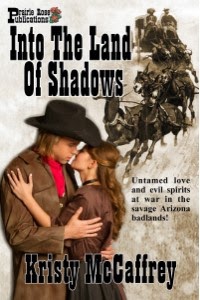 With
my fourth book, Into The Land Of Shadows,
recently published here at Prairie Rose, I think I finally found a balance
between trusting the creative hits alongside the nuts-and-bolts research. I
certainly had the most fun writing this one. Perhaps that’s what experience
bestows—knowing that those dark spots during the writing of a project won’t
always remain. While it’s difficult to trust those whispers nudging you in a
certain direction, there’s always a bigger picture, in life as well as in
stories, and a writer needs to learn to have faith and become the channel for
that narrative to be born.
With
my fourth book, Into The Land Of Shadows,
recently published here at Prairie Rose, I think I finally found a balance
between trusting the creative hits alongside the nuts-and-bolts research. I
certainly had the most fun writing this one. Perhaps that’s what experience
bestows—knowing that those dark spots during the writing of a project won’t
always remain. While it’s difficult to trust those whispers nudging you in a
certain direction, there’s always a bigger picture, in life as well as in
stories, and a writer needs to learn to have faith and become the channel for
that narrative to be born.

Happy
Valentine’s Day!
