Search This Blog

Wednesday, September 11, 2024

Movie Kisses Series 9/11/2024 Pride and Prejudice #prairierosepubs #moviekisses


Here we are at the ninth
installment of my year-long look at The Kiss in historically-set movies.

Recap of movie kisses so far:

January KissThe Phantom of the Opera 

February KissThe Princess Bride

March KissThe African Queen

April KissShakespeare in Love

May KissQuigley Down Under

JUNE KissIndiana Jones and theDial of Destiny

JULY Kiss – The Quiet Man

AUGUST KissCasablanca


The September movie kiss is from the Kiera Knightly and Matthew Macfadyen Pride and Prejudice. While I really like the Colin Firth and Jennifer Ehle Pride and Prejudice, it comes up wanting in the kissing department, which is a missed opportunity.

From the moment Mr. Darcy sees Elizabeth at the party and does the rocked-to-his toes double take, we anticipate The Kiss. We need The Kiss.

We make it almost to the end of the movie wondering when the kiss will happen and here comes Mr. Darcy walking toward Elizabeth through the field in the morning mist scene. We feel our hearts begin to melt with how wildly romantic (and sexy) the scene is.

He says to her, Surely, you must know it was all for you. (be still my heart)

And they move closer…hold hands…foreheads touching…rising sun illuminating their faces… We lean forward for a most touching  and tender scene… without The Kiss. We nearly swoon from the anticipation.


A few scenes later, they enjoy a little newlywed banter that leads to The Kiss, which leaves us perfectly and incandescently happy.


See you in October for more kisses from the big screen.

NOTE: Once again, Blogger is evidently in a mood. I am unable to reply to comments. I appreciate everyone who muscles their way through and leaves a comment, and I appreciate everyone who stops by to read. Thanks bunches.

Kaye Spencer
www.kayespencer.com


Monday, September 2, 2024

The Truth Behind the Pied Piper of Hamelin

 The Truth Behind the Pied Piper of Hamelin

C.A. Asbrey


The German town of Hamelin is the capital of the Hamelin-Pyrmont region of Lower Saxony, but it's known the world over for the tale of the magical piper who led the rats from the town, only to return with a heart full of vengeance when he wasn't paid for his services.  A church window dating from around 1300 is the first mention of the story, but that was destroyed in 1660. Johannes de Lüde, Dean of Hamelin had a chorus book from around 1384 containing a Latin verse of eyewitness account. His mother was reportedly there. The Rattenfängerhaus (Rat Catcher's House) in Hamelin bears the inscription:

In the year 1284 on the day of [Saints] John and Paul on 26 June 130 children born in Hamelin were lured by a piper clothed in many colours to Calvary near the Koppen, [and] lost.   

The Wedding House has a similar inscription, as has the town gate and many supporting manuscripts tell a very similar story, so something obviously happened. But what?

Ergot on Wheat

One theory is that the Dancing Mania that swept through Europe in the 12th century contributed to the tale. This was possibly a form of mass psychogenic illness that caused a contagion of manic dancing in the sufferers. One case in 1237 involved a large group of children who danced from Erfurt to Arnstadt, a distance of 12.92 miles. Some contribute the mania to ergot poisoning; a fungus that grows on rye, wheat, oats, and barley and causes Ergotism. Ergotism is also known as St.Anthony's Fire, named after the monks who specialised in treating the condition, and manifests with symptoms such as muscle spasms, fever, mania, hallucinations, unable to speak, dazed, uterine contractions, vomiting and unconsciousness. Controlled doses were used to induce abortions, and as it also constricted blood supply it could be used to stop bleeding after childbirth. That same vasoconstriction also meant that the victim's feet and hands could be damaged leading to shooting pains, gangrene, and amputation.           

Other possible explanations include a pilgrimage they never returned from, and children really did go en masse on pilgrimages in the Middle Ages in Europe. The most famous is The Children's Crusade of 1212, where thousands of children marched to the Middle East to join the crusades. The movement failed, and many died or were sold into slavery as it was unsanctioned and unsupported. It is possible that children did leave on the crusade and that parents lied to the king and the church about the loss of the children, as the crusade was not approved, but the date is wrong. Hamelin's episode has a very definite of the date of 1284. Others say that it may have been a military campaign, with the Pied Piper being a recruiter. Many documents state the date as the 26th June, midsummer's day, which had significance in agricultural societies, with a battle taking place between the persistent pagan beliefs and the growing power of the church. Some suggest that the piper was a shaman leading the children away to perform midsummer rites, and that a battle ensued between local monks and the pagans, causing children to be taken away into monasteries and nunneries. This seems fanciful and there's no evidence to back this up whatsoever. Nor is William Manchester's book suggesting that the piper was a predatory pedophile supported by evidence either. It's clear that the rats were a later addition, and the agreed date of the departure was too early for it to be a cryptic reference to those who died of the plague.   

Medieval Minstrels

The answer may lie in the odd clothing worn by the piper, and in a battle you may never have heard of. The Battle of Bornhöved meant that an area previously occupied by Slavs was available for occupation by Germans. It broke the Danish hold on the region, and there is historical evidence of systematic efforts to get able-bodied youths to colonize Brandenberg and Pomerania. We do know that the bishops and dukes of Pomerania, Brandenburg, Uckermark, and Prignitz sent out recruitment agents offering rewards for young people prepared to locate to the newly won lands and settle there. The agents were accompanied by drummers and pipers in bright theatrical clothes to catch people's attention-and that was no coincidence as these glib locators looked like entertainers. They were. 

Jongleurs were itinerant musicians who were at the bottom on the ladder of paid musicians. They were all round entertainers, telling stories, preforming tricks, singing and playing instruments. Jongleurs performed in groups as well as alone, but the next step up the career ladder gives us more of a clue and is a more likely suspect. Minstrels wore distinctive coloured clothes, a livery provided by the court that employed them, reflecting the heraldic colours of that aristocratic family and could be described as 'pied' - having two or more colours. They had permanent employment for at least part of the year in the court of a nobleman or in a town, but they did travel, and mostly in the summer - remember that the date is given as midsummer's day. Unlike jongleurs, they only played and sang, but people did dance to their music, again reflecting elements of the legend. Monks were instructed not to watch minstrels as the festivities could lead them into sin. So that gives us a brightly coloured musician, and people encouraging the young to leave. The battle took place in 1227, and landowners were actively encouraging people to move by the time of the exodus of 130 children (more probably young people) in 1284.

To investigate the theory that many young people were tempted away from Hamelin for a new future in much the same way as people emigrated to the New World, historian Ursula Sautter notes that thousands of people from Saxony and Westphalia headed east, and the etymology of the villages proves it. There are five villages called Hindenburg running in a straight line from Westphalia to Pomerania, and three called Spiegelbergs. Other names from the area are scattered around the area of Beverungen south of Hamelin to Beveringen northwest of Berlin to Beweringen in modern Poland. We know that people moving for a new life often take their favoured place names with them.  

More compelling is the research into family names done by Linguistics professor Jürgen Udolph. He entered family names from Hamelin into a database and estimated that they mostly ended up making a settlement near Starogard in what is now northwestern Poland. Local Polish telephone books list names you would not expect in that region. Many appear to be derived from German names that were common in the village of Hamelin in the thirteenth century. The names include Hamel, Hamler and Hamelnikow, all apparently derived from the name of the original village.

And in a final sad touch, it would explain the poignant ending to the tale as the blind and the lame were left behind as they were unable to do the heavy physical work required to build a new community.


Monday, August 26, 2024

The difference of historicals - Historical Romance, Historical Fiction.

From the Haywain Triptych by Hieronymus BoschFor today's blog I'd like to point out a few ways in which historicals are - well, different. I love reading historical novels of all genres and I love to write them, so are my five 'star' points that I look out for in the stories that I really enjoy.
 
1. Realistic reactions. In the past, the roles and pressures on people were different to now and a good historical reveals this. Women's liberation as a movement did not emerge until the late 1960s. Women (and working class men) did not acquire the vote in Britain until the early 20th century. Before then, the role of women was determined by family and peer pressure, by the church, by society's expectations, by class and above all by biology. (My maternal great-grandmother had 14 pregnancies, 12 births, 2 miscarriages. In the days before reliable birth-control, women often spent their child-bearing years doing just that.)

In earlier warrior societies, where brute strength was prized as a means of winning booty, only a very unusual woman would be big enough and strong enough to fight as an equal warrior. Remember, food would often be in short supply and the sons and men ate first, not simply because of their higher status but because of survival. Men are generally more physically strong in pushing heavy ploughs, and so on. They needed to be well-fed.

2. Realistic dress. Fashion and past fashions is a fascinating business to me, but in a good historical dress also reveals class and tactile elements. A heroine who is changing her gowns every chapter may not be realistic. Clothes were costly and time-consuming to make. Fashions in the country would be less cutting edge than those of the city. Even cloth and colours would vary - the rich would have access to silks and more expensive dyes.

3. Realistic settings. How people lived in the past is very different from modern-day life (at least in the developed parts of the world) and that is worth showing in a historical. The daily trudge for water would be part of someone's life, as were the anxious waiting on crops and the hunger experienced while the harvest slowly ripened. In an unscientific age the fear of the unknown affected everyone - was the hail storm the sign of an angry god? Was a sudden illness in the village the result of witchcraft? If illness is not understood, then the evil eye becomes as good a reason as anything else. If 'everybody knows' that disease comes from the stench of the gutter, it becomes understandable to protect your cottage from pestilence by growing fragrant roses around the door.

4. Realistic plotting. In the past, communications were a major problem. In a world without the internet, battles could be lost because the flanks of an army literally could not talk to each other. A messenger could take days to ride or run from one part of any country to another. There were no policemen in ancient Greece, where the family was expected to take revenge and seek redress if any one of their people was murdered or injured. A good historical is aware of these difficulties and exploits them.
 
5. Realistic names. Sorry, but - unless the story is fantasy or timeslip - in a story set in 10th century AD somewhere in western Europe, or in China or India, 'Brad' or 'Chantelle', although pretty names, simply don't fit the places or the period and pull me out of the story.

Those are my 5 key points. What are yours?

For summer reading, why not try my medieval historical romances "The Snow Bride" and its sequel, "A Summer Bewitchment"? Details here:

#ROMANCENOVELS #MEDIEVAL THE SNOW BRIDE(THE KNIGHT&THE WITCH 1) https://amzn.to/2MZZan0 UK https://amzn.to/2H1tYzY #EXCERPT https://bit.ly/2yV95Cb A SUMMER BEWITCHMENT(THE KNIGHT&THE WITCH 2) https://amzn.to/2SxGj5L UK https://amzn.to/352aAfD #EXCERPT http://lindsaytownsend.co.uk/2020/04/flowers-and-romance-with-more-excerpts.html

#Escape into #Romance & #Magic with A SUMMER BEWITCHMENT (THE Knight & the Witch 2)

 https://amzn.to/2SxGj5L  UK  https://amzn.to/352aAfD

“I am the troll king of this land and you owe me a forfeit.”

Elfrida glanced behind the shadowed figure who barred her way. He was alone, but then so was she.


Lindsay Townsend

Wednesday, August 14, 2024

Movie Kisses Series 8/14/2024 Casablanca #prairierosepubs #moviekisses


Here we are at the eighth installment of my year-long look at The Kiss in historically-set movies.

 Recap of movie kisses so far:

 January KissThe Phantom of the Opera 

February KissThe Princess Bride

March KissThe African Queen

April KissShakespeare in Love

May Kiss Quigley Down Under

JUNE Kiss Indiana Jones and the Dial of Destiny

JULY Kiss – The Quiet Man


The August kiss is a classic kiss. It’s as close to a perfect kiss as kisses can be. It’s the reunion kiss between Rick and Ilsa in the 1942 film, Casablanca.

From the scene where we know Ilsa is going to stand Rick up at the train station in Paris to the next time they see each other in Rick’s Café Americain in Casablanca, we want this kiss. We need this kiss. And we are not disappointed.

Here it is...


 See you next month for more kisses from the big screen.


Tuesday, August 6, 2024

Weird Coincidences in Crime

 Weird Coincidences in Crime

C. A. Asbrey

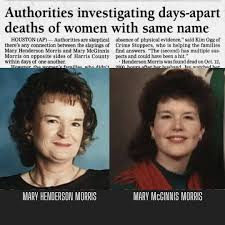
On 12th October, 2000, forty-eight year-old Mary Henderson Morris left her home in Houston to go to work and was never seen alive again. She had failed to answer her husband's call throughout the day, and three days later a body was found in a burned-out car. It was identified as her, and police could find no motive for the murder, and due to the condition of the body, it was hard to establish how she died. Her wedding ring was missing.

Three days later, the body of thirty-nine-year-old Mary Morris was discovered in her car in nearly the exact spot under extremely similar circumstances. The first Mary had been a bank worker, the second was a nurse practitioner and was in charge of a number of clinics. Neither woman knew the other, and there seemed to be no connections between the two. Police began to investigate their backgrounds and found that the second Mary had experienced worrying behaviour from a man working with her, and her husband had been concerned enough to get her a gun. She had told a friend in a phone call that a man had given her "the creeps" in a drugstore, and she was going to go back to work to sign off her computer before returning home. Twelve minutes later, she made a frantic call to 911 begging for help during an apparent attack and abduction.

Her husband's alibi was that he was at the movies with their daughter, but police found that she had had an affair, that their marriage was in difficulty. The second Mary also had a large life insurance policy. The husband was the main suspect, and refused to take a polygraph test, as did the co-worker she had been having problems with. The second Mary's wedding ring was also missing at the scene, but the daughter was later seen wearing it, and the family claimed that they'd 'found it'. Notably, contract killers often take the wedding ring as evidence of the kill to get paid.

Is that why the wedding ring went missing from both bodies? Was the first Mary Morris was a victim of mistaken identity due to the similarity in names? The murders remain unsolved.

On May 27, 1817, in Erdington, Birmingham, England, at 6:30 a.m. on May 27, 1817, a man on his way to work found a bundle of clothing, a hat, and shoes near a water-filled pit. He raised the alert as this was not a swimming hole, and the pool was dragged. They found the bruised body of Mary Ashford, presumably raped before her death. They found footsteps of a man and woman found in a nearby field, but in the days before forensics, they had to follow a more basic trail of evidence.

The victim had been a popular young woman who had attended a local dance the night before with friend, and changed at her house before the festivities. She and her friend had spent the latter part of the dance with Benjamin Carter and Abraham Thornton. The foursome left the dance at midnight, with her friend, Hannah Cox, walking along Chester Road until Hannah returned home and Mary and Abraham stayed out. Carter returned to the dance, which commonly finished at dawn at that time.

Mary was last seen back at Hannah's house at 4AM, changing out of her dance clothes to the everyday dress she'd previously left there when dressing for the dance with her friend. The victim was happy and  betrayed nothing to be concerned about in general conversation, and was seen alone along the road soon after by witnesses. Her body was discovered a few hours later, and she was confirmed to have died by drowning.

Abraham Thornton was arrested and told police, "I cannot believe she is murdered; why, I was with her until four o'clock this morning." Abraham told detectives he had been intimate with Mary and that they talked and gazed up at the sky. Abraham claims to have walked her part of the way back to Hannah's house and to have for her outside, but Mary told Hannah none of this. Abraham then claimed to have left when Mary didn't return to him.

Thornton's trial started on 8th August, and three witnesses confirmed his alibi. That, and a lack of any concrete, evidence led to him to being acquitted, despite a showy challenge to her brother that was a hangover from feudal law; who didn't rise to the provocation. The murder was never solved, but Abraham Thornton was so reviled by the public that he fled to the USA.

Exactly 157 years later to the day, 27th May 1974, another woman was raped, murdered and found in a watery ditch in Erdington Park. Barbara Forrest was a nurse at nearby at Pype Hayes Children's Home. She, too, had gone missing on Whit Monday. Statements say that Barbara was with her boyfriend Simon Belcher at several bars on the evening of her death. Belcher said he walked her to the bus at 1 a.m. and never saw her again. Detectives zeroed in on a co-worker of Barbara's, Michael Ian Thornton. Thornton lived on Chester Road and the police found bloodstains on Thornton's pants and uncovered a false alibi from his mother. They apprehended him and charged him for the slaying, but was acquitted for lack of evidence.

Abraham Thornton

True crime experts read through the Ashford murder of 1817, and compare it to the one in 1974. Whit Monday had been on 26 May both in 1817 and 1975 (a lunar date. It's not always the same date). Both victims were found within 300 yards of one another, shared the same birth date, visited their best friend on the evening of the Whit Monday to change into a new dress for a local dance party. After each murder a suspect was arrested whose name was Thornton, and in both instances, this Mr Thornton was charged with murder but subsequently acquitted.

Both murders remain unsolved.

But there have been crimes solved by coincidences and strange means too. A parrot was the only witness to the murder, of Max Geller im 1942 in the appropriately named "Green Parrot Restaurant" in New York. The bird repeatedly squawked "Robber" to the police, but the detective didn't dismiss that as many would, and learned that the bird was trained to call regular customers by name. None of the regular patrons were able, or willing to help the police. Going purely on a hunch, the detective wondered if the parrot was actually saying, "Robert", and found out that a regular customer, Robert Butler, 28, had left Manhattan shortly after the murder. When police tracked Butler down in Maryland he confessed that he shot the victim in a drunken argument, and got fifteen years.

And then there was the murder solved by accident. In 2011, Laura Giddings went missing from her home in Georgia. Cops attending the report parked outside her home as they searched her apartment and confirmed that there was no trace of her. The garbage truck was unable to empty the trash cans the police had blocked, but he emptied the rest of the street and carried on. Her body was found in one of those unemptied bins, and if the police had parked anywhere else, she may very well have gone off to landfill, perhaps forever, and certainly damaging the forensic evidence.

But that wasn't the only coincidence in this case. The case attracted the local news, who interviewed the neighbours, as they often do in such cases. One such neighbour, Stephen McDaniel was on camera when he was told that Laura's body had been found. His reaction at realising that he was probably about to be arrested for murder can be found on this video at around 1.27.

https://www.youtube.com/watch?v=KIroLgiCyP8&t=1s

And then there was the case of Zephany Nurse who made a new friend, Celeste, at school. The two girls got on famously, and were struck by how alike they looked, and they weren't the only ones. Zephany's father was also taken aback by the similarities; especially as the family had been the victims of one of the cruelest kinds of thefts. Their baby girl had been stolen from the hospital by a woman dressed as a nurse. Mr. Nurse did a DNA test that confirmed the truth. Unbeknownst to the family, that baby girl had been brought up only a few miles away for the last seventeen years, and Celeste was reunited with her real family. Her kidnapper, Lavona Solomon was jailed for ten years and was released in August 2023

Zephany and Celeste Nurse
Coincidences are everywhere, but that doesn't make them less strange or perplexing when they do. On a finish note, it's worth noting that the first and last British soldiers killed in WW1 are buried next to one another. They were John Parr, killed 17 days after Britain declared war, and Private George Ellison, who died 90 minutes before the armistice. Ellison's gravestone gives his age as twenty, but he was actually only seventeen, having lied about his age to join up. The war was sparked by the assassination of Archduke Franz Ferdinand in Sarajevo. The license plate number of Archduke’s car, in which he was killed, was A III118. The official end of WWI was Armistice Day, 11/11/18. 


Sunday, August 4, 2024

Rose Bartlett - Rasing Children in the New Town of Colorado Springs.


Post by Doris McCraw

writing as Angela Raines


Photo (C) Doris McCraw

In 1900 Rose E. Bartlett celebrated twenty-eight years of marriage to Ephraim C. Bartlett. The couple, who married around 1872-3 were both from Maine and married in that state. At the time of their marriage, Ephraim was thirty and Rose was twenty-one 

It seems Ephraim had returned to Maine from Pueblo, Colorado where he was living in 1873. Rose had started teaching school at age seventeen. However, census records show she left teaching and listed the occupation as a housewife from her marriage forward. You do have to wonder, with her background, what kind of foundation she gave her children as they grew.

Copy of Old Birth Record
from Ancestry

The couple had seven children, five who were alive in the 1900 census. 

Frank Arthur Bartlett, born 1888 in Colorado, who was a music teacher in Colorado Springs in 1911, died in 1962 in California at the age of seventy-four. He served in World War I as a Sergeant.

Guy Roderick Bartlett, born in 1874 in Colorado, died in 1940, in California at the age of sixty-six. He was married but had no children as far as any records show.

George Powers Bartlett, born in 1885 in Colorado, died in 1974 in Colorado. He was married and had three children.

Harvey Lewis Bartlett, born in Colorado in 1879 died in 1920 in Colorado. He was not married.

Frances Lena Bartlett Hill, born in 1875 in Colorado, lived to be ninety-two and was buried in The Chapel of the Pines Crematory in Los Angeles, California. So far, I've not located a spouse for Frances.

The other listed child of the couple is Alice Dell Bartlett. She was born in 1877 and died in 1879 in Colorado.

Rose Ella Powers Bartlett died in 1919 just four days shy of her sixty-seventh birthday. She is buried with her husband who preceded her in death in 1912. Although they married after the end of the Civil War, they were both from the same area in Maine and Ephraim may have known Rose before he served the duration of the War.

For other stories in this Civil War series, click the links below.

John H Long -73rd Illinois - Western Fictioneers

Isabella Long - Prairie Rose Publications

Sgt. James W. Bell - Western Fictioneers

Martha Lynn Bell - Prairie Rose Publications

Captain Richmon Finch- Western Fictioneers

Sarah Jane Durkee Anderson - Prairie Rose Publications

Esther Walker, Part 2 - Western Fictioneers

Esther Walker - Prairie Rose Publications

Alpheus R. Eastman - Western Fictioneers Blog

Helen Rood Dillon - Prairie Rose Publications Blog

Virginia Strickler - Prairie Rose Publications Blog

Henry C. Davis - Western Fictioneers Blog

Chester H. Dillon - Western Fictioneers Blog


Until Next Time: Stay safe, Stay happy, and Stay healthy. 

Doris