Search This Blog

Monday, February 26, 2024

Friar Tuck and other Medieval Warrior Clerics


Friar Tuck and other Medieval Warrior Clerics


Figure of Friar Tuck, Scott Monument, Edinburgh, by George Clark Stanton


Friar Tuck is famous in the Robin Hood stories, one of Robin’s Merry Men who lived in Sherwood Forest. He is shown as  jolly, fat, a bit of a glutton and a tough fighter, the equal of Robin himself. He is described as a curtal friar, meaning that his gown was curtailed or tucked up. This may also be the reason for his name Tuck.


There is no evidence that such a cleric existed, and stories about him do not appear until the 1400s. However the tradition of fighting clerics was very real and the name Friar Tuck was used as an alias by the chaplain Robert Stafford in 1417 to cover his own violent criminal activities. Earlier in the middle ages, in 1066, Odo, bishop of Bayeaux, fought at the Battle of Hastings with his half-brother William. As clerics were not supposed to draw blood, Odo is depicted on the Bayeux Tapestry wielding a club or stave. Odo died in 1097, on the way to the Holy Land to fight in the first crusade.

Odo had been a bishop and bishops were seen as part of the secular world, often part of the king’s regime. So in 1295, Anthony Bek, bishop of Durham, was with King Edward the First when the king fought in Wales and again the year after when the king invaded Scotland. Bek even attacked his own cathedral, following a dispute with Durham’s Prior, leading to this contemporary verse:


"From boyhood Bishop Anthony
Had learned to fight most readily,
And in violence trusted more
Than in the texts of canon law.".


           Canon and church law was in fact confused on the issue of fighting clerics.


From 1049 to 1079 twelve church synods said clerics should not bear arms—suggesting that many clerics did so. At the same time, the military order of the Knights Templar, created in 1119 to protect pilgrims in the Holy Land, was avidly supported by the Christian mystic and Abbot Bernard of Clairvaux. In 1289 Pope Nicholas IV allowed the Franciscans the right to bear arms “with the permission of their ministers.” By the late fourteenth century canon lawyer Giovanni da Legnano gave examples when it was appropriate for a priest to fight and even to kill. This included the priest defending himself if attacked whilst baptising a dying child (lest the child, unbaptised, was sent to purgatory) and also the priest killing someone in self-defence during mass.

The middle ages could be very violent!


You can read more about my own medieval stories if you visit my Prairie Rose Publications author page:

http://prairierosepublications.com/authors_2/lindsay-townsend/


Happy Reading!


Lindsay Townsend

Wednesday, February 14, 2024

Movie Kisses Series 2/14/2024 This Kiss Leaves Them All Behind #prairierosepubs #moviekisses #princessbride

What better movie kisses to highlight on Valentine’s Day than the kisses in The Princess Bride?


Buttercup and Westley's kisses melt our hearts in different ways. The first kiss is against the sunset, which is symbolic for endings and separations. This kiss is their first since Buttercup realizes when Westley says As You Wish, he really means I love you. This kiss occurs when they part.

Westley is off to seek his fortune in order to return to Buttercup with the financial means to marry her. Buttercup must stay behind. This is a tender and poignant, heart-squeezing kiss of true love.

The next kiss follows a minute later. This is the kiss that seals their pact that he will return, and she will wait for him. We needed these kisses to sustain us (and Buttercup and Westley) until they’re together again.

The first kiss happens in this clip at 1:56.


Then Buttercup gets word that Westley is dead.

Our lip quivers. All hope seems lost.

But TA DA!

Westley returns five years later in the guise of The Dread Pirates Roberts aka The Man in Black, and we just know there HAS to be a reunion kiss. We wait. We watch. And then it happens after Westley and Buttercup tumble down the steep ravine that leads into the Fire Swamp. We breathe a sigh of relief. Love is still strong between them. For a few moments, our movie world is at peace.

The reunion kiss begins at 0:38 in this clip.


But wait! There’s a bad moon
  rising, and it looks as if Westley and Buttercup will be parted forever…really forever… this time. We feel the grandson’s angst when he asks his grandfather, “Wait, what did Fezzik mean ‘He’s dead?'”

Still, we cling to a thread of hope for a happy ever after ending, and Miracle Max helps us hang on to hope when he determines that Westley is only mostly dead, which means he's slightly alive. Then we recall that Westley promised Buttercup that Death cannot stop true love. All it can do is delay it for a while. This is means it's inconceivable to give up all hope just yet.

Then, whew! Love conquers all, and we learn that we don’t mind kissing parts at all, especially since the invention of the kiss. There have been five kisses rated the most passionate, the most pure. This one left them all behind.


*****

This website is guaranteed to bring a smile and maybe even a good old fashioned chortle: Count Rugen

*****

January Movie Kiss - The Phantom of the Opera (2004)

See you next month for more kisses from the big screen.

Kaye Spencer
www.kayespencer.com


Tuesday, February 6, 2024

What the Heart Wants

 What the Heart Wants

C. A. Asbrey


It's the month of Valentine's Day, a celebration of lovers and all things sensual, and people either love it, or love to hate it. Our screens will be full of romantic movies, authors will be showing us their romantic credentials, and restaurants will be hoping to tempt us in for intimate dinner-for-two in some glamorous location. 

Those who make money from such events seem to have it all down to a fine art, but do they ever get it wrong? Even slightly? I'm thinking of the occasions where a leading man has been chosen with the full expectation that he'll ring that primal bell in the audience's soul, only to find that a secondary character sweeps in from behind to steal the show, as well as the movie.

These are never heroes, but they're not the villain either—twinkle-eyed rogues who'll steal your money, your love, and your heart. These anti-heroes have flaws. They are often prepared to steal, cheat, and lie; but they do have boundaries they won't cross. Their moral code doesn't drive them—they are protagonists who will do the right thing, but only if they lose too much if they won't, or if it gets them what they want anyway. And sometimes casting directors are just so busy looking at the leading man, they totally overlook the charisma of another actor.

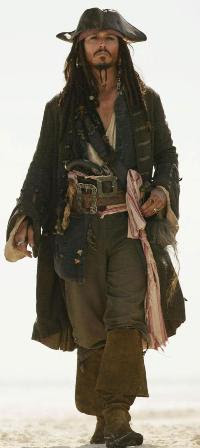
Arguably, the most famous example of this was Johnny Depp's Captain Jack Sparrow in The Pirates of the Caribbean franchise. The popularity of Captain Jack apparently took the studio bosses by surprise. Famously modelled on the drug-and-drink raddled rocker, Keith Richards, Depp played such a heightened, and pantomime, version that they were worried that he really was drunk. Of course, he wasn't. It was such a genius performance that it stole the limelight from Orlando Bloom and Keira Knightly, and he became the standout star of the series. What really took the studio by surprise was women being drawn to Depp's sex appeal in such a bedraggled, erratic, and amoral character. 

A similar tale is that of Harrison Ford's depiction of Han Solo, who totally swept the attention towards himself, any time he appeared on screen. That's not to take anything away from the other actors, but the studio intended that Luke Skywalker was to be the standout romantic hero. The audience thought otherwise. They saw the humour, sex-appeal, and sarcasm of the flawed person Ford was portraying, and loved him for it. This was especially summed up in the scene where Princess Leia confesses her love for him, and he simply replied, "I know."

Those two simple words carried a lot more than their literal meaning. the lines were not in the script, and were improvised between Ford and Irvin Kershner, the director. Carrie Fisher played the scene, but she wasn't expecting it. Her surprise is real, but to the audience it showed that Solo was a man with big emotions that he was unable to express, and who hid behind humour and sarcasm.

Once Upon a Time in Hollywood starred both Brad Pitt and Leonardo DiCaprio, but the prevailing opinion is that Pitt stole the movie from DiCaprio with his engaging, macho, individualism. Tarantino said of the real life person who inspired Cliff Booth, "Yeah, there’s a guy — I can’t say his name, I won’t say his name — he was a ‘60s-era guy, into the ‘70s,” says the writer-director. “I had a couple of actors tell me about this guy and I found him a very fascinating character. Then, I’d meet old stunt guys, and I’d bring him up, and they all knew that guy. He was just this dangerous dude. You know big tough actor cowboy-types, who don’t show weakness in front of other men, he scared even them. There was just something scary about the guy and he was kind of indestructible. He could do stunts that nobody could. He had this killer aspect to him and that’s why he ultimately scared people."

People found their natural sense of justice stirred when Booth's character was seen dealing with a version of The Manson Family, performing an act everyone else was too scared to carry out at the time, and which meant that innocent victims were saved in a way we'd have loved real life to go. Audiences loved it.
Another infamous scene stealer we cannot resist is Alan Rickman. In Hollywood movies he's normally cast as either an anti hero or a villain, and his lambent performances fill the screen in numerous roles. Be he appearing as Die Hard's Hans Gruber who exudes scoffing delight at taking people hostage, or as in costume as the brilliantly self-aware Sheriff of Nottingham in Robin Hood: Prince of Thieves, who threw around withering one liners, he was a delight to watch. And in my humble opinion, made those movies. Another charismatic performance was the gloomy, sometimes casually cruel, and ultimately heroic, Severus Snape in the Harry Potter Universe. Viewers loved to hate him in the beginning, but then we came to know the pain he carried, and the sacrifice he made when the woman he loved died. Rickman dripped it all out perfectly, driving us away, before pulling us back in further than we would have gone with a less nuanced performance. Surely, Rickman is the winner in any contest to be the anti hero we love to love—even when they're bad. 
 
So my question is; who is your scene-stealing anti hero?      


Sunday, February 4, 2024

Virginia Strickler- Wife of Civil War Veteran Wm. Strickler

Post by Doris McCraw

aka Angela Raines


Evergreen Chapel, Evergreen Cemetery,
Colorado Springs, CO.
Photo(C) Doris McCraw

The start of this series on the wives of Civil War Veterans buried in the local cemeteries in Colorado Springs is the wife of Dr. William M Strickler, a Confederate soldier who made his mark on the region as a doctor, rancher, farmer, and politician. Her name was Virginia and this is her story, at least as much as I have been able to find so far.

Born Virginia Lipscomb in Prince William County, Virginia. Her birth year has been listed as 1828, 1833, and 1836. Her headstone lists it as 1829.

Not much is known about her early life. According to census records, her grandfather, Philip Lipscomb was a slave owner, so the probability is her family had money before the war although Philip died in 1821. Her parents, Robert and Ann died in 1858 and 1857 respectively.

At the time of their deaths, their son William would have been twenty-four. Ann, Mary, Betty, and Virginia were all older, so the running of any property would have probably fallen to all of them. In fact, her brother, William, served in Company H of the 15th Virginia Calvary, having enlisted as a private in the Confederate army in 1861. He finished as a lieutenant and in 1864, according to Civil War records, he was a POW.

Virginia met Dr. William Strickler at the second battle of Manassas (Bull Run) in 1862 while he was treating the wounded on the battlefield. He enlisted as a surgeon's assistant in 1861 and served in Companies F & S of the 52nd Virginia Infantry throughout the war.

Photo by Ron West from Find a Grave


Virginia married William in 1865 and by 1868 the couple had moved to Colorado City where William served as a doctor. By 1874 the couple moved to the new city of Colorado Springs. There the couple remained until 1906 when they moved to Denver. William died in 1908. Virginia remained in Denver where she passed away in 1915. Her death registry states her cause of death as senility.

Both she and William are buried in Evergreen Cemetery in Colorado Springs. So far no images of her have been found.


Amazon

Until Next Time: Stay safe, Stay happy, and Stay healthy. 

Doris


Tuesday, January 23, 2024

The Sheriff of Nottingham - A Medieval Myth?


Image from "Robin Hood, Prince of Thieves."


The Sheriff of Nottingham – A Medieval Myth?


We remember the Sheriff of Nottingham, the ultimate medieval ‘baddie’, enemy of Robin Hood, played with vigorous style by Alan Rickman in “Robin Hood, Prince of Thieves.”


No records give this man’s name, only his title, yet there never was a sheriff of Nottingham. So did this un-named villain exist?


One clue is in the title “Sheriff”, meaning shire-reeve, the reeve (royal officer) of the shire.


A further clue to the genesis of this myth is the fact that there was a High Sheriff of Nottinghamshire, Derbyshire and the Royal Forests, appointed by the Crown by the Normans soon after the Norman Conquest of 1066.


The Forest Laws were a Norman import, imposed upon Anglo-Saxon Laws and customs, and very much despised by the conquered population. The Forest Laws were a means by which the King could extend his rule, eagerly used by monarchs to do just that. They could be imposed on more than woodland or forest, and the High Sheriff, the creature of the King, was hated as an enforcer of arbitrary, sometimes brutal laws. Forest Laws were intended to reserve the red and fallow deer  and the boar for the King and the aristocracy – and no one else. Dogs, apart from guard dogs, were forbidden in forest areas, and people were forbidden to carry hunting weapons. William Rufus, the son of William the Conqueror, increased the severity of the laws in the royal forests to include death and mutilation. Such sentences seem to have rarely imposed, but such laws caused resentment.  


King William II Rufus died in the royal New Forest, struck by an arrow. Political assassination or an angry local, furious at the laws?


Another reason why the foil of Robin Hood was a sheriff was because, in history, so many sheriffs or high sheriffs were bad lots. Philip Mark, sheriff from 1209 to 1224, Henry de Faucemberg (!318 to 1319) and John de Oxenford (1334 to 1339) were all corrupt, robbing and extorting with a will. ‘Gentlemen’ gangs of younger sons of the landed gentry, trained for battle and with no lands to inherit, took readily to robbery and more. Men such as the Folvilles and the Coterels actively recruited royal and other officials to help them murder and steal. In 1335 Nicholas Coterel was even made bailiff for the High Peak District of Derbyshire, the ultimate huntsman-turned-gamekeeper!


Given the danger for breakers of the king’s laws, poachers in the royal forest areas were often celebrated and praised. Few who benefited protested, especially if they might receive a share of fresh, tasty meat.


Woodland, forests and hunting feature in many of my medieval stories. I have Magnus, the hero in “The Snow Bride” involved in an assassination attempt in northern woodland during a hunt, and Conrad, the hero of “Sir Conrad and the Christmas Treasure” is a steward of the forest high lands. I speak of poaching, hunting and magic done to aid both in my novel, “The Master Cook and the Maiden”. All three of these novels are available on Amazon and free to read through Kindle Unlimited. Why not give them a try?


"The Snow Bride"


"Sir Conrad and the Christmas Treasure." 


"The Master Cook and the Maiden." 


Lindsay  


Wednesday, January 10, 2024

Movie Kisses Series 1/9/2024 Phantom of the Opera #prairierosepubs #moviekisses #poto


In my 2023 year-long blogging series, I looked at dance scenes from historically-set movies that showed us so much more about the relationship between the dancers than straight dialogue could accomplish as efficiently.

Come along with me in 2024 for my series about kissing scenes in historically-set movies. The time period is roughly cut off at 1945.

These aren’t just any old kisses. These are THE KISS. THE KISS we've craved through the movie. We need THE KISS. We’ve waited and waited for THE KISS. It makes our foot ‘pop’. 

Jeremy Bishop photo | Unsplash

I will offer a background set-up to each scene and a clip of the scene. I’m saving my two favorite kissing scenes until December. It will be worth the wait, I promise.

Each kissing scene is workplace-friendly.

The January Kissing Scene is from The Phantom of the Opera (2004).


Yes. The Phantom is not a nice guy. I get it. Over the course of the movie, he’s committed murder, kidnapping, extortion, and coercion to name a few undesirable traits in a companion, but dang, I love this story so much that I’m able to overlook those rather egregious shortcomings. (twisted…I know)

Sure, the first kissing scene with Christine and Raoul is romantic when they are on the roof of the Opera Populaire and it required so many takes that Emmy Rossum (Christine) had to ice her lips because they were swollen, but it's the kiss with Gerard Butler (the Phantom) that makes my foot pop. (I may or may not have actually swooned the first time I saw this scene.) ;-)

I anticipated The Kiss from the moment the Phantom showed himself in the mirror.


We know Christine and Raoul will end up together, because Raoul is the knight in shining armor. But The Phantom is the bad boy, and I have a soft spot in my romance-writing heart for the misunderstood bad boy.

This clip is the ending few minutes of the movie. Watch through 1:20 and you’ll see The Kiss.


See you next month for more kisses from the big screen.


Kaye Spencer
www.kayespencer.com

Sunday, January 7, 2024

Experience & Assumptions


Post by Doris McCraw

aka Angela Raines


Photo (C) Doris McCraw

We are starting a new year. It's a time of goals and resolutions. It's also true that many of us need to remember or follow through. This year instead of the usual, I use the word experience. 

I choose to experience writing about the Civil War veterans and their wives/families, who are buried in the cemeteries here in the Pikes Peak Region. This can be tricky for there are many assumptions about veterans that I will need to be aware of.

Some of those assumptions may deal with which side of the conflict they served on. So many of us make choices we may or may not regret, yet, those choices do not define us unless we let them. There are at least two who not only served with the South, but when they moved out here after the conflict, they left a positive mark on the region. Their wives, who sometimes are forgotten, will be the focus of most of these posts.


Photo (C) Doris McCraw

What will be your choice of experiences in 2024? What is something that has been waiting to experience? What is holding you back?

As we head into the coming twelve months let's take joy in being alive, and follow the dreams you thought couldn't happen. They won't unless you grab hold and start in.

Wishing you all the best and enjoy those experiences. 

Amazon

Until Next Time: Stay safe, Stay happy, and Stay healthy. 

Doris