Search This Blog

Tuesday, August 2, 2022

Things Discovered by mistake in the Nineteenth Century

 Things Discovered by mistake in the Nineteenth Century

By C. A. Asbrey


There have been many great scientific discoveries that have made our lives longer, easier, more pleasant, but more of them were stumbled upon than aimed for than you'd think. I thought it might be fun to have a look at some of the inventions that changed our lives for the better while the scientists were looking elsewhere for something else entirely.

Artificial Sweetener  

In 1878 the Russian scientists, Constantin Fahlberg and Ira Remsen, were working on the coal tar derivative benzoic sulphimide, when Fahlberg noticed that something on his hand was sweet. In another version of the story, Fahlberg laid down his cigarette, and found that was tainted. Now, I'd never recommend going around laboratories licking at random chemical reactions sticking to your hands, or tasting things the chemicals adhere to, but I'm sure he knew what he was doing. At least, he knew it wouldn't kill him. What did surprise him was the taste. It was sweet. Remsen and Fahlberg developed a synthesis of saccharin from o-sulfamoylbenzoic acid. Despite the slightly metallic aftertaste, it became hugely popular as an aid to weight loss. Its reputation was enhanced when it was endorsed by Theodore Roosevelt in 1906, before it sank in public health warnings in the twentieth century.

Corn Flakes

John Harvey Kellogg built on an invention by his brother, Will, who worked at Battle Creek Sanatorium. It was originally made with wheat, and was popular with inmates there. There is dispute about who did what with the product, with Will's wife, Ella, reputed to be the one who suggested rolling the flakes flat before toasting them. John is said to have designed rollers to do this at an industrial level. What is agreed is that John was testing wheat-berry dough, and left a batch there overnight. Rather than throw it out, they sent it through the rollers and baked it—and it was perfect. Cornflakes were born.

What is less well-known is that the Kelloggs were Seventh-day Adventists who promoted an austere diet as part of their strict moral principles. They saw a link between a teetotal vegetarian diet, restraint from sex and masturbation, and a long healthy life. Their strict moral principles never stopped John, Will, and Ella from each giving a version of the story that favoured their own efforts, and reduced the input of the other two, though. John even claimed to have discovered the secret in a dream.

Worcestershire Sauce

First of all, the pronunciation. It's 'woo-ster' sauce. Not 'wor-chestershire'. Place and proper names in the UK are frequently not phonetic. There are hundreds of them, and this is one. Secondly, etiquette dictates that the 'shire' part is only pronounced when applied to the place - and Worcestershire is a real place. When applied to the sauce, it's 'woo-ster' only. Those are the rules set by the British upper classes to sift the wheat from the chaff hundreds of years ago, and are part of the series of landmines set to catch the unwary. Names like Featherstonehaugh are pronounced Fanshaw, Marjoriebanks turns into Marchbanks, Powell becomes Pole, and Belvoir Castle becomes Beever Castle. Worcestershire Sauce is 'Wooster sauce'. That's how the queen says it, and she's the one to argue to the contrary with, as I'll have moved on and will be writing a different blog post by then. However, she'd probably be too polite to correct you.


 But to the sauce.

The story goes that Lord Sandy had returned from Bengal, India in 1835, and desperately missed his favourite sauce. He commissioned local pharmacists, John Lea and William Perrins, to reproduce it. They mixed spices, tamari, soy, vinegar, anchovies, and numerous other ingredients to come up with a product that was so potent it was soundly rejected not only by Lord Sandy, but by all their customers too.

They put the stock down in the cellar and forgot about it for a couple of years, until it was discovered during a clean-out. The sauce had fermented and changed completely, and they couldn't sell enough of it. Before long they encouraged the transatlantic liners to put it on the tables. That took it to America, recorded as first selling there in 1839.

The fermented fish-based sauce is often compared to the omnipresent Ancient Roman sauce garum. However, garum was based on sauces made throughout the ancient world, and had various names including liquamen. These fish-based, fermented sauces also gave a strong umami flavour based on the presence of glutamates, and perform a similar function to soy sauce in the Far East.

In 2013 the original recipe was discovered and reproduced, giving people a chance to taste the original product. The ingredients were; Barley malt vinegar, Spirit vinegar, Molasses, Sugar, Salt, Anchovies, Tamarind extract, Shallots (later replaced by onions), Garlic, Spices & Flavourings.

Dynamite and Nitroglycerine

Nitroglycerine was discovered in 1847 by the Italian, Ascanio Sobrero, in Turin. He had studied in Paris, a leading centre of scientific discoveries in the nineteenth century, and he initially found no use for it. He called it pyroglycerine, and thought it was far too volatile and destructive to be of any use. nitroglycerine was more powerful than the black powder used at the time. It was over to Alfred Nobel to take the work further. One day he was working in the lab and he dropped a vial of nitroglycerine, but it failed to explode—it had landed on a pile of sawdust, and the absorbent qualities had made the compound more unpredictable. Nobel ran with this discovery, producing sticks of explosives made by mixing nitroglycerin with wood chips, and the rest is history.   

But that wasn't the end of the story. There were numerous medicines discovered by accident, and most of them will be well-known. Cases such as penicillin spores killing off bacteria in a sample left nearby, or Jenner noticing that those who worked with cattle rarely caught smallpox, leading to the advent of vaccinations. There are less well-known ones though, and lithium is a case in point, originally being used for a treatment for gout until other uses were found in the twentieth century.

When Sobrero was working with nitroglycerine, he noted that ingesting just a small amount from his fingers gave him a raging headache. I'll pause once more to reflect how often scientists of the past found themselves licking and tasting their discoveries, before moving on.

Two years later, in 1849, Constantin Hering was working with nitroglycerine, and experimented on healthy volunteers. He found that the headaches were caused with 'such precision' that it merited further investigation. He was originally working on the homeopathic principle of 'curing like with like', and thought that he might have found a cure for headaches, but reached a dead end in his trials.

It was Alfred Nobel who gave a clue to the medicinal application. He had angina, and found that his symptoms were relieved by handling it. Lauder Brunton was working with amyl nitrite, and experimenting on its use as a vasodilator. He picked up on nitroglycerine in 1876, and found it to be a powerful remedy. William Murrel was the first man treated with the compound for angina. It was also used to treat hypertension. Bizarrely, Nobel refused it as a treatment.

Nitroglycerine also contributed to an industrial health scandal known as the Sunday Heart Attack. The production exposed workers to high levels of organic nitrates, and withdrawal over the weekend impacted the health of those working with it.

Mauvine

William Henry Perkin was a British chemist who was working hard on the admirable task of trying to create a synthetic quinine to treat malaria. He didn't find it. What he did find was that aniline could be partially transformed into a crude mixture that when extracted with alcohol, produced an intense purple. It was the first synthetic dye for a colour previously produced from the glands of predatory sea snails. It was so expensive to produce it was largely the preserve of royalty and the very rich. He called the new dye mauvine.

It was a game-changer in the world of fashion, ultimately opening the world up to easier access to a range of inexpensive colours through aniline dyes. However, the first one made an impact, helped by Queen Victoria and the wife of Napoleon III, Empress Eugenie, embracing the new colour. In the late 1850s, mauve was so popular that the press reported an outbreak of what they called mauve measles  

Nikola Tesla

It'd be hard to close a piece on accidental discoveries without mentioning Nikola Tesla. He made two distinct discoveries before anyone else, but—it was only later that the implications became clear—in one case much later. Tesla had the famous writer Mark Twain pose for a photograph using a new device called a Crookes tube. Tesla decided the splotchy photograph was ruined, but weeks later, Wilhelm Röntigen released his discovery of 'x-radiation' using Crookes tubes. Tesla checked again, and found that he had also produced an x-ray picture of Twain, but also that the picture had been ruined by the metal screws in the camera.

The second discovery took much longer to be understood. In 1899, Tesla set up a laboratory in Colorado to investigate the possibility of transmitting information and electrical power over long distances. One day, monitoring lightning storms, he detected a series of bleeps. After ruling out other factors, he concluded the signals must be coming from another space—but he couldn't prove it. It took until 1996 for scientists to replicate the experiment, and far more modern equipment established that the signal had been caused by the moon passing through Jupiter's magnetic field. The man was a genius.   


Excerpt

“She hasn’t got the combination to the safe,” said the manager. “You can scare her as much as you want. We all know you’re not gonna use that gun on us.”

Rebecca’s breath halted as she felt a careless arm drape around her shoulder.

“I don’t need a gun to hurt someone. Give us the combination.” The manager remained mute and turned his face away. “Your call, sir.” He pulled Rebecca around to face him as she gasped in alarm. “Just remember who you’ve got to thank for this, ma’am.”

He pointed over at the manager, who refused to meet her eyes. “That man right there.”

“Anything that happens to her is down to you. Not me,” said the manager.

Rebecca felt herself dragged from the room by one arm. She was pulled into the office next door and pushed against the wall. The man walked over and pulled down the blind before returning to her. Her breath came in ragged pants of fear. “Please, no. Don’t.”

He leaned on the wall, a hand on either side of her head, and pressed his face close. “You were gonna hold this place up. Are you some kind of idiot?”

She blinked in confusion. “Huh?”

The man pulled down his mask, revealing the face of the fair man who had walked into her office looking for Fernsby. “Don’t lie to me, honey. You had the same idea as we did— look at Meagher’s bank account to see where he gets his money. We’ve watched you march up and down outside this place all day, like you were on sentry duty, while you built up your courage. You even got in the way of us doin’ it. What the hell is goin’ on in your head? How dumb can a woman get?”

“You? Here?” She couldn’t quite decide whether to stop being scared or not.

“Yeah. Me.” He indicated with his head. “Now, Nat’s in there, and he needs the combination of the safe. It’s too new and sophisticated for him to crack the combination. You and me need to put on a bit of a show to make sure the manager gives it up.”

“You’re not robbing the bank?”

Jake huffed in irritation. “Try to keep up, Becky. I need you to scream for help so the manager gives Nat the combination to the vault. We want Meagher’s records too.”

She shook her head. “Me? I can’t scream.”

“What do you mean you can’t scream? All women can scream.”

“I can’t. I’m just not made that way.”

He frowned. “Look, Becky. If you won’t scream, I’m gonna have to make you. Let’s do this the easy way, huh?”

“Please, help! Noooo.”

Jake frowned. “You call that screamin’? That’s useless.”

“I told you. I can’t.”

Jake flicked up an eyebrow. “Last chance, Becky.”

“Aaargh—”

“Nope.” A gloved hand reached up to her hat as his eyes glittered with mischief. “Don’t say you weren’t warned, sweetheart.” 


Wednesday, July 27, 2022

USA’s Oldest European Settlement: Maybe Not What You Think


     What comes to mind as the oldest European settlement in the United States? Jamestown, Virginia? Plymouth (as in: Rock), Massachusetts ? Not surprising as these are the two that we learn most about in history classes. But both are wrong. The answer is… St. Augustine, Florida.


Photo by Kristin Wilson via Unsplash

     This area of Florida was first explored by Juan Ponce de Leon in 1513. He called the area La Florida and claimed it for the Spain. At the time, de Leon was the Spanish Governor of Puerto Rico and searching for the legendary Fountain of Youth. Composed primarily of soldiers and their dependents, St Augustine was founded in 1565. It is the oldest continuously occupied European-established city and seaport in the USA.

Photo by Paul Brennan via Pixabay

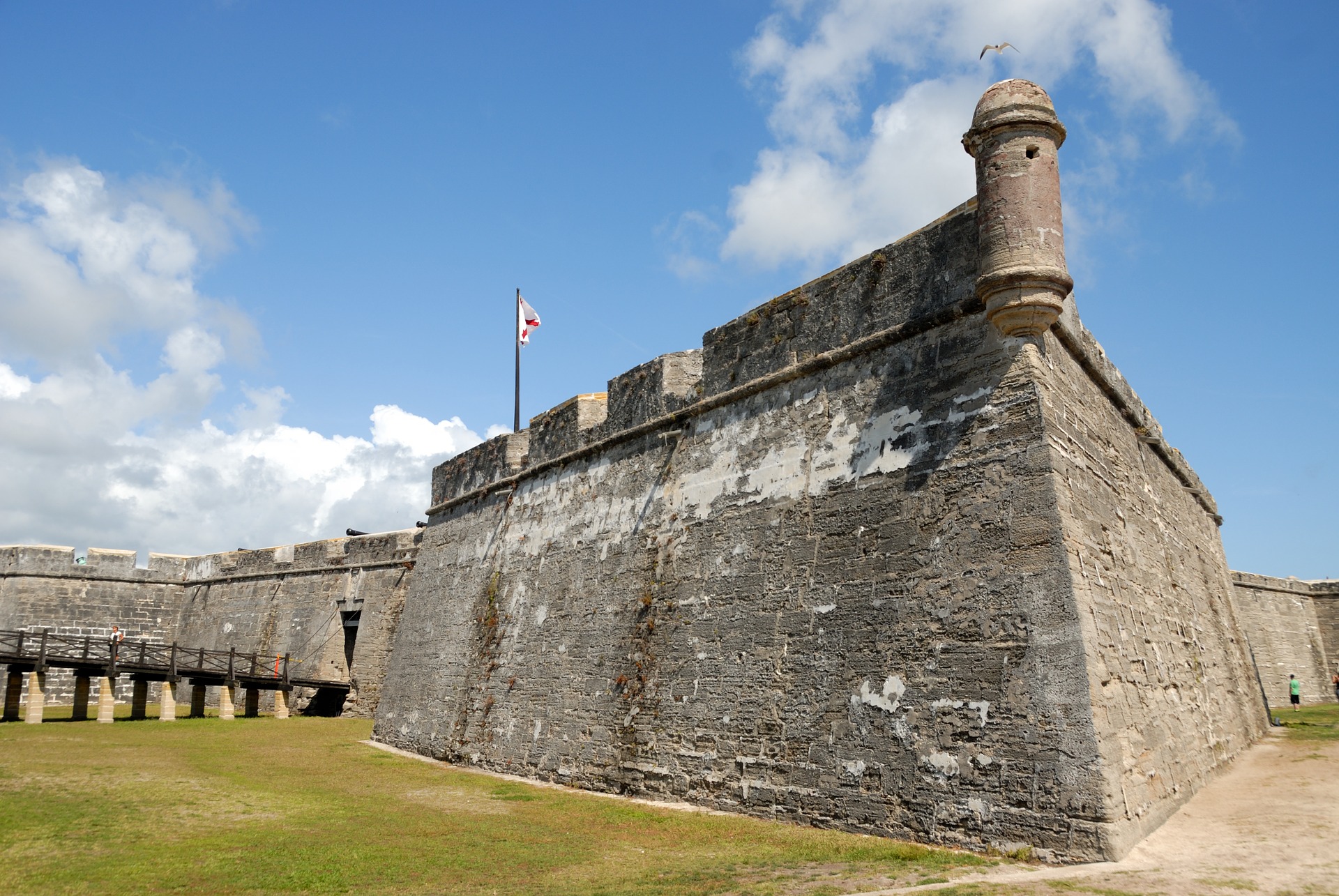
     To guard the fledgling community of St. Augustine and hold the rest of La Florida for Spain, a wooden fort named Castillo de San Marcos was built. The original structure was wood as were a succession of replacement forts. Finally, in 1672 a larger and more permanent fortress was begun. The new walls were built of a local stone called Coquina. This surprisingly strong rock was formed by the compacting of colorful shells of the tiny coquina clam over centuries of changing environmental conditions. The new fort was completed in 1695 and still stands today in the Castillo de San Marcos National Monument.

Photo by and property of the author

     To augment the Castillo’s defenses, Spanish authorities also built a watch tower on Anastasia Island between the town of St. Augustine and the Atlantic Ocean. Just seven years after completion of the Castillo, British forces from the Carolinas attacked. After a two-month siege, the British troops were not able to take the fort, so they burned the town and retreated.

     Spanish Florida afforded protection to enslaved people who escaped to St. Augustine. The city became a principal destination for the first Underground Railroad. Arriving runaways were given their freedom by the Spanish Governor if they declared allegiance to the King of Spain and embraced the Catholic religion. Consequently, plantation owners and the southern British colonies were hostile to St. Augustine and continued frequent attacks.

      In 1738, Spanish authorities established the first legally sanctioned free community of former slaves, Gracia Real de Santa Teresa de Mose, as part of St. Augustine’s northern defenses. In 1740, a strong attack on the city, mounted by the Governor of the British colony of Georgia, General James Oglethorpe, again failed to capture the fort.

     At the end of the French and Indian War in 1763, the Treaty of Paris gave Florida and St. Augustine to the British and the territory served as a pro-British colony during the American Revolution.

Photo from the National Archives

      At the end of the war, a second Treaty of Paris in 1783 gave America's colonies north of Florida their independence, and returned Florida to Spain as a reward for Spanish assistance to the Americans. This began the Second Spanish period for Florida.

     During this time, Spain suffered the Napoleonic invasions and struggled to retain its colonies in the Americas.  The expanding United States considered Florida crucial to its national interests. They negotiated the Adams-OnĂ®s Treaty, which peacefully turned the Spanish colonies in Florida over to the United States in 1821.

Photos by and property of the author
                                           

      In 1845, Florida became a state.  The United States Army took over the Castillo de San Marcos and renamed it Fort Marion. In 1874, a lighthouse was built on the site of the old watch tower and two years later a brick lighthouse keeper’s home was also built there. Both are still standing.

Photo by Philip  Arambula via Unsplash

      Today, the colonial architecture and other remaining historic buildings in addition to the Castillo and lighthouse, provide powerful attractions for history buffs to visit St. Augustine.

  Ann Markim

 Website

Facebook


Buy Links: Paperback at Amazon                     Amazon print or digital

Amazon Kindle 


Monday, July 25, 2022

Some Tree Lore and Magic and the Trees in my Garden by Lindsay Townsend


 I love trees. I am a member of the Woodland Trust and often click on Alistair Campbell's Tree of the Day on twitter. We have a birch tree in our garden, planted when we arrived which is now 20 years old. It's home to all kinds of bugs and birds and shades our kitchen window.

Birch trees are early colonisers after fire in woodland or in tundra after snow. They are good guardian trees, giving protection to the slower growing oaks, ash and beeches that follow. Perhaps because of this, birch trees are linked in folklore with fertility and regrowth. Bundles of birch twigs were offered to newly weds to ensure their marriage was fruitful and a birch wood cradle was said to protect babies from evil spirits. Its sap was held to be antiseptic and good for skin problems. Drinking a tisane of birch tree leaves is said to help with gall bladder problems.

Other trees in our garden are the hawthorn - again a good guardian tree and excellent for wildlife with its berries - and two apple trees, both on dwarf stock. Felling an apple tree was said to be unlucky and my husband and I take care with both, watering each in times of drought. In old apple orchards, the winter custom of wassailing - derived from the Anglo-Saxon wes hal, or be of good health - still goes on to ensure the trees remain healthy. Folk gather around a particular apple tree and beat pots and pans and drums to drive away trouble. They sing to the tree to encourage a  future good harvest and drink its health and their own with cider, pouring some on the roots.  


Two cherries, one sweet, one tart, are also on dwarf stock where I live. The blossom is lovely and leaf cutter bees use the fresh leaves to seal in their grubs and provide protection in the various bee hotels we have about. The blackbirds love the fruit and often leave the stones on the tree!

Other trees that thrive in our garden sadly need to be kept in check. The ash and its smaller cousin the rowan are both natural apex trees where we live and seed themselves with great regularity.  There is a rich history and many legends connected to both. Rowan was said to be a strong protector. The rowan tree, taken from the Norse “runa” meaning charm, was often planted close to houses to protect the household  against evil. Around Easter time medieval people would make small crosses from rowan wood to give further safety to the house. Ash was seen in Viking myths as a tree of power and magic - the god Odin hung from the world ash tree, Yggdrasil, to gain wisdom. In Norse myths the ash was also known as the Venus of the Forest, its leaves used in love charms. The wood of the ash was used for spears and in arrow shafts. It is a strong and flexible tree, as I know whenever I have to dig out unwanted ash saplings.

I wanted a holly for our garden for the beautiful green foliage and the red berries and now have one growing against a boundary of our garden. My husband cuts me a few sprays each winter to bring indoors to decorate our home around Christmas, as people have been doing since Roman times. In later folk lore it was believed to protect against malicious witchcraft and lightning. I also have an ivy, winding through a hedge that is almost all ivy. Drink taken from an ivy goblet was said to protect from poison, although I have never put that to the test. 

  I try to celebrate trees in my romances and use the beliefs of medieval people in my fiction to add interest and realism. 


To close, here is an excerpt from my sweet novella "Midsummer Maid", one of several stories in my anthology "A Knight's Choice and Other Romances." 

It celebrates a very special tree, a wild service tree. These are indicators of ancient Woodland and I would love to grow one in my garden.

Excerpt

She stood very straight but would not meet his eyes. "This is my sin."

            "What?" Haakon heard himself ask, wondering if he had misunderstood.

            "My sin. My vanity." She wrung her hands and clutched at her gown. "I was so proud to be the June Lady, but see! I tempted and sinned and now you…you have lost your home!"

            "You believe you caused those knights to hunt you?" He could not believe her folly. "They would have raped you if they had taken you away! That is their evil, not yours!"

            She looked up at him, her eyes bright with shimmering tears.

            "Never yours, my heart," he said, the endearment rising naturally to his lips. He wrenched his mind round from his rage at the knights and the church for making women feel they were the vessels of sin and sought a way to reassure her. In an instant, he had it. “Come with me.” He held out his hand.

            “Snow?”

            “Happily browsing hawthorn again. Come, Clare. I want you to see something; then you will understand.”

            She looked puzzled, her dark brows drawn in heavy bows over her eyes, but she slipped her narrow tanned fingers readily into his.

            This is madness, part of him complained, but he was too content to care. For months, he had dreamed of Clare and himself together, and now it had happened. "Only woodsmen know this place in the forest," he reassured her. "We shall move on in a few days, when the hunt for us grows slack. We have skills."

            "The other villagers?" she queried.

            "Father Peter will speak for them." Haakon refused to fret over men and women who had never accepted him. Not even knights would slay all their workers, for then they might have to sweat in the fields and bring in their own harvest. "They will be safe, I promise you."

            "It may be that we shall find an even better lord," Clare murmured, as if trying to console him still, a suspicion confirmed when she added, "and you will not miss the village?"

            "Where the women make the evil eye against me? No!" Haakon stopped on a narrow badger run and pointed to a tall, spreading tree with glossy, many-tongued leaves and a dazzle of fading white blossoms. "Look! Is this not a lovely thing?"

            Clare stared. "It is beautiful," she whispered. "The way the wind tumbles the leaves, and it rustles; the way the light shines through the leaves."

            "And is it sinful for that?"

            She gave him a narrow look beneath her dark lashes. "No. It is a tree."

            "And are its blossoms not adornments?" Haakon went on, warming to his theme. "And did God not make this tree and you?"

            "Sometimes you speak like a priest," Clare muttered, and she walked to the tree and laid her hand against its trunk. "I have never seen any like this before."

            Neither have I seen any like you, Haakon almost said, but the moment was too rare for courtly froth and folly. They were, even at this special moment, on the run for their lives. "It is a service tree. They are rare, even in large forests, and their fruits are proof against witches."

            "Last winter, you came to the barn where I sleep and hung a fruit from the lintel over the door," Clare recalled. "And you added more to our beer. It made a fine beer. I sent some to my mother at the lord's house, and she gave it to a maid who had the flux, and it cured her."


Lindsay Townsend.

Thursday, July 21, 2022

New Release -- The Stranger (Friendly Creek Book 3) by Agnes Alexander


When Chad Hathaway drifts into Friendly Creek, he’s not sure if this is where he wants to settle down. He’s a stranger, and the scar on his face makes him look foreboding to most. But he’s got some experience as a lawman, and it just happens that Sheriff Buck Beaumont is looking for a deputy. Running into beautiful Lilibeth Messick makes up his mind for him—Friendly Creek might just be the ideal place to make a home.

But when trouble comes calling in the form of Lilibeth’s prostitute mother, Goldie, and her cohort, the sinister Lester Ferguson, the normally peaceful town of Friendly Creek is turned upside down. Two murders occur in rapid succession, and Chad and Buck must work fast to discover the truth, fearing other citizens might also be at risk.

When Lilibeth is suddenly abducted, Chad’s worst fears are realized, and he vows he’ll do everything in his power to find her and bring her home safely. With a killer on the loose in Friendly Creek, Chad sets out to track Lilibeth and her kidnapper, not at all certain he’s looking for one person or two for the many crimes that have been committed.

With a raging fire threatening the area, he desperately searches for Lilibeth—a woman he’s just realized he’s hopelessly in love with. Can he find her in time to save her? And is it possible she might feel the same love for him—a stranger with a scarred face? Only time will tell, and it’s running out fast for THE STRANGER…

EXCERPT:


Goldie disembarked from the train and looked around. How in the world could that stupid girl think this was a good place to decide to settle down with her brother? I should have ignored Fred and got her into the business, then she’d know what a good life is—because this certainly isn’t it. But it wouldn’t have worked. He kept a close eye on what I did. He’d have stopped sending the money for those brats, and I sure didn’t want to give that up. It came in handy when times were slow.

She sighed and looked around. Maybe I got the location wrong. It could have been a different town. A bigger one. Quit trying to make an excuse to leave here, Goldie, she chided herself in her thoughts. No matter what Lester told you, you didn’t make a mistake. This is it. It has to be. Now, suck up and do what you have to do. Find those young’uns, get the money, and if she refuses to go back with you, forget her. But you need to get the boy. He’s still young enough not to fight you when you demanded that he take care of the menial tasks around the brothel. Things like emptying chamber pots or dragging the dirty sheets down to the wash house. Since he’d been gone, the girls had been complaining about having to do it themselves. Besides, Lester said we need him back, and we wouldn’t punish him too harshly for leaving with his sister.


Monday, July 11, 2022

Taking the Stage--Coach, That Is

One of my favorite John Wayne movies is Stagecoach. Do you remember the scene where, after three days in very close quarters with strangers, the passengers descend the steps, the gentlemen tipping their hats as they walk away, the ladies fanning at the unexpected heat, though they look as fresh as if they’d just left the tender ministrations of their maids.

Yeah. Right.

Nothing could be further from the truth. Stagecoaches were open air affairs where passengers were crammed together onto barely padded benches, some inside, some riding the “rumble seat” on the top of the coach, shoulder to shoulder with strangers, with no privacy from those who were less careful about their personal hygiene. If it rained, oil cloths were lowered over the window frames to keep out some of the water, but that meant less ventilation. Passengers climbed out of those hot boxes with crumpled and stained clothing, sweaty and cranky, with dust in places no one should have to abide dust.

Still, traveling by stagecoach was preferable to making the trip on horseback, or, heaven forbid, walking. And since the trains stopped halfway across the country, in places like St. Joseph, Missouri, or Memphis, Tennessee, the stagecoach picked up their passengers and took them to all points west.

Government mail contracts were the impetus and the financing for many of the stagecoach lines. And a lot of different companies ran stage lines across the west to Texas, Arizona, or California, to take advantage of those contracts. Here are a few examples.

Butterfield Overland Dispatch--two trails, a southern route, established in 1858, ran from Springfield, Missouri and Fort Smith, Arkansas, southwest across Oklahoma, Texas, and New Mexico to California, and was the first to carry mail; the other trail ran from Fort Riley, Kansas, to Denver, Colorado, beginning in 1865.

NOTE: John Butterfield’s company had the southern route, David Butterfield’s the Kansas/Colorado route--and the gentlemen were not related.

Visit this site if you’d like to see all the stations on the Kansas/Colorado route, as well as the approximately mileage between each: http://www.santafetrailresearch.com/research/bod-dispatch.html

Butterfield Overland Stage Company--this was probably the most famous of all stagecoach companies, certainly in Texas. Butterfield proposed the southern route because the mail could continue to run, even through the winter months.

“Butterfield's route headed southwest from St. Louis and Memphis, crossing the Red River at Colbert's Ferry (qv) in Grayson County and continuing across Texas for 282 miles to Fort Chadbourne via Jacksboro, Fort Belknap, and Fort Phantom Hill. The next 458 miles to El Paso swung south across a barren plain between the Concho and Pecos rivers, where water was in short supply, past Horsehead Crossing (qv) on the Pecos, up the east bank to Pope's Camp, (qv) where it crossed the river, hugged the west bank northwestward to Delaware Spring, and then turned westward through Guadalupe Pass to Hueco Tanks and El Paso. The line continued westward through Tucson and Fort Yuma to San Diego.” http://www.tshaonline.org/handbook/online/articles/SS/ers1.html

Butterfield ran the stage lines until they were seized by the Confederate Army at the beginning of the Civil War. When he could no longer operate in the south, he moved his operation north and made use of the “Central Overland Route.”

Central Overland Route (aka “Central Overland Trail", "Central Route", "Simpson's Route", or the "Egan Trail")--This trail was scouted by Howard Egan and used to move livestock between Salt Lake City and California. When the Army heard about the route, they sent an expedition to survey it for military use. It was opened to stagecoach lines and settlers in 1859. In 1860, the Pony Express made use of the trail, followed soon by the laying of lines for the Transcontinental Telegraph.

Cheyenne-Black Hills Stage and Express Line went from the Black Hills of South Dakota to Cheyenne, Wyoming. The Cheyenne-Black Hills line covered just over 300 miles, “…and for the most part the stations were located about 15 miles apart. The daily travel was about 100 miles and three days were necessary to make the entire trip.”

Black Hills Dead Wood Stagecoach went to--you guessed it--Deadwood, South Dakota. And William “Buffalo Bill” Cody rode shotgun and later drove for the company.

In February, 1866, Ben Holladay took over the Butterfield Overland Mail Company, renaming it Holladay Overland Mail and Express Company. Mr. Holladay sold out to Wells, Fargo in November of the same year.

There were specialized coach companies, too, like the Yellowstone Park Stage Coach Line, who had a fleet of bright yellow Concord stagecoaches as sightseeing vehicles in the park in 1886. 

And that most famous of all stagecoaches? Believe it or not, Wells, Fargo and Company didn’t own their own stagecoach line until 1866, when they purchased Ben Holladay’s company. Until then, they rented space from other lines as they needed it. “By 1864, Wells Fargo, and Company were selling over two million envelopes a year for the Wells Fargo mail service and the public was using Wells Fargo green mailboxes throughout California.”

Check out this link for lots more information on these and other stage coach companies:
http://www.legendsofamerica.com/we-stagecoachlines.html


Not all stages were the big coaches, drawn by six horses or mules. Concord made what they called a “Celerity Wagon,” a light, durable vehicle made for travelling over rough roads. But from what I read, it wasn’t any more comfortable, it just held together longer.

“The Butterfield Overland Mail transferred passengers and mail to light, durable vehicles for travel over rough roads.  From Frank Leslie's Illustrated Newspaper, October 23, 1858.”

Whether a Celerity Wagon or a Concord Stage Coach, the trip west was certainly not for the faint of heart.


Tracy G.


Tuesday, July 5, 2022

Victorian Cosmetics and Beauty Secrets

Victorian Cosmetics and Beauty Secrets

By C. A. Asbrey 

unblemished complexion the period demanded. They made most of these themselves, but pharmacies increasingly saw a market for beauty products, and moved to deliver the goods. Propriety demanded that these had to be dressed up as aids to health and youth, as not only was vanity a sin, but only prostitutes and theatrical performers (who were seen as just as bad) used make up.

The basis of a woman's beauty lay in her complexion. It had to be pale, as not only was that a sign of gentility, it was a sign of a woman who didn't have to work outside, and who (horror upon horror) tanned in the sun. Those not blessed with a naturally flawless complexion used various methods to appear as though they had one.

The most approved of cosmetic was cold cream. This had evolved from the moisturising creams of old. Roman moisturisers have been recovered with finger marks still visible. They can be based on oils or beeswax, but the modern addition of emulsifiers made them much more stable, and less likely to solidify. Borax saponifies fatty acids, allowing the basic historical recipe of fat, water and perfume to meld into a soft fluffy grease. It also stopped the mixture from separating, making the commonly added perfumes such as rose, violet, and almond more attractive to the user when they didn't separate from the hard fat Poor women made their own, but as the century wore on cold cream became easier to buy, first of all, from local pharmacies, and later from larger commercial concerns.
Early Commercial Cold Creams

  One recipe used a pound of almond oil, one pound of rose water, one ounce each of spermaceti (waxy substance found in the head cavities of the sperm whale) and white wax, and one half drachm of otto of roses (rose oil). A drachm is a unit of weight formerly used by apothecaries, equivalent to 60 grains or one eighth of an ounce. The ingredients were melted in a bain marie, and stirred together with a lancewood paddle punched with holes. The perfume was added at the end.

Other women used more paint, which was less detectible under poor lighting. They used a whitening paste, with some even going to the lengths to paint on a blue vein. These masks were made of lead, mercury and arsenic, and they tended to crack. This led those using them to avoid using mobile facial expressions. I expect hiding behind fans was also handy, but their cosmetics were one of the reasons some ladies reacted very badly to the advent of electric light. Their conceit was suddenly a lot more obvious. For those using less drastic make up, a simple powder was used to remove shine. 

Other dangerous skin treatments extended to cures for acne. It was commonly supposed that some kind of imbalance of the blood was responsible, and women took supplements of iron and arsenic to treat the problem at source, along with vegetable bitters. Today we only really know Angostura bitters, but a wide array of herb-based infusions were added to wines to boost health. These concoctions could consist of herbs, flowers, barks, botanicals, root, or seed based ingredients. 

Topical applications were also popular. A compound of hypochloride of sulphur ointment is one recommendation, something still in use for various skin conditions today. A less benign remedy was bichloride of mercury—a toxin most certainly not used on the skin today. Sunburn was treated with buttermilk in which grated horseradish had been soaked. Another sunburn remedy was a wineglass of rosewater to a pint of lemon juice. Glycerine was sometimes added to that mixture too.

Freckles were thought of as unsightly when extensive, or when they joined together to form large patches. This was termed epichrosis lenticula, as though it were some kind of medical problem. It was suggested that the 'sufferer' should apply carbolic acid lotion three times a day, and follow that with bichloride of mercury in a bitter almond emulsion. I cannot stress enough that we should never follow these directions today.

Another blight on a beautiful skin was unwanted hair. Plucking was popular in Western countries, but for larger patches, depilatories were applied. In The Woman Beautiful, (1899) Ella Adelia Fletcher said that superfluous hair was a, "a source of extreme annoyance and mortification." There were many recipes, but frankly, the more caustic, the more likely it was to be effective due to its corrosive powers. That's why women happily smeared on arsenic, lye (caustic soda or sodium hydroxide), and quicklime. Depilatories were called a rusma, and they could be tested by applying them to a feather. Once the plumes fell away, the lady knew it was ready for use on her body. It also warns that 'the precise time to leave depilatory upon the part to be depilated cannot be given, because there is a physical difference in the nature of hair. ‘Raven tresses’ require more time than ‘flaxen locks’; the sensitiveness of the skin has also to be considered.”
Quicklime Depilatory, Beeton’s Dictionary, 1871.

Lip balms were a popular home-made cosmetic, with a delicate touch of color providing a natural-looking enhancement, and one that women didn't frown upon unless the colourings were too dramatic and garish. Popular colourings were strawberry, cherry, beetroot, or cochineal, added to beeswax, almond oil, and beef tallow. This balm could also be applied to the cheeks as a subtle rouge—and it had to be applied artfully to avoid being described as a painted lady. Very fair women used petroleum jelly (discovered as by-product in the 1860s) coloured with lamp soot, burnt cloves, or chloride of gold. Brows could also be darkened using the same methods.

Hair was a lady's crowning glory, and many tonics and lotions were used to beautify and enhance it. Rain water was collected for a final rinse in soft water, but a favourite was Eau de Portugal. Mrs. Hale's Receipts for the Million (1857) gives. recipe. ". . .take a pint of orange flower water, a pint of rose water, and half a pint of myrtle water. To these put a quarter of an ounce of distilled spirit of musk, and an ounce of spirit of ambergris. Shake the whole well together, and the water will be ready for use. Only a small quantity should be made at a time, as it does not keep long, except in moderate weather, being apt to spoil either with cold or heat."  

It's well-known that blondes used chamomile to lighten their tresses, and that brunettes used henna, but there were other methods used to keep greys at bay, but less commonly discussed. Peroxide was used in the hat industry to bleach straw hats, and it didn't take women long to discover that it bleached their hair too. This had to be used with caution, as it could look too false and brassy. For ladies, chamomile and lemon juice in the sun provided a degree of plausible deniability. However, those ladies had to be careful not to get a tan at the same time. Brunettes and redheads had to use different options. 

Dyeing the hair black was achieved through adding walnut oil to a tincture of galls (made from oak galls, sugar and alcohol), and then a strong solution of sulphate of iron was added to the wetted hair. This was a lot less subtle than tinctures with rosemary or sage, both of which gradually darken grey hair, with sage being more efficacious than rosemary. Silver caustic was used to turn hair a deep brown. At least one was used by men, as a black dye using precipitated Sulphur, and acetate of lead is known as General Twiggs' Hair Dye in many recipe books. Indian henna allowed women to turn their hair a whole array of coper tones. Adding everything from saffron, indigo, hibiscus, and senna allowed women to colour their hair from strawberry blonde to almost black, with every auburn tone in between. Again, care had to be taken not to go too far, as the bright crimson hair was perceived as being as common as bright yellow.

Mrs. Hale's Receipts for the Million by Sarah Josepha Buell Hale is packed with these recipes, and is available for free as part of the Gutenberg Project. You can download it for free here:

https://www.gutenberg.org/ebooks/46254


EXCERPT  Innocent to the Last

     Rebecca turned over and punched her pillow. Why couldn’t she sleep? There was something worming into the back of her brain, but she couldn’t quite scratch the itch. All of a sudden, she saw herself standing in her office today, waving that check in the face of those damned men. The Farmers & Stockworkers National Bank in St. Louis. That was Meagher’s bank. What was it her father had always told her? If you want to bring someone down, look at where the money came from. She knew Meagher probably paid his henchmen in cash, but whoever he was in thrall to would pay by more sophisticated methods. And Becky Kershaw now had his bank details. She pushed herself upright and ran a distracted hand through her silken blonde hair. The bank. How could she see their records?

     She’d never done anything for the newspaper other than general office and printing work. Her father had acted as the reporter, and when they merged, Fernsby had taken that over. Her role never changed. She knew nothing about how to investigate a powerful man.

     Not for the first time, she wished she knew more about how journalists got private information like bank details. Nobody had ever taught her how. She couldn’t get a job in the bank. They usually only employed men. Rebecca dropped back down, running scenarios and fantasies through her mind, all of them ending with Meagher’s corruption proven by her work. How great would it be to bring down the mayor? It might at least give her some kind of future with another newspaper. And she really needed one. Meagher would arrange an accident if she stayed in Greenville. She had to leave tomorrow, at the latest.

     Schemes and plans percolated until she drifted off to sleep. By the time dawn lit the world she had convinced herself that there was no downside to her grand idea. Even if she was caught holding up the bank, a court appearance would throw enough attention at Meagher to make it worthwhile. She could declare her accusations and get them reported in the press that way. Besides. She wasn’t going to get caught—even if she was, she wasn’t actually stealing any money. All she needed was the name and address of the man paying Meagher.
     What could go wrong?


Sunday, July 3, 2022

For a Change of Pace

 Post by Doris McCraw aka Angela Raines


Photo Property of the Author

I thought I'd change the pace a bit for fun since I've been celebrating another year around the sun. I've been reading W. B. (Bat) Masterson's book, "Famous Gunfighters of the Western Frontier". One thing is clear, you can tell who he likes and who he doesn't. 

In his write-up about Doc Holliday, he clearly does not like the man. Has his opinion, written in 1907, influenced the way we see the man? I don't know, but I thought it would be fun to dig up some titles where the good Doctor plays a big part in the story. So for fun, here are a few:

Mike Resnick wrote steampunk books in which Doc Holliday was featured. There were four books, three of which featured Doc Holliday:

  1. The Doctor and the Kid (2011)
  2. The Doctor and the Rough Rider (2012)
  3. The Doctor and the Dinosaurs (2013)

M.M. Crumley has written a series of books with Doc Holliday as the main character:

Then we have 'regular' stories about Holliday:

Mary Doria Russell has one, and Victoria Wilcox has a three-book series.

What is it about Doc Holliday? What is it about the Old West and the people who lived then? One thing, stories are the product of our imaginations, and as you can see, they can take you anywhere. Have you taken a well-known story or person and given them 'another' life? 

I still remember reading Cheryl Pierson's "The Keepers of Camelot" and being so engrossed in how she took a well-known story and made it fresh and new in the Old West. If you get a chance, check it out.

So, for a change of pace, how can you take something old and make it new? Give it a try.


y Reading and Writing.


Doris McCraw