Villains
By Sarah
J. McNeal
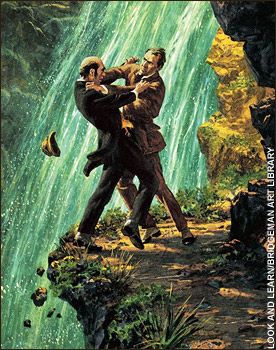
Moriarty and Sherlock Holmes fighting to the death in the book by Sir Author Canon Doyle.
I have always loved villains. They drive the hero/heroine to do
more than they thought they could. Without a really good villain, the story
would just fall flat. Although I’ve written many stories without villains, the
ones where I inserted a proper villain, have been the most fun to write. I’ll
admit, a really good villain is difficult to develop. Villains believe they are
right or entitled in some way to go up against the protagonist. But the reader
must see how wrong the villain is at some point.
There are several types of villains: The pure evil villain, the
forced to be evil villain, the villain who is right, the hero gone bad villain,
the villain gone good guy, and the dumb villain (I personally cannot imagine a
dumb villain being the only opposition to a convincing hero.)
Villains have different motives and different personality types.
Well, that makes it even more interesting because readers have to figure out
why the villain in a particular story has it out for the protagonist, how the
villain is going to carry out the plan to thwart the hero, and how the
culmination of all the villains efforts will present itself. There has to come a point in the story where
it looks like the antagonist is going to win and there better be a
death-gripping something going on to lead the reader to believe the protagonist
might not win. Protagonists cannot come out of this climax without some kind of
collateral damage, either physically or emotionally or we’ll all know they
didn’t fight hard enough to deserve winning.

Darth Vader, a good guy gone bad in the movies, STAR WARS
Now I’ll be the first to admit, I spend an extraordinary amount of
time on Pinterest. It’s my way of brainstorming. Okay, maybe sometimes I just
like to have some fun. I like to see what famous writers have to say about
their process, protagonists and, of course, villains. I found some invaluable
gems from famous authors and script writers.
What goes on in the mind of a villain? Here is a list of the inner
workings of a villainous mind:
Does your villain love? Has the villain ever been loved?
Does your villain have low self-esteem? Where did it originate?
What happened?
Is your villain lucky? Or is the villain a victim of bad luck?
Is your villain a leader? Who are his followers? Why do they follow
him?
Is your villain blinded by his enterprise? Is he unable to see
reason?
Is your villain evil, without morals, or mentally ill?
Who are your villain’s parents? Does your villain have parents?
Is your villain a hero? Who is the villain saving, and from what?
Is your villain seeking revenge? What happened? What was the
catalyst?
Is your villain a loner? Why are they alone? Are they isolated?
Is your villain just following orders?

Loki, the villain in the THOR movies. A villain you love to hate and hate to love.

Another world nominator, Khan, in STAR TREK, a self-righteous villain.
Villains are so much fun to write, an author has to be careful not
to give them more page time than the hero, unless of course, the villain turns
out to be the real hero. I did not
heed this message in my first published novel THE DARK ISLE. My evil queen,
Mahara, almost ran away with the story. She enjoys doing evil things—a
psychopath, if ever there was one. By the time I wrote the third novel in that
trilogy, I managed to get Mahara under control. Of course, I still made my
hero, Falcon, suffer.
Sometimes a villain makes us wonder if we would fare any better in
their circumstances. Such was the case with Sid Effird in my novella, FLY AWAY
HEART, in the Wildings series. His father, Edgar Effird, was the real villain
of this story. Sid’s motives were very different from his father’s. I almost
felt sorry for him.
In my novel, HARMONICA JOE’S RELUCTANT BRIDE, the first novel in
the Wildings series, the crafty villain, Callie McGraw, is a villain on a
mission. She is somewhat a victim from her cohort in crime, but Callie is quite
capable of taking care of herself. It’s unfortunate that the heroine, Lola
Barton, is mistaken for Callie, but necessary for the story line. Callie has no
redeeming qualities. She is the perfect sociopath, completely without empathy. Manipulation
and control are her tools to make people do what she wants them to do. She can
be charming though, if it serves a purpose.
Villains take as much time, energy, and thought to write as the
protagonist…maybe even more. But, oh boy, when there’s a villain in a story, I
get geared up. I love to read about them, and I love to write them.

My favorite villain, Spike, in the BUFFY THE VAMPIRE SLAYER and ANGEL the spin-off. He was complex, smart, funny, sarcastic, evil, and yet good. Josh Whedon creates the most interesting antagonists. You want to hate them, but you love them, too.

Angel in the Buffy and Angel series. Another good guy-bad guy-good guy villain.
What is your favorite type of villain? What makes you enjoy reading
about that particular type? Have you written a story with a great villain? What
kind of villain was your antagonist?

Just me, not a villain, but I could turn bad I suppose.
