Post
(c) Doris McCraw
For this First Sunday post, I will continue to share information about early women doctors, focusing on Colorado. Dr. Alida C. Avery was one of the first medical school graduates to arrive in Colorado. As you can see, she left her mark.
For this First Sunday post, I will continue to share information about early women doctors, focusing on Colorado. Dr. Alida C. Avery was one of the first medical school graduates to arrive in Colorado. As you can see, she left her mark.
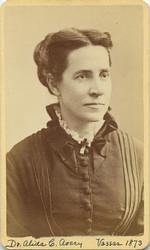
Dr.
Alida C. Avery was not only a women doctor of formidable skills, she played a major part in the struggle for women’s rightsin the West. Her story,
while unique, also is universal. Women, by the nature of following
their passion to study medicine and become doctors, were in their own
way promoting the equality of women.
Dr.
Avery was born June 11, 1933 in Shelburne, New York. Her parents,
Deacon William Avery and Hannah Dixon Avery were abolitionist
leaders. She began teaching school at the age of 16. She began her
formal study of medicine in 1857. She attended the Philadelphia
Women’s Medical College for one year, 1858. She concluded her study
at New England Female Medical College in Boston, graduating in 1862.
In
1865 she joined the faculty of Vassar, which
was founded in 1861 as the first degree-granting institution of
higher education for women in the United States. She remained at
Vassar until1874, when
she resigned
to take a job as Superintendent of Hygiene for the state of Colorado,
in addition to opening a private practice in
Denver, Colorado. Her
income was reported to have been $10,000 a year.
Prior
to her arrival in Colorado, there had been attempts at equality in
the territory. In 1868,
territorial Governor
Evans and Mr. Richards attempted to secure women’s suffrage in the
territorial legislature but failed. Again in 1870 Governor
McCook
addressed the legislature in which he stated:
"our
higher civilization has recognized women’s equality with man in all
other respects save one – suffrage. It has been said that no great
reform was ever made without passing through three stages –
ridicule, argument and adoption. It rests with you to say whether
Colorado will accept this reform in its first stage, as her sister’s
territory of Wyoming has done, or the last; whether she will be a
leader in the movement or a follower; for the logic of a progressive
civilization leads to the inevitable results of a universal
suffrage.”
Despite
attempts at suffrage, the movement did not gain much momentum until
1876. It was then
the subject of suffrage
began in earnest as Colorado moved toward statehood. On January 10,
1876 a convention was held at
the Unity Church in Denver, with attendees coming from a number of
towns and regions throughout the state.
As a result of the convention the Territorial Woman’s Suffrage
Association of Colorado was formed. Its first president was Dr. Alida
Avery. The honorary Vice-presidents were J.E. Washburn, Willard
Teller, and Greeley, Colorado founder Nathan C. Meeker.
Dr.
Avery traveled, spoke and
attended national conventions and meetings. She continued
her involvement with the movement after her retirement from medicine
in 1887. She moved to San Jose, California and in 1901 to San
Francisco. After surviving the 1906 earthquake she returned to San
Jose where she passed away on September 22, 1908 at the age of
seventy-five.
Many
were the women who campaigned for suffrage until the passage and
ratification of the 19th
amendment in 1920. In later years the campaign became more militant,
with marches on Washington with
women spending time in jails and prison. In the
book “Jailed for Freedom” by
Doris Stevens, published
in 1920, is a list of the
women who were jailed. In that list were Women Doctors who continued
the efforts of women like Dr. Alida Avery.
For
those who would like to read more, here are some links to additional
information:
https://sites.google.com/site/denvercountycogenweb/biographies/1880-history-of-denver/avery-m-d-alida-c
Doris McCraw, pen name-Angela Raines, is an author, speaker, historian who specializes in Colorado and Women's History.
For a list of Angela Raines Books: Click Here
Photos and Poetry: Click Here
Like Angela Raines on Facebook: Click Here
Doris McCraw, pen name-Angela Raines, is an author, speaker, historian who specializes in Colorado and Women's History.
For a list of Angela Raines Books: Click Here
Photos and Poetry: Click Here
Like Angela Raines on Facebook: Click Here


