Search This Blog

Showing posts with label The Claim - Prairie Rose Publications. Show all posts

Wednesday, December 22, 2021

What’s Old is New Again

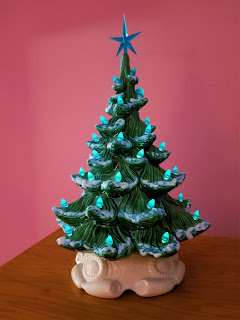
     In the 1960s and ‘70s, lighted ceramic Christmas trees were everywhere in the United States, and this year they seem to be making a comeback. These cheerful decorations have been around for about eighty years, so many may have been inherited from mothers and grandmothers but new ones are being advertised in a variety of outlets.

Debra Hines' Tree

     The earliest models appeared in the 1940s and were made by private craftspeople. As the figures gained popularity, they began to be commercially produced. The Atlantic Mold company copyrighted the first lighted ceramic tree in 1958. The traditional model is a green tree with ‘snow’ on the branches and multi-colored lights. But as more manufacturers entered the market, variability in size and colors were introduced. Initially, the lights were lit individually, but soon an easily replaceable single bulb in the hollow center of the tree became the source for lighting all of the bulbs.

     Popularity of these trees grew through the ‘60s, reaching its peak in the 1970s. As women wanted to produce their own decorations or handmade gifts, they flocked to classes at local ceramics shops to paint their own creations. This allowed many choices of paint and plastic ‘bulb’ colors. 

My Tree

     In the 1980s, the demand for the trees declined as did interest in ceramics as a hobby. At that time, I worked at the Iowa Veterans Home, where production of these decorations was still popular among the residents who frequented the Recreation Department’s ceramics workshop. I placed my order for a green tree with blue lights to match my holiday décor during my time there.

     In the 1990s many mold makers and ceramics manufacturers went out of business, merged, or discontinued making the lighted trees. This year interest has again surged. According to Country Living magazine (countryliving.com), lighted ceramic Christmas trees are “all the rage again.”

     Mine is out and shining brightly every night. Does your grandma have a lighted, ceramic Christmas tree? Your mother? You? 

Merry Christmas!

Ann Markim

 Website

Facebook


Buy Links: Paperback at Amazon                     Amazon print or digital

Amazon Kindle 

Wednesday, November 24, 2021

The Path to a Thanksgiving Holiday


Saratoga Surrender (Library of Congress)

     We all have been taught the story of Thanksgiving, how the pilgrims were helped by the native Americans to survive and celebrated with a big feast. Well, maybe. Many myths and much controversy surround the “first Thanksgiving,” but the march of Thanksgiving toward its status as a U.S. national holiday is well documented. Although individual colonies had various earlier observances, the first time all thirteen colonies celebrated a day of thanksgiving on the same date was December 18, 1777. George Washington, in his role as Commander-in-Chief, called for a day of “Solemn Thanksgiving and Praise” to celebrate the Continental Army’s victory over the British in the Battle of Saratoga on October 17th.


The proclamation was printed in newspapers, including the October 9, 1789 issue of the Pennsylvania Packet and Daily Advertiser (via mtvernon.org)

     The first Federal Congress passed a resolution asking the President to recommend to the nation a day of thanksgiving. Not long after, President Washington proclaimed Thursday, November 26, 1789 a
 "day of publick thanksgiving and prayer" to express gratitude for both the successful end to the war for independence and the ratification of the U.S. Constitution. Washington attended church and donated money and food to prisoners and debtors in observance of the holiday. Subsequently, Presidents John Adams and James Madison designated days of thanks.

Sarah Hale pictured in Godeys (via Wikimedia Commons)

     During the first half of the 19th century, several states officially adopted an annual Thanksgiving holiday, although each designated a different day. Additionally, Sarah Josepha Hale, best known for authoring “Mary Had a Little Lamb,” began a 36-year campaign to get Thanksgiving designated a national holiday. She was later nicknamed the “Mother of Thanksgiving.”

President Abraham Lincoln s Thanksgiving Day Proclamation of October 3, 1863, Page 3 (National Archives)

     In 1863, Hale implored both President Abraham Lincoln and Secretary of State William Seward to officially designate Thanksgiving as a permanent national holiday. Despite the United States being torn apart by the bloody Civil War, Lincoln proclaimed the last Thursday of November to be Thanksgiving Day in words written by Seward. “I do therefore invite my fellow citizens in every part of the United States… to set apart and observe the last Thursday of November next, as a day of Thanksgiving and Praise to our beneficent Father who dwelleth in the Heavens, and fervently implore the interposition of the Almighty Hand to heal the wounds of the nation and to restore it as soon as may be consistent with the Divine purposes to the full enjoyment of peace, harmony, tranquility and Union.”

President Franklin D. Roosevelt Carving the Thanksgiving Turkey (National Archives) 

     Thanksgiving was celebrated on the last Thursday in November every year until 1939. In that year, Thanksgiving was set to fall on November 30, leaving only 24 shopping days until Christmas. President Franklin Roosevelt feared the short Christmas season would negatively impact the economy. He signed an executive order that moved the holiday a week earlier to November 23 in an attempt to aid retail sales. This met with fiery opposition, with critics calling it “Franksgiving.”

Senate Amendments to H.J. Res. 41, Making the Fourth Thursday in November a Legal Holiday, December 9, 1941

     After much effort to return the holiday to its traditional date, in 1941, Congress officially moved the holiday to its current place. President Roosevelt reluctantly signed the bill making Thanksgiving the fourth Thursday in November.

Happy Thanksgiving!

  Ann Markim

 Website

Facebook


Buy Links: Paperback at Amazon                   Amazon print or digital

Amazon Kindle 


Wednesday, August 25, 2021

Thomas Jefferson: Innovator-in-Chief

      Although Abraham Lincoln is the only president to hold a patent, he is not the only one credited with inventions and improvements on existing devices. One of the most prolific tinkerers among our Commanders-in-Chief was Thomas Jefferson. 

Thomas Jefferson - National Gallery

      Jefferson’s innovations cover a broad spectrum of ingenuity. According to Neely Tucker at the Library of Congress, “Throughout his life, Jefferson possessed an insatiable curiosity about technology and a compulsion to figure out how things work and to make them work better.

Revolving Book Stand -
Monticello.org

     One of Jefferson’s original inventions, the revolving book stand, consisted of five adjustable book stands on a turntable. The stand could be folded down to make a cube. When in use, it swiveled so any of the books could face the reader, and multiple open books could be viewed at the same time, thereby making comparison and cross-referencing more convenient. For the user, it was the 1810 version of having multiple computer files open while working on a project.

Wheel Cipher - Wikicommons

     While serving as George Washington’s Secretary of State, Jefferson invented the wheel cipher to provide an easy way to create and decipher encoded messages. It is made up of 36 wooden disks on a spindle. Each disk is inscribed with letters of the alphabet in a different order.  By arranging the disks in different patterns, one could create a "key" and inscribe messages under a set code. 

Jefferson's Drawing of Macaroni Machine and Instructions -
Library of Congress 

     Although frequently credited with inventing the macaroni extruder, many credible sources believe that Jefferson had acquired a macaroni mold from Italy while he was serving as ambassador to France. This document in his own handwriting indicates not only his interest in how the machine worked, but his reference to the best macaroni in Italy being made with Semola flour suggests he might also have been an eighteenth century “foodie.”

Re-creation of Spherical Sundial -
Monticello Classroom

     Sundials had been around for centuries, but Jefferson devised one in the shape of a sphere for his home at Monticello. The globe was made of slate and marked with lines. A semicircular bar attached at its axis cast a shadow that aligned with a line etched on the globe that indicated the time.

Polygraph - Monticello.org

     One of his most famous innovations is an early version of a copying machine, the polygraph. Jefferson’s device incorporated his improvements to an earlier letter-copying device invented by John Hawkins and Charles Peale. Jefferson’s polygraph was basically one pen attached to another pen that moved in tandem with the first pen. He used it extensively to write letters with his polygraph and at the same time create an identical copy.     

  
Jefferson's Diagram for Plow and Re-creation - 
Monticello.org

     As the owner of extensive crop fields, Jefferson had a keen interest in improving the technology of farming. After extensive study of European plows, he designed the “mouldboard of least resistance” to move with as little effort as possible. The mouldboard is the part of the plow that turns and lifts the soil. He applied his mastery of mathematics to the design process so the plow could be pulled through the soil with the least expenditure of force, and had the mouldboard made with cast iron so it would be stronger than wood.

     Thomas Jefferson never personally held a patent, but he was the first commissioner and inspector of patents in the United States. This kept him current on new inventions and allowed him to incorporate good ideas and the latest technology into his daily life.


Ann Markim

Website


Wednesday, July 28, 2021

Abraham Lincoln: Little-known Facets of his Life


    Abraham Lincoln has fascinated me since I was a child. A few years ago, I went on a marathon of reading Lincoln biographies and those of his military and political contemporaries. I learned a lot of interesting facts about the man, outside of his presidency.

Abraham Lincoln on February 9, 1864. 
(Library of Congress; public domain via Wikimedia Commons.)


           It’s common knowledge that Lincoln was a lawyer but, prior to that, he had a number of other jobs. In April 1832, at age twenty-three, he signed up for a 30-day enlistment in the Illinois Militia. The men in his company elected him captain and he ended up re-enlisting. He served a total of 51 days.

      After this, he returned to New Salem, Illinois and resumed his first campaign for the elected office of representative in the Illinois State Legislature. Although he did well in New Salem, he was defeated in the rest of the district and lost the election.

Image via Pinterest

     He entered into a partnership with his friend William F. Berry in January 1833 to purchase a small saloon which they called Berry and Lincoln.  Berry was an alcoholic, and the enterprise did not go well. Lincoln sold his share to Berry in April 1833. Lincoln was left deep in debt and didn’t get that debt paid off until he was elected to the U.S. House of Representatives.

     But May 1833, Lincoln received an appointment as Postmaster of New Salem and continued in this position until the post office was relocated to a different city three years later. During his tenure, he supplemented his income with a variety of jobs including helping farmers with their harvests, splitting rails, clerking in a store, and surveying land for the county. It was also during this period that he began seriously studying the law. He earned his law license in September 1836 and was admitted to the Illinois bar in March 1837 at age twenty-eight. Practicing law became Lincoln’s lifelong career, but his early experiences helped him relate to people from all walks of life. The New Salem State Historic Site preserves the village where he lived before moving to Springfield, Illinois.

     While in New Salem, Lincoln earned a reputation for being an elite wrestler eventually winning the county wrestling championship. According to Carl Sandburg’s biography of Lincoln, the future president once challenged an entire crowd of onlookers after dispatching an opponent in a match. There were no takers.  Lincoln was defeated only once in approximately 300 matches. His record earned him recognition in the National Wrestling Hall of Fame.

Lincoln's Patent Sketches, Wikimedia Commons

     Lincoln was also a tinkerer and inventor. As a young man, he was aboard a steamboat that ran aground on low shoals. He had to help unload the cargo to free it. Subsequently, he developed a design to keep vessels afloat in shallow waters by attaching empty metal air chambers to their sides and later modified it to use four balloons, collapsed accordion-like, attached to the four “corners” of the craft.  If the boat encountered shallow waters, the balloons would be filled with enough air to raise the hull higher than the shoals or sandbar and keep the vessel afloat. For his invention, Lincoln was granted Patent No. 6,469 in 1849. He is the only president to hold a patent.

     According to accounts of his wife, Mary Todd Lincoln, and many other contemporaries, Lincoln was an avid cat-lover. He had two cats while he was in the White House, Tabby and Dixie, and he would also bring in strays. There are some reports that he fed Tabby and Dixie on the dining table, a practice his wife did not approve of.

Lincoln family: From left to right: Mary Todd Lincoln, Robert Lincoln, Tad Lincoln, Abraham Lincoln

By Currier & Ives [Public domain], via Wikimedia Commons


Lincoln and his wife had a great interest in psychic phenomena. During his first term, their son, Willie, died of a typhoid-like disease and the Lincolns were overcome with grief. Mrs. Lincoln convinced her husband to hold séances at the White House to communicate with Willie and another son who had died prior to his presidency. It is believed that Abraham attended at least two of the séances, but didn’t find them gratifying.

      As a theatre-lover, Lincoln was a fan of actor John Wilkes Booth. Before going to Ford’s Theatre in the evening to see Our American Cousin on April 14, 1865, Lincoln signed legislation creating the U.S. Secret Service. The original mission of the law enforcement agency was to combat widespread currency counterfeiting.

     The president was guarded around-the-clock by one member of a four-man security unit. A new bodyguard, John Parker, was assigned to protect the president at the theatre but he went missing. No one knows for sure where Parker was, but he had a reputation for being unreliable, including drinking and frequenting a “house of ill repute” while on duty, according to the Abraham Lincoln Presidential Library and Museum in Springfield, Illinois.

Shooting of U.S. President Abraham Lincoln

.Library of Congress / Reuters


That evening, John Wilkes Booth assassinated the president. Lincoln died the next day. According to the report of Ward Hill Lamon, one of the president’s friends, Lincoln had dreamt of his assassination.

     It was not until 1901, after Garfield and McKinley were killed, that the Secret Service was assigned to protect the president.

   Ann Markim

Website


Wednesday, April 28, 2021

Starvation Winter in the Klondike

     The Klondike Gold Rush began in 1896 with the discovery of gold along Rabbit Creek in the Klondike Valley. George Washington Carmack, nicknamed Lying George by his acquaintances, announced the strike in August at a saloon in Forty Mile, a town on the border of the Alaska and Yukon territories. Word spread quickly among the miners and settlers in the area, and soon many people deserted the major Yukon River communities of Circle City and Forty Mile to stake claims upstream. Rabbit Creek was soon renamed Bonanza Creek. A new town, Dawson, sprang up at the confluence of the Yukon and Klondike rivers in the Yukon Territory.  

     News of the Klondike strike was slow to reach the outside world. In July 1897, ships loaded with Klondike gold and rich miners arrived in Seattle and San Francisco. This triggered the northward stampede. More than 1000 people beat the hoards of stampeders and reached Dawson before winter. Many were disappointed to learn that most of the promising sites had already been claimed by residents of the area. 

Panning for Gold (Vancouver Public Library)

     The last steamship of the season unloaded its cargo at Dawson on September 30, 1897. The Northwest Mounted Police soon determined there would not be enough food for everyone during the upcoming winter. Inspector Charles Constantine posted a notice that read: "I, having carefully looked over the present distressing situation regarding the supply of food for the winter, find that the stock on hand is not sufficient to meet the wants of the people and can see but one way out of the difficulty, and that is an immediate move down-river, of all those who are now unsupplied, to Fort Yukon, where there is a large stock of provisions."

      Several hundred people heeded the warning and left for Fort Yukon, Alaska by the end of October.  But more kept coming. The Canadian government was reluctant to accept responsibility for the tens of thousands of stampeders in the Skagway and Dyea area, poised to cross the border via the White Pass and Chilkoot Trails. This led the Mounties to require that each person carry nearly a ton of designated supplies.

Chilkoot Pass (National Park Service)

     Those who were progressing along the routes as winter set in began to hear tales of harsh conditions in Dawson, including rumors of starvation. Many of them camped at smaller communities along the trails. But for people who stayed in Dawson the winter months were difficult. Even the Northwest Mounted Police at Fort Cudahy, who had some stockpiles available and could pay the escalating prices for provisions, were forced to reduce their basic flour ration. In Dawson itself, there were no eggs.  Miners and trappers who had been living in the North knew what to expect and had accumulated adequate supplies to survive the winter. But most of the large population of stampeders, who had rushed to Dawson in the late summer and fall of 1897, were not prepared for the ferocious cold and living in a gold-based economy with no gold – and little money.

Dawson City during the Gold Rush

     As the days grew short, the temperatures plummeted and food supplies dwindled. Dawson slowed nearly to a standstill. Hotels were full. Many residents spent the majority of each day in bed, conserving their energy and heat. Men without homes or sleeping rooms took shelter wherever they could find it. One such refuge was Bill McPhee’s Pioneer Saloon, packed with unfortunate souls who slept on benches and tables.

     Both of the trading companies that serviced Dawson tried to control steeply rising prices, but a black market sprang up. Flour, the most basic staple, was in such limited supply that a rancid 50-pound sack could command a payment of anywhere from $35 to $100. Tinned vegetables had gone off the market early in the season, and shriveled potatoes sold for a dollar a pound.

Bowery Street in Dawson, 1898 (Canadian Archive)

     By the time spring break-up of the Yukon came and the steamer Mae West delivered a load of provisions on June 8, saloons had been serving what amounted to whiskey-flavored water for quite some time. Everyone celebrated the arrival of food and spirits – and the end of the winter.

      In my novel, The Claim, I have included the “Starvation Winter” as the backdrop for several scenes. Here is a brief excerpt:

     Erik stared at the lifeless town. After the arduous journey over frozen snow, along treacherous rivers of ice, jagged with bergs of all sizes jutting from the surfaces, he had been looking forward to the hustle and bustle of Dawson.

     No people could be seen on the eerily quiet streets. Many windows were shuttered. Except for the acrid smoke wafting above the chimneys, the place resembled a frigid ghost town. 

     “Vad happened?” Filip’s breath froze as he spoke.

     “Don’t know.” Erik’s scarf muffled his words.

     He and Filip pulled the sled up the icy deserted street. The restaurants were closed. The hotels were full. The opera house was a burned-out shell.

     “Let’s go over to Fort Herchmer,” Erik said.

     They proceeded at a snail’s pace to avoid searing their lungs with the bitterly cold air. The ravens squawked at them as they passed.

     When they stepped inside the NWMP offices, they took a few minutes to soak in the warmth.

     “If you’re wanting food, we can’t help you,” the officer greeted them.

     Erik unwrapped his scarf. “We brought our own. But what’s going on here?”

     The bearded man’s expression softened. “Too many people, too few provisions.”

     Now that the warmth had begun penetrating Erik’s mittens, he removed them. Filip was already blowing on his hands. 

     Sergeant Ibsen came through the side door. “Stryker?”

     “Good to see you again.” Erik shook his outstretched hand.

     “That’s Bentnor,” Ibsen gestured toward his cohort. Erik nodded to him.

     “Guess there won’t be much of a market for my spirits, then.” He sighed. “We would have been better off staying home.”

     Ibsen grinned. “On the contrary. There’s plenty of gold. You’ll be able to command a premium price.”

     Bentnor fed a shovelful of coal into the burner.

     “We need to find two people.” Erik said. “Sam McGee was working at Jimmy Kerry’s saloon last I knew.”

     Ibsen rubbed his chin. “Don’t think I know him.” He looked to the other officer, who was shaking his head. “If he’s not there, try Bill McPhee’s. There are a lot of men staying there.”

     “The other is a…” Erik was almost thankful for the warmth rising in his neck. “A showgirl.” He couldn’t bring himself to call Miss Garrick’s friend a “whore,” even though she was. “Last fall she was at the Little Paris.” 

     People came from all walks of life to seek their fortunes in the Klondike. Those who did not strike gold had to find other ways to support themselves, return home, or move on. In 1899, word reached Dawson that gold had been discovered in Nome, Alaska. More than 8000 people left Dawson that summer to chase new dreams of easy riches.

Ann Markim

Website

 
 Amazon print or digital