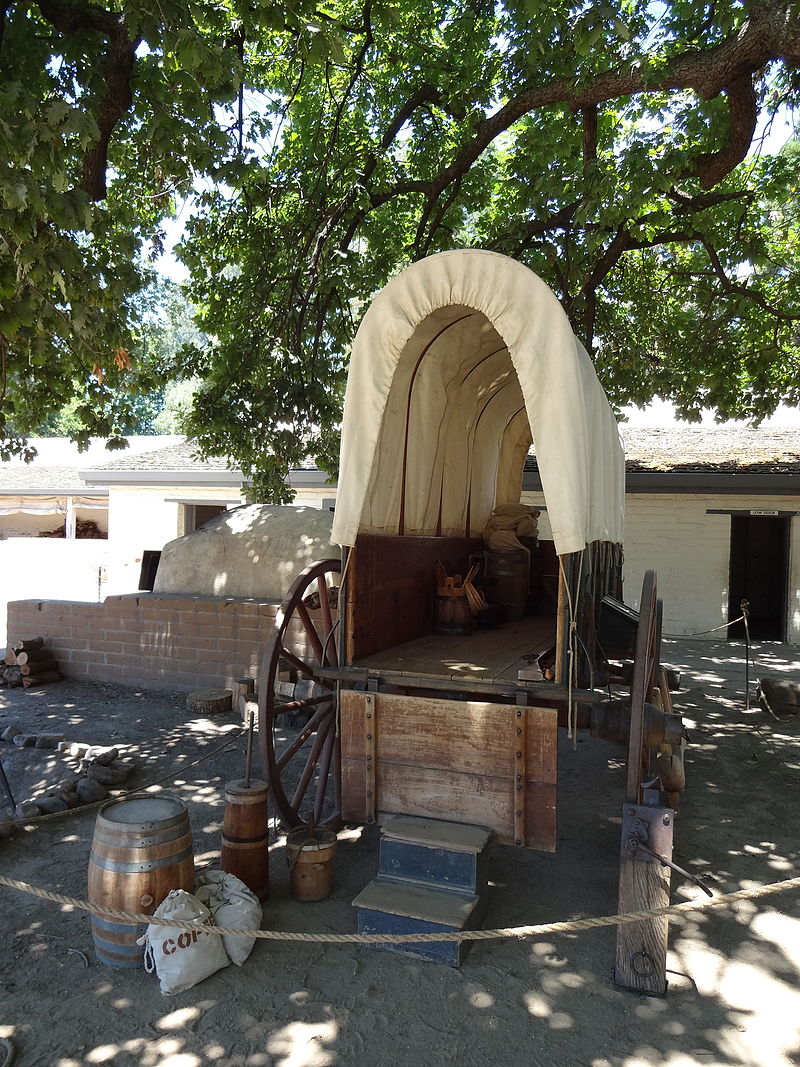
Sutter's Fort was the creation of Johann Augustus Sutter, a
Swiss immigrant to Alta California. It was intended to become a 19th-century agricultural and trade
colony in the Mexican Alta California province.
Sutter was born in Kandern, Germany, a few miles
from the Swiss border, on February 15, 1803. He went to school in Neuchâtel,
Switzerland and later joined the Swiss army, eventually becoming captain of the
artillery.
After military service, he worked as an apprentice
in a print shop, before clerking in a draper's shop, where he met his wife,
Annette D'beld. The two were married in Burgdorf on October 24, 1826 and the
couple would eventually have four children. Dabbling in a number of businesses,
Sutter was unsuccessful and decided to seek his fortune in the United States.
In May, 1834, he left his family destined for New York, promising to bring them
later once he was settled.
Sutter arrived at New York in July 1834 at the age
of 31. soon made his way to St. Louis, Missouri.
While there, he made two trading trips to Santa Fe, New Mexico in 1835 and
1836. In 1838, he traveled with a group of missionaries on the Oregon Trail to
Fort Vancouver in Oregon Territory.
After spending the next five years in various
business pursuits, Sutter worked his way across the western American wilderness
by way of St. Louis, Oregon, Hawaii and Sitka, Alaska, finally arriving at
Monterey, on July 3rd 1839.
The fort was built in 1839 on level ground northward toward the American River and
westward toward the Sacramento River. The fort was originally called New
Helvetia (New Switzerland). It was the first non-Indigenous community in
the California Central Valley. The fort is famous for its association with the
Donnor Party, the California Gold Rush and the formation of Sacramento.
His settlement was the beginning of what will
become the future Mexican "land grant" baron ranches in California
during the latter days of the Mexican period and into the American settlement
of the greater part of California. The transition from world empires to the
common man on the land had begun.
His intention was to establish an inland empire as
far removed from the Spanish settlements as possible where he could conduct
himself as he saw fit. The country was well populated by the Native Americans
whom he planned to use to develop his empire. During his travels, Sutter had
gathered around him a small core of persons dedicated to his cause and loyal to
him. Sutter had to become a Mexican citizen to qualify for a land grant. With
his position and plans laid out before the Mexican Governor Alvarado, Sutter
set off for the interior to select a site for his empire.
Chartering two schooners named Isabella and Nicolas
and purchasing a four-oared pinnace, Sutter embarked on August 9 with eight or
ten kanakas (Hawaiians), three or four white men who had come with him and two
or three others engaged at Yerba Buena besides the crews of the two schooners.
The vessels were loaded with stores of provisions,
ammunition, implements and three small cannon, which had been brought from
Hawaii. After exploring the Sacramento, Feather and American Rivers, Sutter
selected a site for his planned settlement about a quarter mile inland on high
ground near a pond fed from the American River. At first, tule houses were
built by the kanakas in the Hawaiian style, but by the fall of 1839 an adobe
structure 40 feet long with a tule roof was completed. It was divided into
three apartments, in one of which Sutter lived, while the other two served as
kitchen and blacksmith shop. The new settlement was christened in honor of
Sutter's homeland, Nueva Helvecia or New Switzerland.
Employing
members of the Miwok, Maidu, and Kanakas tribes, he began to build the
settlement and, to protect it, in 1840, Sutter began work on the
walls of the Fort
which included 18 foot walls surrounding shops, houses, mills, and craftsmen. He was concerned for the safety of the settlers because of possible
attacks from the overwhelming numbers of Native Americans in the area, many of
whom resented intruders into their territory. The Native American tribes made
endless raids on each other and on the Europeans when they appeared. Slavery
was practiced by the indigenous people on each other and then by the Europeans.
In August of that year, Sutter went down to
Monterey where he took the final steps to become a Mexican citizen on August
27th. The fact that Sutter was a good Swiss Catholic and had good references
for his character helped to speed things along. In addition, Sutter was duly
authorized by Jimeno Casarin, Governor Alvarado's secretary, to "represent
the departmental government at Nueva Helvecia, being endowed with all the civil
authority necessary for the local administration of justice, the prevention of
robberies by adventurers from the United States, the repression of hostilities
by savage Indians, and the checking of the illegal trapping and fishing carried
on by the Company of Columbia, for which purpose he might even resort to force
of arms if necessary." He assumed the position of Justice of the Peace on
the Sacramento River frontier.
Sutter had probably a force of twenty white men at New Helvetia by the end of
1840 with which to enforce the peace.
Sutter had a survey of New Helvetia made in the
early part of 1841. A map or diseno was drawn to show Sutter's claim. Thus
armed, Sutter went down to Monterey in June for his grant. His petition to
Alvarado was dated June 15th. On the 18th the grant was made for eleven square
leagues bounded on the north by the Three Peaks and latitude 39 degrees
41'45"; on the east by the margins of Feather River; on the south by
latitude 38 degrees 49'32"; and on the west by the Sacramento River - the
eleven leagues not including lands flooded by the river, in all about 47,827
acres. The conditions were that Sutter "shall maintain the native Indians
of the different tribes of those points in the enjoyments and liberty of their
possessions, without molesting them, and he shall use no other means of
reducing them to civilization but those of prudence and friendly intercourse,
and not make war upon them in any way without previously obtaining authority
from the government."

In 1841-42 work was continued, chiefly by Native
American laborers on the Fort. The Fort was a structure of adobe with walls
eighteen feet high, and three feet thick enclosing an area of 500 by 150 feet. The Main Building of the
fort is a two story adobe structure built between 1841 and 1843.
At the southeast and northwest corners projecting
bastions, or towers, rose above the walls of the rectangle and contained in
their upper stories cannon, which commanded the gateways in the center of each
side except the western. Loopholes were pierced in the walls at different
points. Guns were mounted at the main entrance on the south and elsewhere, and
the north side seemed also to be protected by a ravine. An inner wall, with the
intermediate space roofed over, furnished a large number of apartments in the
California style and there were other detached buildings both of wood and adobe
in the interior. Some of the wooden buildings were brought from Fort Ross when
it was sold to Sutter. His headquarters was in a central building, a
three-story structure in the middle of the rectangle with wooden staircases at
the middle on opposite sides of the building.

He had quarters for some of his workers, a bakery,
gristmill, blanket factory, and workshops within the Fort. He located a tannery
on the American River. Dwellings for guests and his vaqueros were also outside
the Fort. No more than 50 people stayed inside at any one time prior to the
immigration of 1845. A maximum of 300 people could have used the Fort during
the daylight but it would have been crowded. The design of Sutter's Fort seemed
to be a mix of that of the Spanish presidios and Fort Ross. The corner bastions
were similar to the Russian design but of adobe. The walls were of the Spanish
adobe design instead of redwood as in the Russian Fort. The central building
for the "management" was similar to the Russian idea although of
adobe instead of redwood.
Twenty four cannons and other smaller artillery
pieces all in good order were in place for defense. These were from Sutter’s
earlier purchase of the former Russian fort, Fort Ross.
The armament, as early as 1842, consisted of two
brass fieldpieces and a dozen or more iron guns of different kinds brought from
Hawaii and purchased from different vessels. In a letter to the California
Pioneers published in their Bulletin, dated July 12, 1879, Sutter states the he
got six larger cannon in 1841 from the captain of an American vessel who
brought them from South America expressly for him, one brass fieldpiece only
from the Russians and a few others, including 2 brass pieces from other vessels
at different dates. John Bidwell, a caretaker for Sutter at Fort Ross in 1842,
states that about 40 rusty guns and one or two small brass cannon were obtained
from the Russians. However there are rumors that the iron guns were lost when
the raft carrying them from Fort Ross to Yerba Buena was overturned at the
entrance to the bay and lost. But no written information is available to back
up these rumors. So it is likely that Sutter got most of his guns from Fort
Ross.
Sutter's grant became an extensive farming and
ranching operation. Wheat, barley, peas, beans and cotton were raised with the
help of Native American labor. Tradesmen were hired from all nations to help
provide implements for the Fort and the ranch. Business was developed around
furs, whiskey, brandy distilling, and beer brewing. Wheat was exported to
Russian Alaska. As a Justice of the Peace, Sutter issued Mexican passports to
American immigrants who were first his guests, and later his customers.
By 1845 the ranch had 1,700 horses and mules, 4,000
cattle and 3,000 sheep. Sutter established his own home guard with fifty Native
Americans whom he trained, armed with muskets and had dressed in military
uniforms. The Fort became famous as a temporary refuge for pioneers between
1841 and 1849. It
served as a waystation at the end of the California trail which started along
the Missouri River, and the Siskiyou Trail coming from Oregon’s Willamette
Valley. Sutter provided free shelter and supplies to weary immigrants,
trappers
and traders traveled through the area.. He recruited
settlers for his settlement not only in this country, but also in Switzerland
and Germany.
The Fort was so renowned that many foreign
expeditions came to visit it as well as many itinerant artists. The U. S.
military occupied the Fort during the early days of the Conquest of Mexico, but
the fort was returned to Mr. Sutter after matters in the region were settled.
As a result, several drawings and photographs of the Fort come down to us and
are shown in this history. The many visitors during this time are reviewed in
The History of California by H. H. Bancroft, Vol. III and IV.
An 1842 visitor described as the “King’s Orphan”
described the river approach to Sutter’s Fort as follows:
"Although not very distant from the mouth of
the river in a straight line, the settlement of Captain Sutter was reached only
after many turns of the river. So we arrived at the embarcadero late in the
evening, having seen only one hut and some sheep pens on the right side of the
river all the passage up. At the embarcadero, or port, were some huts situated
under the shade of lofty sycamores and oaks...New Helvetia lay two and half
miles from this landing.”
A typical scene at Sutter’s Fort is described by the
same 1842 visitor:
“I arrived very early in the morning just as the
discordant notes of the Mexican drums were calling the people to assemble for
labor. I alighted and proceeded immediately to pay my compliments to the
Captain. Although he was very busily employed distributing orders for the day,
he most hospitably received and made me at home under his roof." Wheat was
being harvested in the nearby fields and before being sent with their sickles,
rakes, and other tools, the Native American crews were brought inside the
enclosure and given their morning meal. The method of feeding the Native
Americans shocked the visitor who made the following comments: "I must
confess I could not reconcile my feelings to see these fellows being driven, as
it were, around some narrow troughs of hollow tree trunks, out of which,
crouched on their haunches, they fed more like beasts than human beings, using
their hands in hurried manner to convey to their mouths the thin porridge which
was served to them. Soon they filed off to the fields after having, I fancy,
half satisfied their physical wants." Sutter and his guest then sat down
to their own breakfast, which was served in a small building detached from the
dwelling house, and under the same roof as the kitchen. Their meal bore no
likeness to that served the Native Americans. It consisted of excellent
beefsteak, tea, butter with coarse bread, eggs, beans, etc.
Industrial activity at the Fort, though less
diversified than it later became, was already well advanced. In the sheds
ranged about the inner sides of the walls were a distillery, where a fiery
native brandy, aguardiente, was being made from home-grown wheat and wild
grapes that grew along the river banks, and shops where a carpenter, a
blacksmith, a cooper, and a saddler were at work. Outside the walls were
corrals where the domestic animals were kept. An adobe building used to store
wheat, corn and other farm products.
A little distance away was an assemblage of huts
where the Native American workers lived, and to the rear of the Fort, a large
pond bordered with fine willows and other trees. The pond was a slough off the
American River, which "could have been a most valuable asset, ornamental
and useful, providing water for both domestic use and for irrigating the newly
laid out kitchen garden. However, because it had been neglected, it had become
a source of colds and fever.
Sutter had planned a gradual development of
settlements on his land grant and all was going well in that direction. He had
a booklet published in Darmstadt, Germany showing his Fort and advertising for
settlers from Germany and Switzerland. For awhile, his Fort was taken over by the American Army during the conquest of
California in 1846-1847 when Sutter raised the Stars and Stripes over the Fort.
Shortly after, the Fort was returned to Sutter.
Within
just a few years, Sutter was the wealthiest and most influential man in the
region and even he would later admit: "I was everything, patriarch,
priest, father and judge." Somewhere along the line, Sutter's family also
joined him in California.
In
1847, California became part of the United States. At first Sutter supported
the establishment of an independent California Republic. When U.S. troops
briefly seized control of his fort, Sutter did not resist.
Sources:
http://www.legendsofamerica.com/ca-johnsutter.html
http://oldsacramento.com/about/history
http://www.militarymuseum.org/Sutter.html
Wikipedia