Search This Blog

Tuesday, January 20, 2015

It Cost How Much!! by Linda Broday

Good Morning! Hope everyone is warm and happy and safe.

I think everyone will agree that grocery and dry goods stores are the lifeblood of a town now just as mercantiles were back in the 1800s. I won't say that it's impossible to survive without them because people can, but it's extremely rough. Especially for this girl!!

Every town on the frontier had a mercantile. Not only were they important places in which to buy things, they were a social gathering place. Most had a potbellied stove where people could gather around, get a cup of coffee and talk or play dominoes.

Many of these general stores also doubled as post offices, dental offices, saloons.

In my latest book TEXAS MAIL ORDER BRIDE, Delta Dandridge travels to Battle Creek, Texas to marry rancher Cooper Thorne. But after learning she'd been duped and Cooper has no plans to marry anyone, she gathers her tattered pride and gets a job working in the mercantile. Because returning to Georgia is not an option.

She has much to offer this dying town and its citizens who have become resigned to watching things fall in around them. Delta sets to work in fixing up the dark and gloomy mercantile. Maybe if she can change one building, it will give them hope.

And it does. Folks begin to see the difference she's made and soon they pitch in, determined to put Battle Creek back on the map.

One person. One vision. One goal. One chance to really matter.

Battle Creek becomes her town and she'll fight tooth and nail to save it. It's funny how in saving it, she saves herself.

Of course, Cooper can't help but be attracted to the dynamo in petticoats. It wouldn't be a romance if he wasn't. But she sure makes him crazy as they navigate the twists and turns.

I thought it would be fun to look at some of the prices of items back then.

A Pound of Tea ---  12 cents to $1.00
A Pound of Coffee ---  15 cents to 35 cents
5 Pounds of Flour ---  14 cents
A Pound of Preserved Meat --- 12 cents to 25 cents
5 Pounds of Sugar --- 34 cents
A Dozen Eggs --- 20 cents
A Pound of Butter --- 25 cents
A Pound of Bacon --- 12 cents
A Gallon of Syrup or Molasses --- 40 cents to $1.15
One can of peaches --- 20 cents
500 rounds of cartridges -- $12.00 (roughly $335 today's prices)

I found a historical site that said cowboys often traded one bullet for one shot of whiskey which is why the phrase "a shot of whiskey" came about. That made one bullet worth somewhere around 25 cents (two bits in cowboy jargon) each. Or $6 in today's prices.

Pretty costly. Bet they didn't waste too many.

How often do you go the grocery store or Walmart? Daily, weekly, twice a month? I usually go once a week and average about $65. Of course there's just me. I hate to think what the cost would be for a family of four. Good Lord!

You can visit me at: www.LindaBroday.com 

And I'm on Facebook, Twitter, Google+, Pinterest

Monday, January 19, 2015

The U.S. Mail in the Old West


This blog post piggy-backs on a blog post I wrote for Prairie Rose Publication’s imprint, Fire Star Press, titled “Before the Post Office was the Postal Service.” Especially if you are a writer, you may find some interesting facts about the differences between the Post Office and the Postal Service in it. You may read that post first by clicking HERE.

The old Post Office Department set up post offices in various cities and towns, large and small. Postmasters were selected through a system of political patronage. Congressmen chose postmasters by selecting from applicants. Many times they chose to reward a friend or loyal associate who had provided a benefit either to the congressman, himself, or to the community.

In some isolated areas, it may have been a case of anyone willing to take the job was gratefully awarded it. Still, whether in large cities or tiny towns, a postmaster position meant a regular salary and status. The position was often sought after and regarded as a political plum.

Classic Wells Fargo stagecoach design in red & yellow.
Once Rural Free Delivery began in 1896, rural carrier positions were also awarded through political patronage. Other employees were hired. But, in the past, as well as today, much of the mail was moved through contract carriers.

These carriers were not employed by the Post Office, but were either companies or individuals who won a bid for a contract to deliver mail over a set period of time at a given rate in a specific locality.

The following summary of mail service in the gold mining town of Lundy, California may have been typical of mail service in the old wild West:

In my upcoming book, Big Meadows Valentine, my fictional character, Beth Dodd, comes to Lundy on the Lundy and Bodie Stage Line.

1881 Sonora-Bodie Stage-Courtesy McHenry Museum, Modesto, CA
In real life, the owner of this stagecoach service, C.F. “Charley” Hector, starting in 1880, held the contract to transport U.S. mail from Bodie to Lundy. He also contracted to transport Wells Fargo’s express. In addition, he transported passengers and small freight on his Lundy and Bodie Stage Line. In the Homer Mining Index, the newspaper for Lundy, is the following description: “Charley Hector drives a red wagon with yellow wheels, and when his two curly mustangs are hitched to the vehicle and Charley is seated on the driver’s seat, with his hat tied under his chin, the effect is grand....” (Index, Feb. 19, 1881)

In good weather, mail came by coach. When there was snow on the ground, the stage line would switch to sleighs. In bad weather, mail was not reliable. The Homer Mining Index on December 11, 1880 reported: “Little Ed. Hector came through from Bodie with the mail on Tuesday, on horseback, arriving here somewhat in advance of the time. Considering the snow is deep all the way, and that Ed. is a mere child of 10 or 11 years, he may safely be called a plucky little hero.” [The Index got his age wrong. In the 1880 census, he was enumerated at 15 years of age.]

Charley Hector lost the mail contract for five months to a new contractor. He regained it again when that company folded and abandoned its contract. In 1882, Charley Hector was awarded a four-year contract by the Post Office Department to transport mail from Bodie to Lundy, but he also abandoned the contract at the end of 1884 when he ran into financial difficulties. 
Historic Bodie Stage has seen better days- June Lake, CA. Note eastern Sierra-Nevada Mountains
The winter of 1883-84 Eddie Hector, Charley’s younger brother, was promoted to driving the stage. By January, 1884 when Beth in Big Meadows Valentine arrives in Lundy, Eddie would have been the driver. Heavy snows were typical of the winter in Lundy that year. As a result, the appearance of Eddie carrying the mail was an occasion to rejoice in this small community the winter in which my story takes place. The Homer Mining Index reported on March 8, 1884: “Eddie Hector came in last Tuesday afternoon, two days out from Bodie, with a sleigh - the first vehicle in since the 1st day of February.”


Until the closing of the Bennettville post office in November, 1884, there was one mail route out  of Lundy. It was only nine miles long up Lake Canyon, but crossed a mountain ridge at nearly 12,000 feet in elevation. In 1881-82, the carrier was C.W. Curtis who then became Bennettville’s postmaster. In the winters of 1882-83 and 1883-84, the mail was carried by J.L. Redlingshafer on skies during all sorts of weather. Once the Bennettville post office was closed, all mail for that community was handled out of Lundy.

As for Lundy, Henry H. Moody secured the appointment for postmaster on March 26, 1880. He set up the post office in the Senate Saloon owned by Hiram Blackburn. He did not manage his duties well, with most of the complaints being that he wasn’t there half the time or he was drunk. Messrs. Blackburn and Osborne who worked in the saloon had to handle his duties much of the time. The Homer Mining Index pointed out in its July 10, 1880 edition that it was against the law for a post office to be in a place where liquor is served.

In August 1880, the post office was moved out of the saloon and into the store of Rosenwald, Coblentz & Co. Alexander Rosenwald was appointed postmaster and held that position until 1887, after the hey-day of Lundy was past. In March 1881, a new building adjacent to the retail store was completed--"a private outlay for public service"--and became the post office. Fifty post office boxes were installed and general delivery was handled there.

The town of Lundy as it existed in the 1880s is now gone. Due to the dam built on the east end of Lundy Lake, water covers most of the original town site. But, these newspaper reports from Lundy’s history give an interesting insight into how mail delivery was managed in the western towns of the 1800s.


Zina Abbott is the pen name used by Robyn Echols for her historical novels. Her novel, Family Secrets, was published by Fire Star Press in October 2014 and her novelette, A Christmas Promise, was published by Prairie Rose Publications in November 2014. Her novella, Big Meadows Valentine, will be published shortly. Please visit the Zina Abbott’s Amazon Author Page by clicking HERE.


Wednesday, January 14, 2015

Kaye Spencer - remembering a writing contest

Walk with me as I take a brief excursion down memory lane that will ultimately end with YouTube.

https://openclipart.org/detail/181906/a-walk-with-grandfather-by-moini-181906

Several years ago, I participated in a writing contest sponsored by The Romance Studio (TRS). In fact, I made it to the final round. I *think* (memory failure) I finished third, which was okay with me, because I came away from that contest with the foundation for two stories that I eventually published. Today, I’ll share the story behind one of these contest stories.

The first TRS writing contest set-up was this:

 Character A is a quirky critic who's secretly attracted to Character B, an eccentric artist who lives in the apartment right above Character A. Character A is on a deadline to get her review finished, but Character B is making a lot of noise, and it's very distracting. Write a 750-1000 word confrontation scene.

This is what I came up with:

Character A became the heroine, Janae Palmer, the reclusive, introverted book reviewer and Character B, Owen Quinlan, became the rodeo clown/bullfighter living in the apartment above her. I added two more layers to Owen's character: 1) he's recovering from a rodeo-related broken back and during his "grounded" months, he pursues his artistic side. They meet because he's cranked-up his music to set the mood for painting, and Janae is at her wit's end listening to him stomp around on her ceiling, because she can't concentrate on writing her book review. When she barges into his apartment, because he hasn’t locked his door, she startles him, he swings his painter's palette around, smacks her in the nose, and knocks her out. Now that's a confrontation. *wink*


So, The Dance was born, but I didn't develop the story until two years later and, alas, it was title-less. (I'm terrible with titles.) I was nearing the end of the story—with the dreaded black moment looming—when the title came to me. I had Owen tell Janae to listen to a Garth Brooks song (The Dance) and if the words "reached" her, he'd know it because she'd come back to him. If not, then he truly wishes her a happy life without him. The song evolved into his personal philosophy for living, and the message in the song is the theme of the story.


The Dance is a contemporary rodeo cowboy (rodeo clown/bullfighter) story. It's funny, serious, and bittersweet (and *spicy+++*). It’s also going to be out-of-digital-print in a month or so, because I’ve requested a rights reversion from the publisher.

So, where was I going with this? Oh, yeah, YouTube. Every time I think about this story, it takes me back to my younger self and my rodeo years, which invariably brings up two rodeo songs that still mean a great deal to me all these many years (ahem... decades...) later.

For your earworm/nostalgic/rodeo-remembering pleasure…

Rodeo Cowboy - Lynn Anderson


 Someday Soon - Ian & Sylvia Tyson with Judy Collins


Until next time,

Kaye

Fall in love…faster, harder, deeper with Kaye Spencer romances

www.kayespencer.com
Twitter - @kayespencer

Tuesday, January 13, 2015

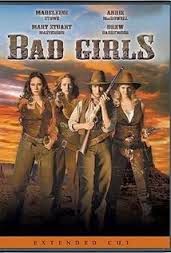
Western Movies: Bad Girls

By Kristy McCaffrey

As we welcome the New Year and the hopes for a great 2015, I find myself...exhausted. All the festivities and traveling and gift-giving—while fun—demand down-time. When I need to refill the creative coffers, I turn to music and movies. I thought I’d share one of my favorite western movie guilty pleasures: Bad Girls.

Released in 2005 and starring Madeleine Stowe, Mary Stuart Masterson, Andie MacDowell and Drew Barrymore, what it lacks in believability it makes up for in decent acting and an inspiring score. It’s also an Old West chick-flick, and there’s not too many of those (The Quick and the Dead also comes to mind, but that’s for another post).

The four girls are fallen women, each for different reasons. Cody Zamora (Stowe) is the leader and the most hardened. She was found by a man named Frank Jarrett (Robert Loggia) when she was 14-years-old, and rode for many years among his gang. More on this later. Anita Crown (Masterson) lost her husband to cholera on the Oregon Trail, and while she turns tricks at the local saloon, she refuses to kiss a man on the mouth out of respect to said husband. Eileen Spenser (MacDowell) presents herself as a Southern Belle from New Orleans, but in reality she grew up poor on a grub ranch in East Texas. And Lilly Laronette (Barrymore) was the daughter of a prominent trick rider; when he died, it fell to her to settle his debts.

A scuffle in a saloon results in Cody shooting a Colonel, and the man’s wife sets Pinkerton detectives on her trail. The girls escape town and head to Agua Dulce, Texas to claim $12,000 Cody has stashed at a bank. Anita has a homesteader’s claim for the Oregon Territory, and they plan to take the money and begin fresh.

The bank is overrun by Kid Jarrett’s gang—the very gang that Cody was involved with and abandoned one night long ago—and this leads to a series of retaliations between Kid and Cody that drive the remainder of the tale. There’s also a love interest for Cody—Josh McCoy (Dermot Mulroney)—a man who looks out for her, but, as we soon learn, has an agenda of his own that involves her connection to the Jarrett’s.

The silliness of a few scenes—the girls swimming buck naked in a creek or the fact that Lilly maintains a tart tongue and gorgeous hair while being abused by Kid’s gang—are balanced by Cody’s quiet stoicism to make a better life for herself, and Anita’s disillusionment that women had very little independence without the support of a man. The story doesn’t have a standard happily-ever-after, but each of the women honor one truth: to keep moving forward toward their best self.


Bad Girls is available on iTunes if you’d like to check it out.


Happy New Year!!


Monday, January 12, 2015

IDEAS ARE EVERYWHERE

One question every author will be asked at some point is where we get the ideas for our stories. Creative folks have prodigious imaginations, so ideas are, literally, everywhere. We can hear a snippet of a conversation that will generate a scene, see a picture of historical dress and imagine our heroine in it, pick up a replica revolver and know it’s exactly what our hero would have in his holster.

And, sometimes, ideas come from you, our readers. I received an email last week in which the reader described a gunsmith shop in the very early 1800s St. Louis and the long-barreled muzzle-loading “Plains” rifle that was made there for settlers heading west.

Now, my very active imagination immediately started crafting scenes, characters, stories… And I can hardly wait to begin researching the weapon.
 
So, you see, ideas really do come from everywhere. That’s part of what makes my job so much fun!


Happy reading!

Tracy

Saturday, January 10, 2015

NEW RELEASE AND GIVEAWAY! The Saga of Indian Em’ly Book 3: The Orphanage by Sara Barnard

Sara Barnard has a new middle grade reader release! This is book 3 in her series about what might have befallen the children of Indian Em'ly, a Texas historical figure. You will be just as enthralled as your youngsters over this wonderful series! Leave a comment for a chance to win a copy!

Far from home in a land foreign to them, kidnapped Apache
siblings Wind That Knocks Down Lodges and Cactus Flower are at the mercy of the
Army soldiers they have grown to despise. When ordered to dispose of the
children or else, the Army soldiers waste no time in depositing them at the
nearest Catholic orphanage, where unlikely alliances are forged and Knocks Down
must make a decision: conform to the Pale Face world or risk everything for an
unlikely chance at escape.

Excerpt

    “A new garrison,” Cactus translated, though she didn’t have to.
I was rolling the pale face words off my tongue easier with each passing sunset.
“Wants to see the …prisoners?” Her word tweaked up at the end, turning it into a
question. She looked at me. “Do they mean us?”
     Glancing over the seat again, I could see that they did. “They’re
coming with a big man that is red in the face and whose head is covered in silver
hair, like the cunning fox. Sit up and look like one of The People.”
     Cactus Flower did as I said, just as the dirty canvas pulled
back. The red faced man peered in, a brown wad that looked like a fat twig clenched
in his teeth. He must have held it there often, because a brown stain from the juice
had crusted on his lips. “Kids!” he spat, flinging the wad of juicy brown paper
and leaves into the back of the wagon with us. Neither Cactus nor I flinched. “Brats!
Whelps, they are.”
     Silence covered the men like the burial shroud had covered my
mother.
     The big man with the hair like the silver fox continued, his
face growing redder with each breath he sucked in. “You call these Injuns prisoners? It’s no wonder why the general
saw fit to relieve you bunch of misfits. Me and my men are taking over. Now.

Buy Links       B&N Nook       Smashwords


Friday, January 9, 2015

The Story of Yellow Bird and Elizabeth Wilson Ridge by Cheryl Pierson


This love story starts many years before the lovers ever met. It begins with something that happened when John Rollin Ridge was an eleven-year-old boy, and witnessed his father’s bloody murder.

John Rollin Ridge, called Cheesquatalawny, or “Yellow Bird,” by his fellow Cherokee tribesmen, was the son of John Ridge, and the grandson of a prominent Cherokee leader, Major John Ridge. Major Ridge was one of the most powerful and wealthy members of the eastern Cherokee tribes in the early 1800s. By the time John Rollin Ridge was born in 1827, the State of Georgia had discovered gold on Cherokee lands and wanted them relocated. Cherokee leaders, at first, were opposed to signing treaties with the U.S. Government, refusing to go.


But the State of Georgia confiscated Cherokee lands in 1832, including the homes and thriving plantation owned by some members of the tribe, including another prominent family, the Waties. Major Ridge and his son John opposed the removal, but because of the inevitability of the outcome of the situation, they and some of the other leaders reversed their stance on negotiating with the federal government. Major Ridge, and John Ridge, along with Stand Watie and his brothers, formed the powerful Ridge-Watie-Boudinot faction of the Cherokee council, standing in favor of the Cherokee Removal. Their signing of the Treaty of New Echota sold Cherokee lands and facilitated the removal of the Cherokee people to Indian Territory—what is now Oklahoma—an act considered treasonous by many.

Another faction of Cherokees following John Ross refused to ratify the treaty signing. This segment was known as The Anti-Removal National Party. The word was out—traitors were to be executed.

Blood Law (also called blood revenge) is the practice in traditional customary Native American law where responsibility for seeing that homicide is punished falls on the clan of the victim. The responsibility for revenge fell to a close family member (usually the closest male relative). In contrast to the Western notion of justice, blood law was based on harmony and balance. It was believed that the soul/ghost of the victim would be forced to wander the earth, not allowed to go to the afterlife, unless harmony was restored. The death of the killer (or member of the killer's clan) restored the balance. (From Wikipedia)


Members of this Ross group targeted Stand Watie and his brother, Elias Boudinot, along with their uncle, Major Ridge for assassination. On the morning of June 2, 1839, John’s father, John Ridge, was dragged from his bed by some of the tribesmen of The Anti-Removal National Party and murdered as his wife and children, including young John, looked on. This event would color John’s life until the end.

Mrs. Ridge took her family to northwestern Arkansas. Young John’s thirst for vengeance was tempered only by a young woman he met and fell in love with, Elizabeth Wilson.

They first met when John was studying Latin and Greek with a local missionary. Elizabeth worked for the missionary. John wrote to his cousin, “There is a prettily shapely girl of about 16 or 17 years, who is very friendly and gives me a quantity of enjoyment in her company, whenever I get tired of dusty pages of legal technicalities.”

Elizabeth was part Native American, and John was half Cherokee. To her, he was the handsomest man she’d ever seen, and she believed him to be a talented writer—one of the most intelligent men in the country. John was not only entranced by Elizabeth’s beauty, but the sweet honesty and goodness of her character, and her brilliance. They married in May, 1847, and though they were happy, their love couldn’t overcome the bloody images that John tried to forget, the tragedy that consumed him.


(Elizabeth Wilson Ridge--John Rollin Ridge's wife)
As an adult, he often dreamt of the morning of his father’s murder, awakening from sleep screaming. Elizabeth was at his side, calming him. She promised to help him fulfill his desire for revenge any way she could.

“There is a deep seated principle of revenge in me which will never be satisfied, until it reaches its object,” he told her.

Eventually, they traveled to Indian Territory (present-day Oklahoma) where they joined forces with other allies of the Ridge faction, all of them eager to track down and punish those responsible for the deaths of the Major Ridge, and members of Stand Watie’s family. In the end, thirty-two of the thirty-six men who had been responsible for the murders were found and killed.

John squared off against one of the four remaining assassins, Judge David Kell. When Kell advanced on John, John shot him, claiming it was done in self-defense. But John had no faith in getting a fair trial (Cherokee court) and he and Elizabeth ran to Missouri, settling in Springfield.

John became a freelance writer, selling articles to various newspapers to supplement his salary in the county clerk’s office. He and Elizabeth now had a baby girl, Alice.


>
(Alice Bird, daughter of Elizabeth and John)
The Ridges lived an idyllic life. But John’s health failed him at the age of thirty-nine. He became afflicted with “softening of the brain,” a disease that took its toll quickly through the spring and summer of 1867.

>
(John Rollin Ridge and his daughter, Alice)
John Rollin Ridge, Yellow Bird, died on October 5, 1867, leaving behind a collection of fine articles, sketches and poetry. In 1868, Elizabeth published an anthology of his poetry.

Elizabeth died in 1905 and was buried beside her husband in Grass Valley.
>>
The Maple tree on the right was planted by Elizabeth (Wilson) Ridge's - Rollin's wife. The tree was brought back from Gettysburg by Alice Bird in 1876. On 10/10/1976, a plaque was mounted on the tree for a dedication.

Inscription on tombstone:
John Rollin Ridge
California Poet, Author of "Mount Shasta"
And Other Poems,
Born March 19, 1827 In Cherokee Nation,
Near What Is Now Rome, Georgia,
Died in Grass Valley, October 5, 1867,
In Grateful Memory


I want to offer an e-copy of my novella, FOUND HEARTS, today to one lucky commenter. Please leave your contact information along with your comment to be entered in the drawing.

You can find my works here:https://www.amazon.com/author/cherylpierson

OF HER I LOVE
I READ but a moment her beautiful eyes,
I glanced at the charm of her snowy-white hand
I caught but the glimpse of her cheek's blushing dyes
More sweet than the fruits of a tropical land;

I marked but an instant her coral-hued lips,
And the row of sweet pearls that glimmered between--
Those lips, like the roses the humming bird sips
On his bright wing of rainbows, when summer is green.

I timidly gazed on a bosom more white
Than the breast of the swan, more soft than its down--
To rest on whose pillows were greater delight
Than all else of rapture that heaven may own.

I gazed but a second on these, and on all
That make up the sum of her angel-like form,
And ere I could think I was bound in her thrall,
And peace fled my breast, as the birds flee a storm!
I am bound in love's pain, and may never be free,
Till the bond is dissolved in her own melting kiss:
Till her loveliness, like the embrace of a sea,
Enclasps me, and hides me in the depths of its bliss.

John Rollin Ridge