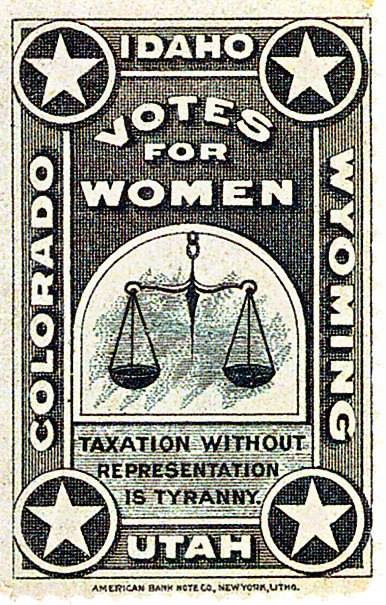
By the end of
the nineteenth century, women had won full suffrage in only four states —
Wyoming, Colorado, Idaho, and Utah. In 1900, Susan B. Anthony turned over the
presidency of the now-united National American Woman Suffrage Association (NAWSA) to Carrie Chapman Catt, signaling a
new generation of leadership.

During this
period, little effort was devoted toward passage of a constitutional amendment.
Instead, the association’s work centered around winning voting rights in the
individual states. Catt gave speeches and organized women to help plan and
execute suffrage campaigns. In many states, men feared that enfranchising women
would interfere with political efforts to disenfranchise African-Americans and
immigrants. Despite its Quaker roots, NAWSA was not immune to Jim Crow
influences. While the national organization did not explicitly prohibit
non-white members, it allowed state and local affiliates to set their own
membership requirements. Many groups, especially in the South, admitted only
white women.
Catt devised
the ‘society plan’ to recruit wealthy
members of women's clubs into the NAWSA. These women had organizing
experience, time to volunteer, and money to contribute to the cause. While
there was a strong black woman’s club movement, Catt did not extend her
recruiting efforts to them, even though those groups were often engaged in
promoting women’s rights, including suffrage. Consequently, the NAWSA became
predominantly white.

In 1902, Catt
helped to found the International Woman Suffrage Alliance (IWSA). The IWSA brought
together groups pursuing votes for women around the world, eventually
representing 32 nations. The organization is now known as the International
Alliance of Women.
When Catt’s
husband fell ill in 1904, she resigned her NAWSA presidency to care for him. He
died in October 1905.
 |
| Anna Howard Shaw |
Anna Howard Shaw
succeeded Catt to the NAWSA presidency. Although she was a talented speaker,
she lacked the leadership skills of her predecessors. However, when southern
NAWSA members formed the Southern Woman Suffrage Conference in 1906, Shaw
refused to give the national association’s endorsement to the overtly racist
organization.
During Shaw’s
term, members organized other new affiliates. In 1907, Harriet Stanton Blatch
(Elizabeth Cady Stanton’s daughter) formed the Equality League of Self-Supporting
Women, with membership comprised of professional and industrial working women.
This contrasted with Catt’s ‘society plan’ which appealed to upper-class women.
The Equality League adopted tactics of English suffragists, including parades,
street speakers, and pickets. The League became the Women's Political Union in
1910.

The National College Equal Suffrage League became an affiliate of the NAWSA in 1908.
The organization had been founded in Boston at the beginning of the century as
the College Equal Suffrage League.
The death of
Carrie Chapman Catt’s husband was followed by a rapid succession of more deaths
among people important to her. Susan B. Anthony died in February 1906, and Catt's mother and younger brother both died in 1907. These sorrows plunged Catt into
despair. Her doctor and friends convinced her that traveling abroad would help
her recover from the devastating losses. She spent much of the following eight
years promoting equal-suffrage rights worldwide as the IWSA president.

In 1909, Catt and some of her friends
founded the Woman Suffrage Party to fight for the vote in New York. Within a year,
the Party had 20,000 members. The organization remained independent, but Catt
and its other leaders remained loyal to the NAWSA.
By the end of
the decade, the public’s attitude toward the suffrage movement had improved
dramatically. Working for the cause had come to be viewed by many as a
respectable activity for middle-class women. Infrastructure in support of the
suffrage movement had been built. However, from 1896 to 1910 there had been six
state campaigns for suffrage. All six failed.
But the tide was
about to turn.
Ann Markim