Search This Blog

Showing posts with label " Prairie Rose Publications. Show all posts

Wednesday, August 24, 2022

Prohibition – A Constitutional Flip Flop


The temperance movement in the United States began nearly as soon as the country was founded. Many citizens considered drinking beer, wine and liquor to be immoral. Many others believed that widespread imbibing of alcohol would threaten the young nation’s future.

From as early as 1800, these citizens wanted to prohibit their fellow citizens from making and/or drinking all forms of alcoholic beverages. Their efforts grew the movement, and in 1826 the American Christian Temperance Union was founded, initially with 222 local chapters. By 1835, there were approximately 8000 chapters.

Image via Wiki Media

According to historian Ken Burns, by 1930 the average American over the age of fifteen consumed nearly seven gallons of pure alcohol per year. This is about three times as much as Americans drink today. The abuse of alcohol, primarily by men, wreaked violence on women and children and created instability in families in a time when women had few legal rights. Most women were totally dependent on their husbands for support.

In America’s Protestant churches, many leaders and congregations, who wanted to rid America of evil, came to consider alcohol to be nearly as sinful as slavery. Thus, during the nineteenth century, efforts of the abolitionist and the temperance movements frequently overlapped. Many of the activists in both efforts were women, so it isn’t surprising that these movements became entwined with the fight for women’s rights, including women’s suffrage. The associations among these movements had both pros and cons for each of the individual endeavors. For example, the link between temperance and women’s suffrage threatened to sink ratification of the 19th Amendment, which granted women the right to vote, in the Tennessee legislature since most members of that body were not fans of prohibition.

By the turn of the twentieth century, communities across the country had local temperance societies. One of these organizations was the Anti-Saloon League which was formed in 1893 to lobby all levels of government to prohibit the manufacture and sale of beverages containing alcohol. Although much public-facing support came from evangelical Protestantism which considered saloons to be wicked, many factory owners also backed these measures, believing that having sober workers would result in increased production and fewer accidents. Throughout the early years of the new century, the fight for prohibition continued to grow.


18th Amendment - National Archives

When the United States entered World War I, President Woodrow Wilson established an order for temporary wartime prohibition to preserve grain for food production. Subsequent public pressure induced Congress to pass the 18th Amendment, banning manufacture, transportation and sale of intoxicating liquors by the end of that same year—1917. Within eleven months, the amendment received approval by the necessary three quarters of the states. It was ratified on January 16, 1919 and was set to go into effect a year later. In the meantime, Congress passed the Volstead Act which laid out guidelines for federal enforcement.
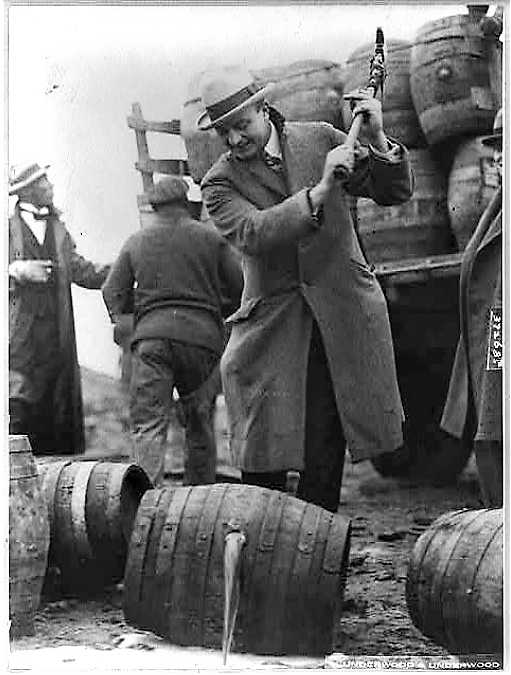
                                           

Image from Library of Congress

While temperance societies rejoiced, much of the rest of the country did not. The sizable portion of the population who wanted to keep drinking alcohol found a myriad of ways to do so, ranging from bootlegging to development of speakeasies, spawning the culture of the ‘roaring 20s,’ Many times, the ‘bathtub gin’ or moonshine was produced in personal homes or on private land. Consequently, enforcement of prohibition was difficult at all levels of government. Not surprisingly, the law was applied more stringently in geographical areas where the population was supportive of temperance than those where the residents were not.

Outside the Krazy Kat Speakeasy in Washington, D.C.-1921 
Image from Library of Congress

Organized crime sprang up around bootlegged production, the operation of speakeasies and the transportation of illegal alcoholic beverages across state lines. This also led to increased violence, especially in cities where there were competing organized crime families. Attempts to bring this rise in lawlessness under control led to the transfer of federal responsibility for enforcement of prohibition from agency to agency. Desperate to bring the situation under control, the U.S. government ordered the poisoning of industrial alcohols, which were routinely stolen by bootleggers. At least 10,000 people are estimated to have died as a result of this federal mandate.

21st Amendment - National Archives

In 1932, Franklin D. Roosevelt ran for president on a platform that included calling for the repeal of prohibition. The country was in the throes of the Great Depression, and legalizing the liquor industry promised to create numerous jobs and needed revenue. Roosevelt was elected in a landslide. In February 1933, Congress passed the resolution proposing a 21st amendment to the constitution which would repeal the 18th Amendment and end prohibition. By December of that same year, the required 36 states had voted for ratification and the federal prohibition of beer, wine and liquor officially ended. A few states initially continued to ban alcohol, but by 1966 all had abandoned prohibition.

  Ann Markim

 Website

Facebook


Buy Links: Paperback at Amazon                     Amazon print or digital

Amazon Kindle 

Wednesday, May 25, 2022

Anticipation: Hopefulness vs. Worry

We can never know about the days to come. But we think about them anyway. This is the opening line of Carly Simon’s iconic 1971 song, Anticipation. These words have been especially poignant for me during these past few months. In 2020, my daughter and I had scheduled a vacation in Denmark, but it was canceled due to COVID. We now plan to take that trip in a few weeks. I’m looking forward to the joy of vacationing and seeing the sights I’ve been hoping to visit for so long. Even so, I have some trepidation about the war in Eastern Europe and the potential for another COVID spike.

Thinking about these polar opposite feelings has led me to consider, just what is anticipation?   One of Merriam Webster Online’s definitions is: visualization of a future event or state. This is something we can all relate to—anticipation of Christmas morning, or a blind date, or even waiting for ketchup to emerge from its bottle. These visualizations can be either hopeful or worrisome, or a combination of both.

Okay, so can I characterize anticipation as an emotion? Yes, according to Wikipedia, “Anticipation is an emotion involving pleasure or anxiety in considering or awaiting an expected event.” But Brene Brown’s Atlas of the Heart did not include Anticipation as one of the 87 emotions she listed, although both hopefulness and worry are included. Maybe this categorization doesn’t really matter. What does matter to me, both personally and as a writer, is the impact of anticipation on life.


In The Legacy, Anna looks forward with hopefulness–-pleasurable anticipation—to being reunited with the love of her life, Jorn Stryker. In her diary she writes:

…we have our wedding to plan, and I hope he will show me his vast farm, which he described so proudly when he told me of his life in Iowa. Many times, I have imagined what his house looks like, since I am soon to become its mistress. I wonder how many servants we shall have. Probably quite a few, since he has helped so many people emigrate from Denmark.     

   Oh Jorn. Your Special Girl is here and ready to begin our life together.

If her expectations are met, the story goes one way. If not, it takes a far different turn.


In The Claim, Katie’s fiancĂ© has arranged passage for her to join him in the Klondike. When she reaches her destination, it’s not at all what she expected, leading her to worry about her future:

     Katie stood on the deck of the steamer and studied the deserted town through the drizzling rain. Haphazard drab, log-cabin buildings. Sloppy streets of mud. Nothing that looked like a theatre. She swallowed against the sour taste rising in her throat.

    Only a few scruffy residents met the boat, and Charles was not one of them. She pulled her cloak tighter around her.

     “Are you sure this is Forty Mile?” she asked the captain again.

     “Yes ma’am,” he replied in his annoyingly patient tone. “But these folks say that most of the town moved upriver to Dawson when gold was discovered in that area last year. I’m sure your Mr. Gasnier has probably gone there, too.”

     The captain was probably right. There would be no point in operating a theatre in a town with too few people to attend the plays.

     A woman with a face painted bright with scandalous amounts of rouge and lipstick moved along the rail, closer to Katie. “You mean Frenchy Gasnier?”

     Katie frowned in distaste. “His name is Charles. He is my fiancĂ©.”

     The gaudy female stared openly at Katie. “Then I guess it can’t be the same guy.” A garish red grin broke across her face. “Frenchy’s going to marry me.”

     Katie forced a smile. “Maybe they’re brothers.”

     The woman’s rosy mouth formed a pout. “Maybe. But Frenchy didn’t mention having a brother.”

     Neither had Charles. Still, how common could a name like Gasnier be up here in this God-forsaken country?

     “I think we should go on to Dawson,” the woman said, more to the captain than to Katie. “Our men most likely moved down there with everyone else.”

     The captain’s gaze flitted from her to Katie. “There will be a slight charge for the extra passage.”

     “I’m sure Charles will pay you the difference when we arrive in Dawson.” Katie had little money left in her handbag. “He bought my passage to Forty Mile.”

     “If he doesn’t, you’ll be responsible for it.”

     “Yes, sir.”

Katie’s arrival in the north is not what she had anticipated, and trepidation begins to set in. Will Charles meet her in Dawson? If so, will she realize the life he’d promised her? If not, what happened to him?

Anticipation can lead to realizing joyful expectations, to disappointment, to disorientation, to preparing—physically and/or emotionally—for negative outcomes and a myriad of positive or negative emotions. This mechanism allows me as a writer to show the reader a deeper understanding of a character.

And personally, anticipating both positive and negative potential outcomes provides me at least a modicum of mental preparation for however an event plays out. Perhaps, in a way, it’s a self-preservation mechanism. At any rate, Carly Simon’s observation of anticipation captures a universal human behavior we can all relate to. And I’m looking forward to vacationing in Denmark despite the mix of hope and worry thinking about it engenders. 

  Ann Markim

 Website

Facebook


Buy Links: Paperback at Amazon                     Amazon print or digital

Amazon Kindle